

412
2
General Synthetic Methods
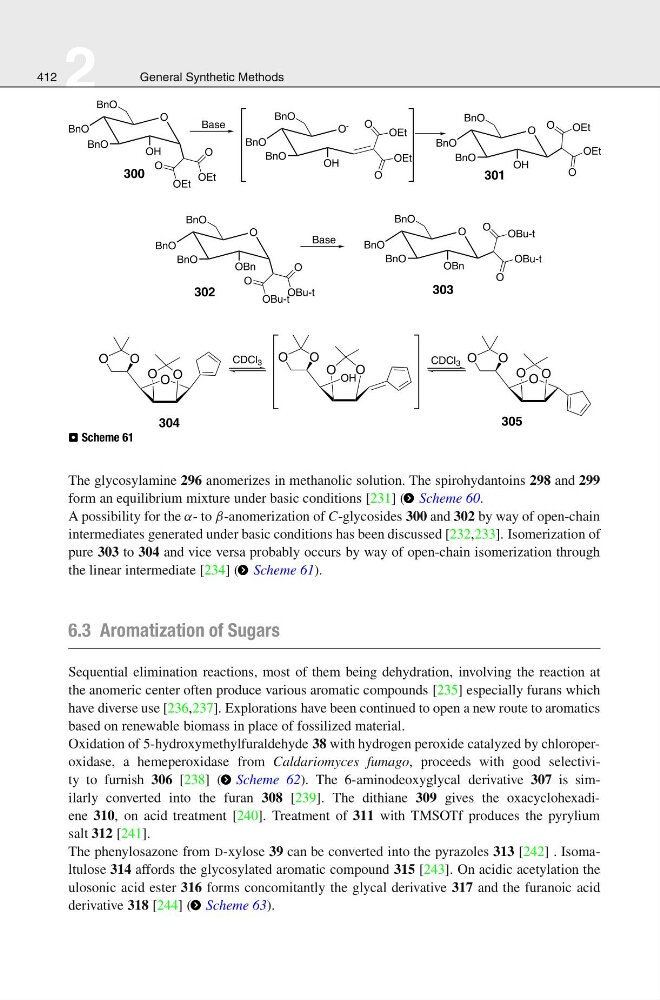
⊡ Scheme 61
The glycosylamine 296 anomerizes in methanolic solution. The spirohydantoins 298 and 299
form an equilibrium mixture under basic conditions [231] ( > Scheme 60.
A possibility for the α- to β-anomerization of C-glycosides 300 and 302 by way of open-chain
intermediates generated under basic conditions has been discussed [232,233]. Isomerization of
pure 303 to 304 and vice versa probably occurs by way of open-chain isomerization through
the linear intermediate [234] ( > Scheme 61).
6.3 Aromatization of Sugars
Sequential elimination reactions, most of them being dehydration, involving the reaction at
the anomeric center often produce various aromatic compounds [235] especially furans which
have diverse use [236,237]. Explorations have been continued to open a new route to aromatics
based on renewable biomass in place of fossilized material.
Oxidation of 5-hydroxymethylfuraldehyde 38 with hydrogen peroxide catalyzed by chloroperoxidase, a hemeperoxidase from Caldariomyces fumago, proceeds with good selectivity to furnish 306 [238] ( > Scheme 62). The 6-aminodeoxyglycal derivative 307 is similarly converted into the furan 308 [239]. The dithiane 309 gives the oxacyclohexadiene 310, on acid treatment [240]. Treatment of 311 with TMSOTf produces the pyrylium
salt 312 [241].
The phenylosazone from D-xylose 39 can be converted into the pyrazoles 313 [242] . Isomaltulose 314 affords the glycosylated aromatic compound 315 [243]. On acidic acetylation the
ulosonic acid ester 316 forms concomitantly the glycal derivative 317 and the furanoic acid
derivative 318 [244] ( > Scheme 63).
2
General Synthetic Methods
⊡ Scheme 61
The glycosylamine 296 anomerizes in methanolic solution. The spirohydantoins 298 and 299
form an equilibrium mixture under basic conditions [231] ( > Scheme 60.
A possibility for the α- to β-anomerization of C-glycosides 300 and 302 by way of open-chain
intermediates generated under basic conditions has been discussed [232,233]. Isomerization of
pure 303 to 304 and vice versa probably occurs by way of open-chain isomerization through
the linear intermediate [234] ( > Scheme 61).
6.3 Aromatization of Sugars
Sequential elimination reactions, most of them being dehydration, involving the reaction at
the anomeric center often produce various aromatic compounds [235] especially furans which
have diverse use [236,237]. Explorations have been continued to open a new route to aromatics
based on renewable biomass in place of fossilized material.
Oxidation of 5-hydroxymethylfuraldehyde 38 with hydrogen peroxide catalyzed by chloroperoxidase, a hemeperoxidase from Caldariomyces fumago, proceeds with good selectivity to furnish 306 [238] ( > Scheme 62). The 6-aminodeoxyglycal derivative 307 is similarly converted into the furan 308 [239]. The dithiane 309 gives the oxacyclohexadiene 310, on acid treatment [240]. Treatment of 311 with TMSOTf produces the pyrylium
salt 312 [241].
The phenylosazone from D-xylose 39 can be converted into the pyrazoles 313 [242] . Isomaltulose 314 affords the glycosylated aromatic compound 315 [243]. On acidic acetylation the
ulosonic acid ester 316 forms concomitantly the glycal derivative 317 and the furanoic acid
derivative 318 [244] ( > Scheme 63).