

Structure and Conformation of Carbohydrates
1.1
17
The conformational situation for α-D-idopyranose is more complicated. Estimation of the
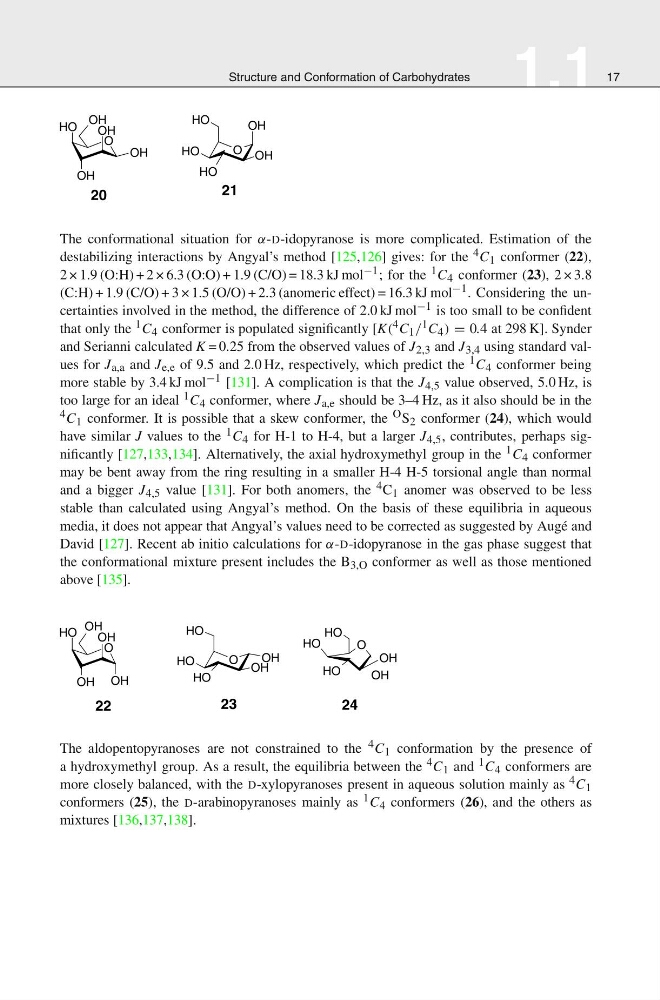
destabilizing interactions by Angyal’s method [125,126] gives: for the 4 C 1 conformer (22),
2 × 1.9 (O:H) + 2 × 6.3 (O:O) + 1.9 (C/O) = 18.3 kJ mol −1 ; for the 1 C 4 conformer (23), 2 × 3.8
(C:H) + 1.9 (C/O) + 3 × 1.5 (O/O) + 2.3 (anomeric effect) = 16.3 kJ mol −1 . Considering the uncertainties involved in the method, the difference of 2.0 kJ mol −1 is too small to be confident
that only the 1 C 4 conformer is populated significantly [K( 4 C 1 / 1 C 4 ) = 0.4 at 298 K]. Synder
and Serianni calculated K = 0.25 from the observed values of J 2,3 and J 3,4 using standard values for J a,a and J e,e of 9.5 and 2.0 Hz, respectively, which predict the 1 C 4 conformer being
more stable by 3.4 kJ mol −1 [131]. A complication is that the J 4,5 value observed, 5.0 Hz, is
too large for an ideal 1 C 4 conformer, where J a,e should be 3–4 Hz, as it also should be in the
4 C 1 conformer. It is possible that a skew conformer, the O S 2 conformer (24), which would
have similar J values to the 1 C 4 for H-1 to H-4, but a larger J 4,5 , contributes, perhaps significantly [127,133,134]. Alternatively, the axial hydroxymethyl group in the 1 C 4 conformer
may be bent away from the ring resulting in a smaller H-4 H-5 torsional angle than normal
and a bigger J 4,5 value [131]. For both anomers, the 4 C 1 anomer was observed to be less
stable than calculated using Angyal’s method. On the basis of these equilibria in aqueous
media, it does not appear that Angyal’s values need to be corrected as suggested by Augé and
David [127]. Recent ab initio calculations for α-D-idopyranose in the gas phase suggest that
the conformational mixture present includes the B 3,O conformer as well as those mentioned
above [135].
The aldopentopyranoses are not constrained to the 4 C 1 conformation by the presence of
a hydroxymethyl group. As a result, the equilibria between the 4 C 1 and 1 C 4 conformers are
more closely balanced, with the D-xylopyranoses present in aqueous solution mainly as 4 C 1
conformers (25), the D-arabinopyranoses mainly as 1 C 4 conformers (26), and the others as
mixtures [136,137,138].
1.1
17
The conformational situation for α-D-idopyranose is more complicated. Estimation of the
destabilizing interactions by Angyal’s method [125,126] gives: for the 4 C 1 conformer (22),
2 × 1.9 (O:H) + 2 × 6.3 (O:O) + 1.9 (C/O) = 18.3 kJ mol −1 ; for the 1 C 4 conformer (23), 2 × 3.8
(C:H) + 1.9 (C/O) + 3 × 1.5 (O/O) + 2.3 (anomeric effect) = 16.3 kJ mol −1 . Considering the uncertainties involved in the method, the difference of 2.0 kJ mol −1 is too small to be confident
that only the 1 C 4 conformer is populated significantly [K( 4 C 1 / 1 C 4 ) = 0.4 at 298 K]. Synder
and Serianni calculated K = 0.25 from the observed values of J 2,3 and J 3,4 using standard values for J a,a and J e,e of 9.5 and 2.0 Hz, respectively, which predict the 1 C 4 conformer being
more stable by 3.4 kJ mol −1 [131]. A complication is that the J 4,5 value observed, 5.0 Hz, is
too large for an ideal 1 C 4 conformer, where J a,e should be 3–4 Hz, as it also should be in the
4 C 1 conformer. It is possible that a skew conformer, the O S 2 conformer (24), which would
have similar J values to the 1 C 4 for H-1 to H-4, but a larger J 4,5 , contributes, perhaps significantly [127,133,134]. Alternatively, the axial hydroxymethyl group in the 1 C 4 conformer
may be bent away from the ring resulting in a smaller H-4 H-5 torsional angle than normal
and a bigger J 4,5 value [131]. For both anomers, the 4 C 1 anomer was observed to be less
stable than calculated using Angyal’s method. On the basis of these equilibria in aqueous
media, it does not appear that Angyal’s values need to be corrected as suggested by Augé and
David [127]. Recent ab initio calculations for α-D-idopyranose in the gas phase suggest that
the conformational mixture present includes the B 3,O conformer as well as those mentioned
above [135].
The aldopentopyranoses are not constrained to the 4 C 1 conformation by the presence of
a hydroxymethyl group. As a result, the equilibria between the 4 C 1 and 1 C 4 conformers are
more closely balanced, with the D-xylopyranoses present in aqueous solution mainly as 4 C 1
conformers (25), the D-arabinopyranoses mainly as 1 C 4 conformers (26), and the others as
mixtures [136,137,138].