

404
2
General Synthetic Methods
5.3 Ring Transformation
Additive ring-opening of 209, followed by Swern oxidation and aminocyclization, affords the
aza-C-nucleoside 210 [169], belonging to an attractive class of C-glycosides [170,171,172,173,
174,175]. The glycosylamine 211 is converted to the azasugar 212 via an alkylative ringopening reaction [176,177]. The aminoaldehyde derivative generated from the unsaturated
aminocyclitol 213 cyclizes to give 214 [178] ( > Scheme 46). Descending oxidative aminocyclization of 215 affords the lactam 216 [179].
5.4 Ring-Opening Rearrangements
A fragmentation ring-opening rearrangement reaction of 217 using a Grignard reagent has
been reported [180]. The combined reagent acetyl chloride/sodium iodide induces a ringopening rearrangement of the bicyclic ketal 219 [181]. The iodide ion serves to promote the
reaction [182] ( > Scheme 47).
6 Miscellaneous Reactions
6.1 Ferrier Carbocyclization and Related Reactions
The Ferrier II reaction, a carbocyclization reaction, is of widespread use as a tool for the
conversion of glycosides into cyclitols [183,184,185]. Newer examples for the utilization of the
reaction conducted under catalytic conditions [186,187] have appeared in the recent literature.
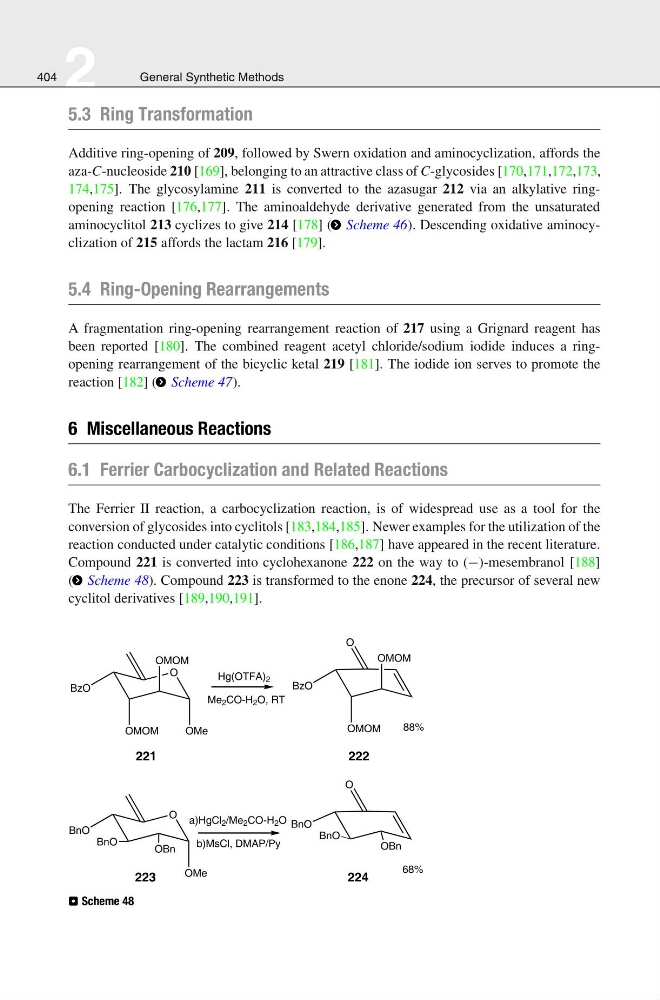
Compound 221 is converted into cyclohexanone 222 on the way to (−)-mesembranol [188]
( > Scheme 48). Compound 223 is transformed to the enone 224, the precursor of several new
cyclitol derivatives [189,190,191].
⊡ Scheme 48
2
General Synthetic Methods
5.3 Ring Transformation
Additive ring-opening of 209, followed by Swern oxidation and aminocyclization, affords the
aza-C-nucleoside 210 [169], belonging to an attractive class of C-glycosides [170,171,172,173,
174,175]. The glycosylamine 211 is converted to the azasugar 212 via an alkylative ringopening reaction [176,177]. The aminoaldehyde derivative generated from the unsaturated
aminocyclitol 213 cyclizes to give 214 [178] ( > Scheme 46). Descending oxidative aminocyclization of 215 affords the lactam 216 [179].
5.4 Ring-Opening Rearrangements
A fragmentation ring-opening rearrangement reaction of 217 using a Grignard reagent has
been reported [180]. The combined reagent acetyl chloride/sodium iodide induces a ringopening rearrangement of the bicyclic ketal 219 [181]. The iodide ion serves to promote the
reaction [182] ( > Scheme 47).
6 Miscellaneous Reactions
6.1 Ferrier Carbocyclization and Related Reactions
The Ferrier II reaction, a carbocyclization reaction, is of widespread use as a tool for the
conversion of glycosides into cyclitols [183,184,185]. Newer examples for the utilization of the
reaction conducted under catalytic conditions [186,187] have appeared in the recent literature.
Compound 221 is converted into cyclohexanone 222 on the way to (−)-mesembranol [188]
( > Scheme 48). Compound 223 is transformed to the enone 224, the precursor of several new
cyclitol derivatives [189,190,191].
⊡ Scheme 48