

Degradations and Rearrangement Reactions
2.7
401
The key compound on the way to the debranched nagstatin 175 has been synthesized from
the L-ribose derivative 176 by employing ring-chain interconversion involving addition of
trityl imidazole, selective sulfonylation, and warm acetylation which causes detritylation with
cyclization [139] ( > Scheme 42).
The glycosylamine 179 transforms to the piperidinone 180 on reductive amination [140].
Sequential deprotection to regenerate hemiacetal OH and amino groups from 181 induces ring
interconversion and reduction to give the azasugar 182 [141]. Similarly, the azidodeoxyketose
derivative 183 can be converted to the piperidine derivative 184 by reductive aminocyclization [142]. Reduction of 185 affords the bicyclic azasugar 186 on intramolecular reductive
cyclization, which is not a stable system and forms an equilibrium mixture with the monocyclic imine 187 [143]. Reactions of this type are also of use for the synthesis of the branchedchain 1-N-iminosugars such as 189, which have been the subject of continuous attention as
glycosidase inhibitors [144,145,146,147,148,149,150,151,152] ( > Scheme 43).
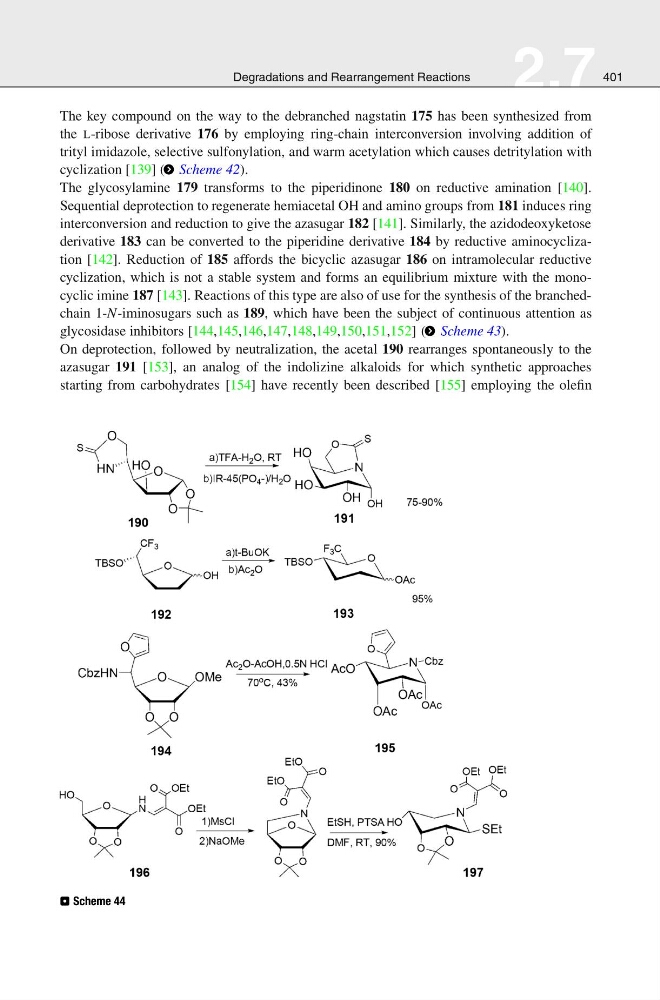
On deprotection, followed by neutralization, the acetal 190 rearranges spontaneously to the
azasugar 191 [153], an analog of the indolizine alkaloids for which synthetic approaches
starting from carbohydrates [154] have recently been described [155] employing the olefin
⊡ Scheme 44
2.7
401
The key compound on the way to the debranched nagstatin 175 has been synthesized from
the L-ribose derivative 176 by employing ring-chain interconversion involving addition of
trityl imidazole, selective sulfonylation, and warm acetylation which causes detritylation with
cyclization [139] ( > Scheme 42).
The glycosylamine 179 transforms to the piperidinone 180 on reductive amination [140].
Sequential deprotection to regenerate hemiacetal OH and amino groups from 181 induces ring
interconversion and reduction to give the azasugar 182 [141]. Similarly, the azidodeoxyketose
derivative 183 can be converted to the piperidine derivative 184 by reductive aminocyclization [142]. Reduction of 185 affords the bicyclic azasugar 186 on intramolecular reductive
cyclization, which is not a stable system and forms an equilibrium mixture with the monocyclic imine 187 [143]. Reactions of this type are also of use for the synthesis of the branchedchain 1-N-iminosugars such as 189, which have been the subject of continuous attention as
glycosidase inhibitors [144,145,146,147,148,149,150,151,152] ( > Scheme 43).
On deprotection, followed by neutralization, the acetal 190 rearranges spontaneously to the
azasugar 191 [153], an analog of the indolizine alkaloids for which synthetic approaches
starting from carbohydrates [154] have recently been described [155] employing the olefin
⊡ Scheme 44