

362
2
General Synthetic Methods
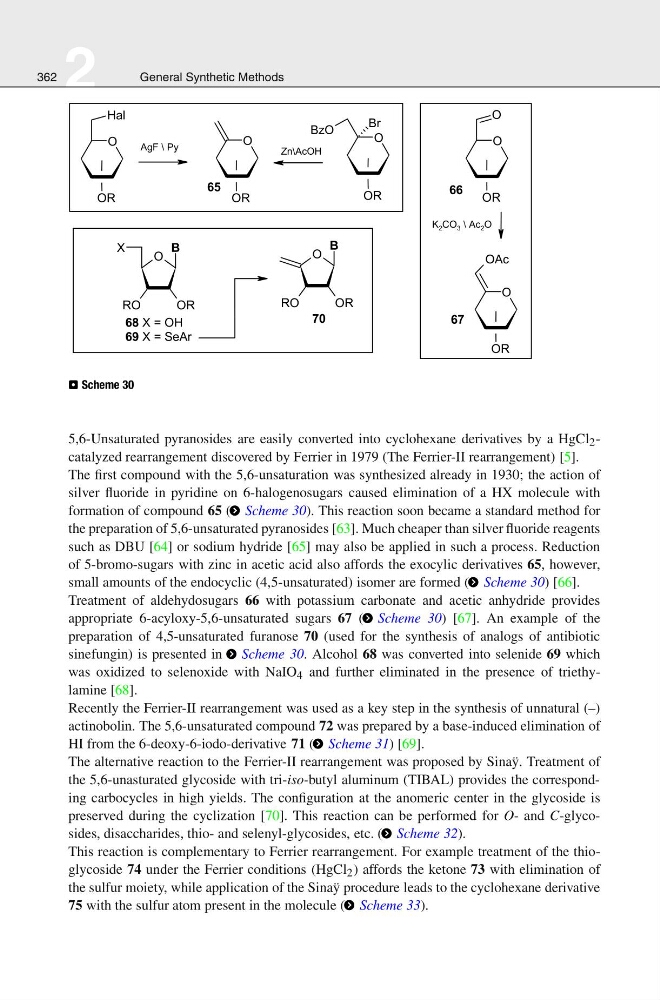
⊡ Scheme 30
5,6-Unsaturated pyranosides are easily converted into cyclohexane derivatives by a HgCl 2 -
catalyzed rearrangement discovered by Ferrier in 1979 (The Ferrier-II rearrangement) [5].
The first compound with the 5,6-unsaturation was synthesized already in 1930; the action of
silver fluoride in pyridine on 6-halogenosugars caused elimination of a HX molecule with
formation of compound 65 ( > Scheme 30). This reaction soon became a standard method for
the preparation of 5,6-unsaturated pyranosides [63]. Much cheaper than silver fluoride reagents
such as DBU [64] or sodium hydride [65] may also be applied in such a process. Reduction
of 5-bromo-sugars with zinc in acetic acid also affords the exocylic derivatives 65, however,
small amounts of the endocyclic (4,5-unsaturated) isomer are formed ( > Scheme 30) [66].
Treatment of aldehydosugars 66 with potassium carbonate and acetic anhydride provides
appropriate 6-acyloxy-5,6-unsaturated sugars 67 ( > Scheme 30) [67]. An example of the
preparation of 4,5-unsaturated furanose 70 (used for the synthesis of analogs of antibiotic
sinefungin) is presented in > Scheme 30. Alcohol 68 was converted into selenide 69 which
was oxidized to selenoxide with NaIO 4 and further eliminated in the presence of triethylamine [68].
Recently the Ferrier-II rearrangement was used as a key step in the synthesis of unnatural (–)
actinobolin. The 5,6-unsaturated compound 72 was prepared by a base-induced elimination of
HI from the 6-deoxy-6-iodo-derivative 71 ( > Scheme 31) [69].
The alternative reaction to the Ferrier-II rearrangement was proposed by Sinaÿ. Treatment of
the 5,6-unasturated glycoside with tri-iso-butyl aluminum (TIBAL) provides the corresponding carbocycles in high yields. The configuration at the anomeric center in the glycoside is
preserved during the cyclization [70]. This reaction can be performed for O- and C-glycosides, disaccharides, thio- and selenyl-glycosides, etc. ( > Scheme 32).
This reaction is complementary to Ferrier rearrangement. For example treatment of the thioglycoside 74 under the Ferrier conditions (HgCl 2 ) affords the ketone 73 with elimination of
the sulfur moiety, while application of the Sinaÿ procedure leads to the cyclohexane derivative
75 with the sulfur atom present in the molecule ( > Scheme 33).
2
General Synthetic Methods
⊡ Scheme 30
5,6-Unsaturated pyranosides are easily converted into cyclohexane derivatives by a HgCl 2 -
catalyzed rearrangement discovered by Ferrier in 1979 (The Ferrier-II rearrangement) [5].
The first compound with the 5,6-unsaturation was synthesized already in 1930; the action of
silver fluoride in pyridine on 6-halogenosugars caused elimination of a HX molecule with
formation of compound 65 ( > Scheme 30). This reaction soon became a standard method for
the preparation of 5,6-unsaturated pyranosides [63]. Much cheaper than silver fluoride reagents
such as DBU [64] or sodium hydride [65] may also be applied in such a process. Reduction
of 5-bromo-sugars with zinc in acetic acid also affords the exocylic derivatives 65, however,
small amounts of the endocyclic (4,5-unsaturated) isomer are formed ( > Scheme 30) [66].
Treatment of aldehydosugars 66 with potassium carbonate and acetic anhydride provides
appropriate 6-acyloxy-5,6-unsaturated sugars 67 ( > Scheme 30) [67]. An example of the
preparation of 4,5-unsaturated furanose 70 (used for the synthesis of analogs of antibiotic
sinefungin) is presented in > Scheme 30. Alcohol 68 was converted into selenide 69 which
was oxidized to selenoxide with NaIO 4 and further eliminated in the presence of triethylamine [68].
Recently the Ferrier-II rearrangement was used as a key step in the synthesis of unnatural (–)
actinobolin. The 5,6-unsaturated compound 72 was prepared by a base-induced elimination of
HI from the 6-deoxy-6-iodo-derivative 71 ( > Scheme 31) [69].
The alternative reaction to the Ferrier-II rearrangement was proposed by Sinaÿ. Treatment of
the 5,6-unasturated glycoside with tri-iso-butyl aluminum (TIBAL) provides the corresponding carbocycles in high yields. The configuration at the anomeric center in the glycoside is
preserved during the cyclization [70]. This reaction can be performed for O- and C-glycosides, disaccharides, thio- and selenyl-glycosides, etc. ( > Scheme 32).
This reaction is complementary to Ferrier rearrangement. For example treatment of the thioglycoside 74 under the Ferrier conditions (HgCl 2 ) affords the ketone 73 with elimination of
the sulfur moiety, while application of the Sinaÿ procedure leads to the cyclohexane derivative
75 with the sulfur atom present in the molecule ( > Scheme 33).