

Structure and Conformation of Carbohydrates
1.1
11
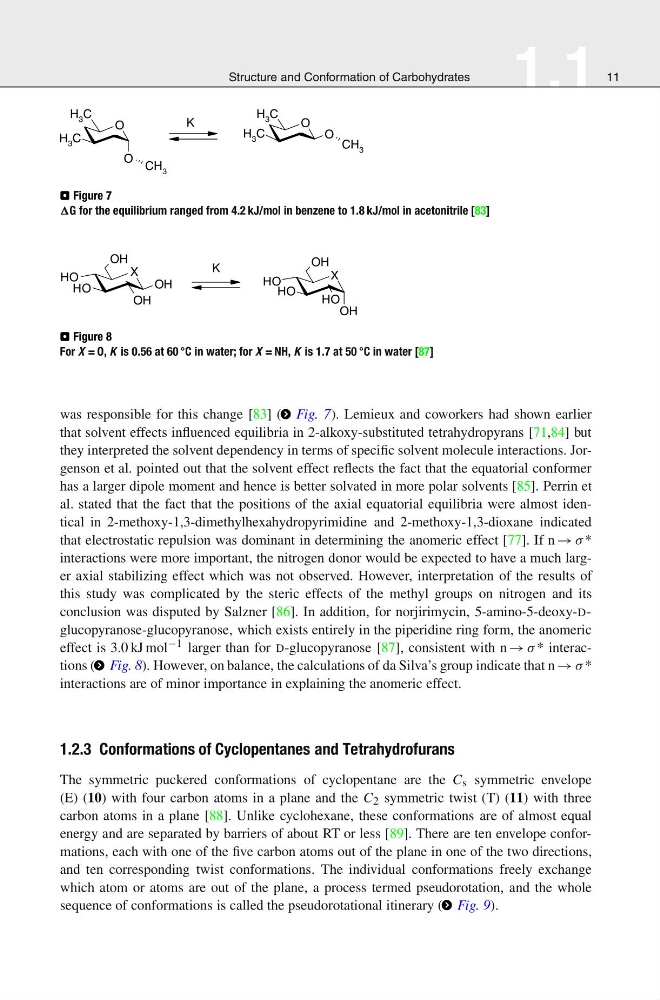
⊡ Figure 7
G for the equilibrium ranged from 4.2 kJ/mol in benzene to 1.8 kJ/mol in acetonitrile [83]
⊡ Figure 8
For X = O, K is 0.56 at 60 °C in water; for X = NH, K is 1.7 at 50 °C in water [87]
was responsible for this change [83] ( > Fig. 7). Lemieux and coworkers had shown earlier
that solvent effects influenced equilibria in 2-alkoxy-substituted tetrahydropyrans [71,84] but
they interpreted the solvent dependency in terms of specific solvent molecule interactions. Jorgenson et al. pointed out that the solvent effect reflects the fact that the equatorial conformer
has a larger dipole moment and hence is better solvated in more polar solvents [85]. Perrin et
al. stated that the fact that the positions of the axial equatorial equilibria were almost identical in 2-methoxy-1,3-dimethylhexahydropyrimidine and 2-methoxy-1,3-dioxane indicated
that electrostatic repulsion was dominant in determining the anomeric effect [77]. If n → σ *
interactions were more important, the nitrogen donor would be expected to have a much larger axial stabilizing effect which was not observed. However, interpretation of the results of
this study was complicated by the steric effects of the methyl groups on nitrogen and its
conclusion was disputed by Salzner [86]. In addition, for norjirimycin, 5-amino-5-deoxy-Dglucopyranose-glucopyranose, which exists entirely in the piperidine ring form, the anomeric
effect is 3.0 kJ mol −1 larger than for D-glucopyranose [87], consistent with n → σ * interactions ( > Fig. 8). However, on balance, the calculations of da Silva’s group indicate that n → σ *
interactions are of minor importance in explaining the anomeric effect.
1.2.3 Conformations of Cyclopentanes and Tetrahydrofurans
The symmetric puckered conformations of cyclopentane are the C s symmetric envelope
(E) (10) with four carbon atoms in a plane and the C 2 symmetric twist (T) (11) with three
carbon atoms in a plane [88]. Unlike cyclohexane, these conformations are of almost equal
energy and are separated by barriers of about RT or less [89]. There are ten envelope conformations, each with one of the five carbon atoms out of the plane in one of the two directions,
and ten corresponding twist conformations. The individual conformations freely exchange
which atom or atoms are out of the plane, a process termed pseudorotation, and the whole
sequence of conformations is called the pseudorotational itinerary ( > Fig. 9).
1.1
11
⊡ Figure 7
G for the equilibrium ranged from 4.2 kJ/mol in benzene to 1.8 kJ/mol in acetonitrile [83]
⊡ Figure 8
For X = O, K is 0.56 at 60 °C in water; for X = NH, K is 1.7 at 50 °C in water [87]
was responsible for this change [83] ( > Fig. 7). Lemieux and coworkers had shown earlier
that solvent effects influenced equilibria in 2-alkoxy-substituted tetrahydropyrans [71,84] but
they interpreted the solvent dependency in terms of specific solvent molecule interactions. Jorgenson et al. pointed out that the solvent effect reflects the fact that the equatorial conformer
has a larger dipole moment and hence is better solvated in more polar solvents [85]. Perrin et
al. stated that the fact that the positions of the axial equatorial equilibria were almost identical in 2-methoxy-1,3-dimethylhexahydropyrimidine and 2-methoxy-1,3-dioxane indicated
that electrostatic repulsion was dominant in determining the anomeric effect [77]. If n → σ *
interactions were more important, the nitrogen donor would be expected to have a much larger axial stabilizing effect which was not observed. However, interpretation of the results of
this study was complicated by the steric effects of the methyl groups on nitrogen and its
conclusion was disputed by Salzner [86]. In addition, for norjirimycin, 5-amino-5-deoxy-Dglucopyranose-glucopyranose, which exists entirely in the piperidine ring form, the anomeric
effect is 3.0 kJ mol −1 larger than for D-glucopyranose [87], consistent with n → σ * interactions ( > Fig. 8). However, on balance, the calculations of da Silva’s group indicate that n → σ *
interactions are of minor importance in explaining the anomeric effect.
1.2.3 Conformations of Cyclopentanes and Tetrahydrofurans
The symmetric puckered conformations of cyclopentane are the C s symmetric envelope
(E) (10) with four carbon atoms in a plane and the C 2 symmetric twist (T) (11) with three
carbon atoms in a plane [88]. Unlike cyclohexane, these conformations are of almost equal
energy and are separated by barriers of about RT or less [89]. There are ten envelope conformations, each with one of the five carbon atoms out of the plane in one of the two directions,
and ten corresponding twist conformations. The individual conformations freely exchange
which atom or atoms are out of the plane, a process termed pseudorotation, and the whole
sequence of conformations is called the pseudorotational itinerary ( > Fig. 9).