

332
2
General Synthetic Methods
obtained with 79% yield. After the transformation of protecting groups, double bond migration
and olefin ozonolysis, formyl-branched monosaccharide 184 was achieved in high yield.
5 Rearrangement and Cycle Additions
Many of the 2-C-branched sugars are synthesized from glycals through 1,2-cyclopropanation
and a subsequent selective ring opening via solvolysis in the presence of a stoichiometric
amount of mercury(II) salts, strong acid, or halonium ions. In all cases an anomeric mixture of
glycosides were often provided through an oxocarbonium-like intermediate, although α-glycosides are being favored due to the anomeric effect.
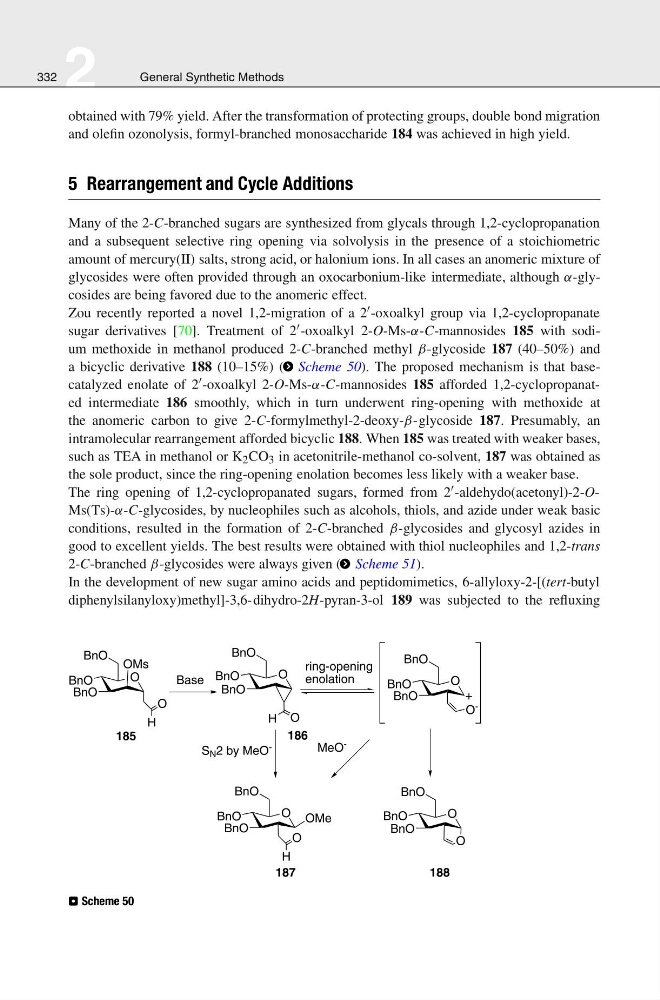
Zou recently reported a novel 1,2-migration of a 2 -oxoalkyl group via 1,2-cyclopropanate
sugar derivatives [70]. Treatment of 2 -oxoalkyl 2-O-Ms-α-C-mannosides 185 with sodium methoxide in methanol produced 2-C-branched methyl β-glycoside 187 (40–50%) and
a bicyclic derivative 188 (10–15%) ( > Scheme 50). The proposed mechanism is that basecatalyzed enolate of 2 -oxoalkyl 2-O-Ms-α-C-mannosides 185 afforded 1,2-cyclopropanated intermediate 186 smoothly, which in turn underwent ring-opening with methoxide at
the anomeric carbon to give 2-C-formylmethyl-2-deoxy-β-glycoside 187. Presumably, an
intramolecular rearrangement afforded bicyclic 188. When 185 was treated with weaker bases,
such as TEA in methanol or K 2 CO 3 in acetonitrile-methanol co-solvent, 187 was obtained as
the sole product, since the ring-opening enolation becomes less likely with a weaker base.
The ring opening of 1,2-cyclopropanated sugars, formed from 2 -aldehydo(acetonyl)-2-OMs(Ts)-α-C-glycosides, by nucleophiles such as alcohols, thiols, and azide under weak basic
conditions, resulted in the formation of 2-C-branched β-glycosides and glycosyl azides in
good to excellent yields. The best results were obtained with thiol nucleophiles and 1,2-trans
2-C-branched β-glycosides were always given ( > Scheme 51).
In the development of new sugar amino acids and peptidomimetics, 6-allyloxy-2-[(tert-butyl
diphenylsilanyloxy)methyl]-3,6-dihydro-2H-pyran-3-ol 189 was subjected to the refluxing
⊡ Scheme 50
2
General Synthetic Methods
obtained with 79% yield. After the transformation of protecting groups, double bond migration
and olefin ozonolysis, formyl-branched monosaccharide 184 was achieved in high yield.
5 Rearrangement and Cycle Additions
Many of the 2-C-branched sugars are synthesized from glycals through 1,2-cyclopropanation
and a subsequent selective ring opening via solvolysis in the presence of a stoichiometric
amount of mercury(II) salts, strong acid, or halonium ions. In all cases an anomeric mixture of
glycosides were often provided through an oxocarbonium-like intermediate, although α-glycosides are being favored due to the anomeric effect.
Zou recently reported a novel 1,2-migration of a 2 -oxoalkyl group via 1,2-cyclopropanate
sugar derivatives [70]. Treatment of 2 -oxoalkyl 2-O-Ms-α-C-mannosides 185 with sodium methoxide in methanol produced 2-C-branched methyl β-glycoside 187 (40–50%) and
a bicyclic derivative 188 (10–15%) ( > Scheme 50). The proposed mechanism is that basecatalyzed enolate of 2 -oxoalkyl 2-O-Ms-α-C-mannosides 185 afforded 1,2-cyclopropanated intermediate 186 smoothly, which in turn underwent ring-opening with methoxide at
the anomeric carbon to give 2-C-formylmethyl-2-deoxy-β-glycoside 187. Presumably, an
intramolecular rearrangement afforded bicyclic 188. When 185 was treated with weaker bases,
such as TEA in methanol or K 2 CO 3 in acetonitrile-methanol co-solvent, 187 was obtained as
the sole product, since the ring-opening enolation becomes less likely with a weaker base.
The ring opening of 1,2-cyclopropanated sugars, formed from 2 -aldehydo(acetonyl)-2-OMs(Ts)-α-C-glycosides, by nucleophiles such as alcohols, thiols, and azide under weak basic
conditions, resulted in the formation of 2-C-branched β-glycosides and glycosyl azides in
good to excellent yields. The best results were obtained with thiol nucleophiles and 1,2-trans
2-C-branched β-glycosides were always given ( > Scheme 51).
In the development of new sugar amino acids and peptidomimetics, 6-allyloxy-2-[(tert-butyl
diphenylsilanyloxy)methyl]-3,6-dihydro-2H-pyran-3-ol 189 was subjected to the refluxing
⊡ Scheme 50