

C–C Bond Formation
2.5
315
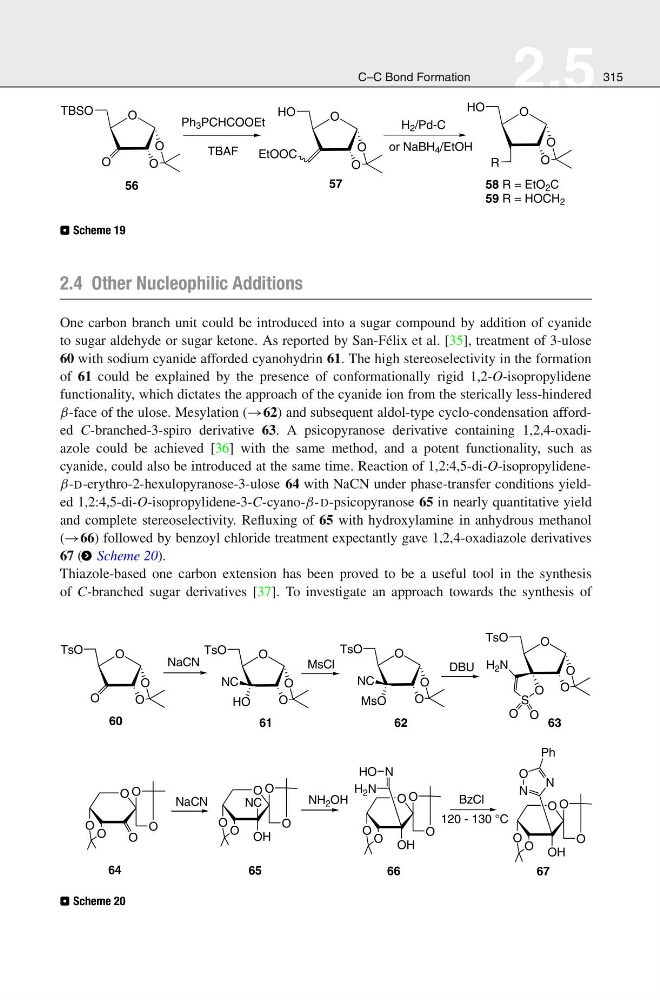
⊡ Scheme 19
2.4 Other Nucleophilic Additions
One carbon branch unit could be introduced into a sugar compound by addition of cyanide
to sugar aldehyde or sugar ketone. As reported by San-Félix et al. [35], treatment of 3-ulose
60 with sodium cyanide afforded cyanohydrin 61. The high stereoselectivity in the formation
of 61 could be explained by the presence of conformationally rigid 1,2-O-isopropylidene
functionality, which dictates the approach of the cyanide ion from the sterically less-hindered
β-face of the ulose. Mesylation (→62) and subsequent aldol-type cyclo-condensation afforded C-branched-3-spiro derivative 63. A psicopyranose derivative containing 1,2,4-oxadiazole could be achieved [36] with the same method, and a potent functionality, such as
cyanide, could also be introduced at the same time. Reaction of 1,2:4,5-di-O-isopropylideneβ-D-erythro-2-hexulopyranose-3-ulose 64 with NaCN under phase-transfer conditions yielded 1,2:4,5-di-O-isopropylidene-3-C-cyano-β-D-psicopyranose 65 in nearly quantitative yield
and complete stereoselectivity. Refluxing of 65 with hydroxylamine in anhydrous methanol
(→66) followed by benzoyl chloride treatment expectantly gave 1,2,4-oxadiazole derivatives
67 ( > Scheme 20).
Thiazole-based one carbon extension has been proved to be a useful tool in the synthesis
of C-branched sugar derivatives [37]. To investigate an approach towards the synthesis of
⊡ Scheme 20
2.5
315
⊡ Scheme 19
2.4 Other Nucleophilic Additions
One carbon branch unit could be introduced into a sugar compound by addition of cyanide
to sugar aldehyde or sugar ketone. As reported by San-Félix et al. [35], treatment of 3-ulose
60 with sodium cyanide afforded cyanohydrin 61. The high stereoselectivity in the formation
of 61 could be explained by the presence of conformationally rigid 1,2-O-isopropylidene
functionality, which dictates the approach of the cyanide ion from the sterically less-hindered
β-face of the ulose. Mesylation (→62) and subsequent aldol-type cyclo-condensation afforded C-branched-3-spiro derivative 63. A psicopyranose derivative containing 1,2,4-oxadiazole could be achieved [36] with the same method, and a potent functionality, such as
cyanide, could also be introduced at the same time. Reaction of 1,2:4,5-di-O-isopropylideneβ-D-erythro-2-hexulopyranose-3-ulose 64 with NaCN under phase-transfer conditions yielded 1,2:4,5-di-O-isopropylidene-3-C-cyano-β-D-psicopyranose 65 in nearly quantitative yield
and complete stereoselectivity. Refluxing of 65 with hydroxylamine in anhydrous methanol
(→66) followed by benzoyl chloride treatment expectantly gave 1,2,4-oxadiazole derivatives
67 ( > Scheme 20).
Thiazole-based one carbon extension has been proved to be a useful tool in the synthesis
of C-branched sugar derivatives [37]. To investigate an approach towards the synthesis of
⊡ Scheme 20