

C–C Bond Formation
2.5
313
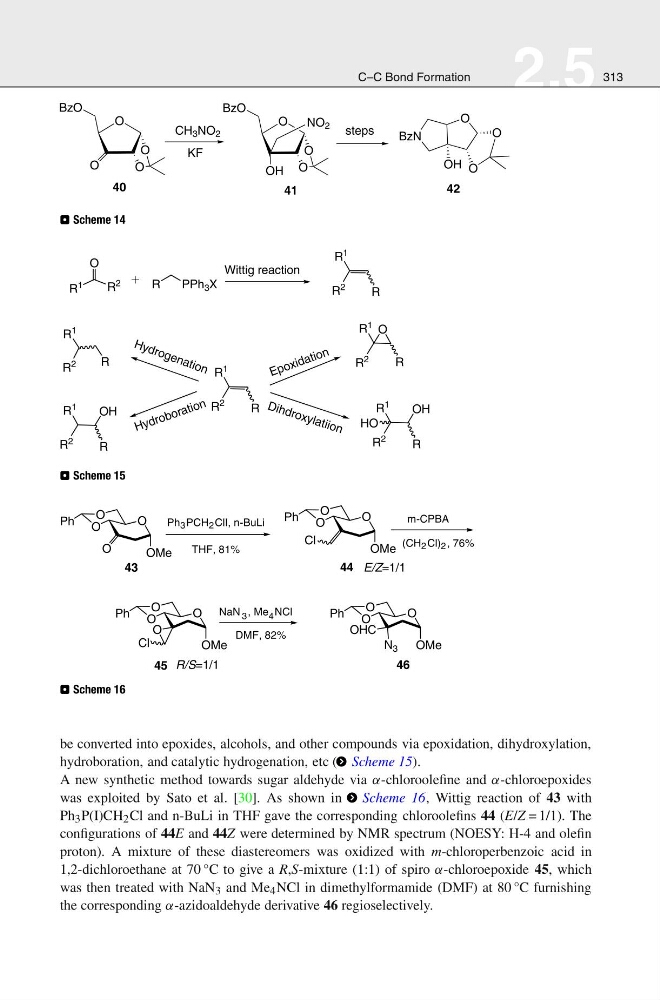
⊡ Scheme 14
⊡ Scheme 15
⊡ Scheme 16
be converted into epoxides, alcohols, and other compounds via epoxidation, dihydroxylation,
hydroboration, and catalytic hydrogenation, etc ( > Scheme 15).
A new synthetic method towards sugar aldehyde via α-chloroolefine and α-chloroepoxides
was exploited by Sato et al. [30]. As shown in > Scheme 16, Wittig reaction of 43 with
Ph 3 P(I)CH 2 Cl and n-BuLi in THF gave the corresponding chloroolefins 44 (E/Z = 1/1). The
configurations of 44E and 44Z were determined by NMR spectrum (NOESY: H-4 and olefin
proton). A mixture of these diastereomers was oxidized with m-chloroperbenzoic acid in
1,2-dichloroethane at 70 °C to give a R,S-mixture (1:1) of spiro α-chloroepoxide 45, which
was then treated with NaN 3 and Me 4 NCl in dimethylformamide (DMF) at 80 °C furnishing
the corresponding α-azidoaldehyde derivative 46 regioselectively.
2.5
313
⊡ Scheme 14
⊡ Scheme 15
⊡ Scheme 16
be converted into epoxides, alcohols, and other compounds via epoxidation, dihydroxylation,
hydroboration, and catalytic hydrogenation, etc ( > Scheme 15).
A new synthetic method towards sugar aldehyde via α-chloroolefine and α-chloroepoxides
was exploited by Sato et al. [30]. As shown in > Scheme 16, Wittig reaction of 43 with
Ph 3 P(I)CH 2 Cl and n-BuLi in THF gave the corresponding chloroolefins 44 (E/Z = 1/1). The
configurations of 44E and 44Z were determined by NMR spectrum (NOESY: H-4 and olefin
proton). A mixture of these diastereomers was oxidized with m-chloroperbenzoic acid in
1,2-dichloroethane at 70 °C to give a R,S-mixture (1:1) of spiro α-chloroepoxide 45, which
was then treated with NaN 3 and Me 4 NCl in dimethylformamide (DMF) at 80 °C furnishing
the corresponding α-azidoaldehyde derivative 46 regioselectively.