

C–C Bond Formation
2.5
311
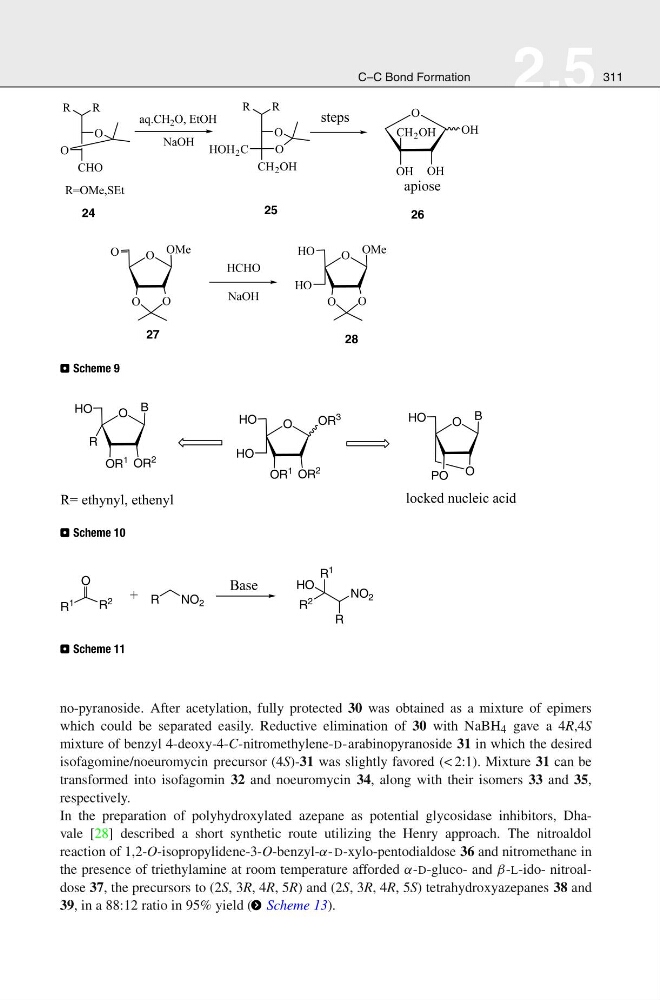
⊡ Scheme 9
⊡ Scheme 10
⊡ Scheme 11
no-pyranoside. After acetylation, fully protected 30 was obtained as a mixture of epimers
which could be separated easily. Reductive elimination of 30 with NaBH 4 gave a 4R,4S
mixture of benzyl 4-deoxy-4-C-nitromethylene-D-arabinopyranoside 31 in which the desired
isofagomine/noeuromycin precursor (4S)-31 was slightly favored (< 2:1). Mixture 31 can be
transformed into isofagomin 32 and noeuromycin 34, along with their isomers 33 and 35,
respectively.
In the preparation of polyhydroxylated azepane as potential glycosidase inhibitors, Dhavale [28] described a short synthetic route utilizing the Henry approach. The nitroaldol
reaction of 1,2-O-isopropylidene-3-O-benzyl-α- D-xylo-pentodialdose 36 and nitromethane in
the presence of triethylamine at room temperature afforded α-D-gluco- and β-L-ido- nitroaldose 37, the precursors to (2S, 3R, 4R, 5R) and (2S, 3R, 4R, 5S) tetrahydroxyazepanes 38 and
39, in a 88:12 ratio in 95% yield ( > Scheme 13).
2.5
311
⊡ Scheme 9
⊡ Scheme 10
⊡ Scheme 11
no-pyranoside. After acetylation, fully protected 30 was obtained as a mixture of epimers
which could be separated easily. Reductive elimination of 30 with NaBH 4 gave a 4R,4S
mixture of benzyl 4-deoxy-4-C-nitromethylene-D-arabinopyranoside 31 in which the desired
isofagomine/noeuromycin precursor (4S)-31 was slightly favored (< 2:1). Mixture 31 can be
transformed into isofagomin 32 and noeuromycin 34, along with their isomers 33 and 35,
respectively.
In the preparation of polyhydroxylated azepane as potential glycosidase inhibitors, Dhavale [28] described a short synthetic route utilizing the Henry approach. The nitroaldol
reaction of 1,2-O-isopropylidene-3-O-benzyl-α- D-xylo-pentodialdose 36 and nitromethane in
the presence of triethylamine at room temperature afforded α-D-gluco- and β-L-ido- nitroaldose 37, the precursors to (2S, 3R, 4R, 5R) and (2S, 3R, 4R, 5S) tetrahydroxyazepanes 38 and
39, in a 88:12 ratio in 95% yield ( > Scheme 13).