

Anhydrosugars
2.4
299
⊡ Scheme 29
⊡ Scheme 30
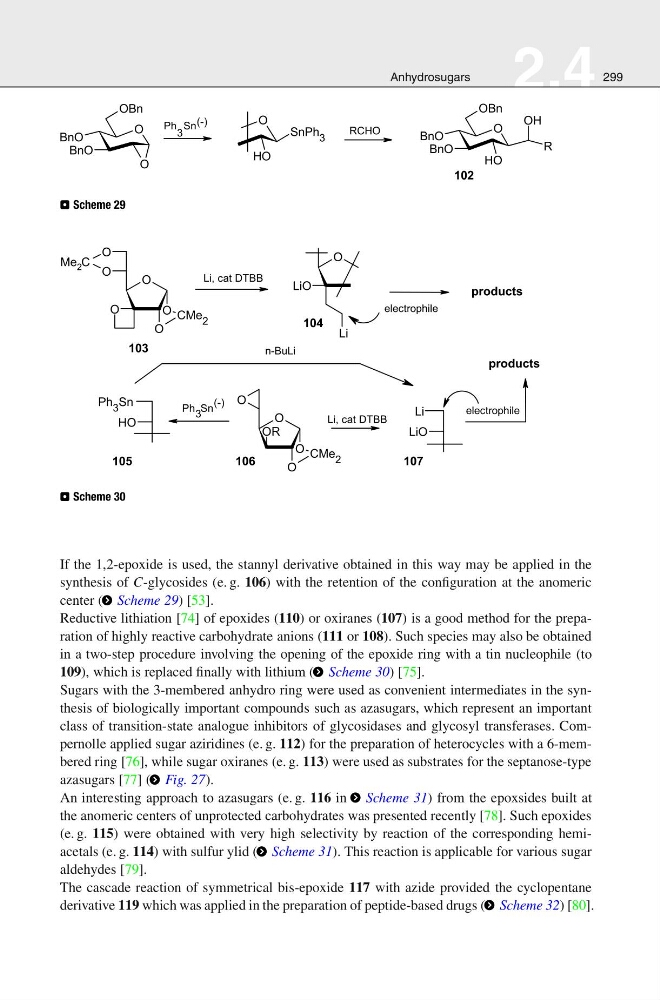
If the 1,2-epoxide is used, the stannyl derivative obtained in this way may be applied in the
synthesis of C-glycosides (e. g. 106) with the retention of the configuration at the anomeric
center ( > Scheme 29) [53].
Reductive lithiation [74] of epoxides (110) or oxiranes (107) is a good method for the preparation of highly reactive carbohydrate anions (111 or 108). Such species may also be obtained
in a two-step procedure involving the opening of the epoxide ring with a tin nucleophile (to
109), which is replaced finally with lithium ( > Scheme 30) [75].
Sugars with the 3-membered anhydro ring were used as convenient intermediates in the synthesis of biologically important compounds such as azasugars, which represent an important
class of transition-state analogue inhibitors of glycosidases and glycosyl transferases. Compernolle applied sugar aziridines (e. g. 112) for the preparation of heterocycles with a 6-membered ring [76], while sugar oxiranes (e. g. 113) were used as substrates for the septanose-type
azasugars [77] ( > Fig. 27).
An interesting approach to azasugars (e. g. 116 in > Scheme 31) from the epoxsides built at
the anomeric centers of unprotected carbohydrates was presented recently [78]. Such epoxides
(e. g. 115) were obtained with very high selectivity by reaction of the corresponding hemiacetals (e. g. 114) with sulfur ylid ( > Scheme 31). This reaction is applicable for various sugar
aldehydes [79].
The cascade reaction of symmetrical bis-epoxide 117 with azide provided the cyclopentane
derivative 119 which was applied in the preparation of peptide-based drugs ( > Scheme 32) [80].
2.4
299
⊡ Scheme 29
⊡ Scheme 30
If the 1,2-epoxide is used, the stannyl derivative obtained in this way may be applied in the
synthesis of C-glycosides (e. g. 106) with the retention of the configuration at the anomeric
center ( > Scheme 29) [53].
Reductive lithiation [74] of epoxides (110) or oxiranes (107) is a good method for the preparation of highly reactive carbohydrate anions (111 or 108). Such species may also be obtained
in a two-step procedure involving the opening of the epoxide ring with a tin nucleophile (to
109), which is replaced finally with lithium ( > Scheme 30) [75].
Sugars with the 3-membered anhydro ring were used as convenient intermediates in the synthesis of biologically important compounds such as azasugars, which represent an important
class of transition-state analogue inhibitors of glycosidases and glycosyl transferases. Compernolle applied sugar aziridines (e. g. 112) for the preparation of heterocycles with a 6-membered ring [76], while sugar oxiranes (e. g. 113) were used as substrates for the septanose-type
azasugars [77] ( > Fig. 27).
An interesting approach to azasugars (e. g. 116 in > Scheme 31) from the epoxsides built at
the anomeric centers of unprotected carbohydrates was presented recently [78]. Such epoxides
(e. g. 115) were obtained with very high selectivity by reaction of the corresponding hemiacetals (e. g. 114) with sulfur ylid ( > Scheme 31). This reaction is applicable for various sugar
aldehydes [79].
The cascade reaction of symmetrical bis-epoxide 117 with azide provided the cyclopentane
derivative 119 which was applied in the preparation of peptide-based drugs ( > Scheme 32) [80].