

Anhydrosugars
2.4
293
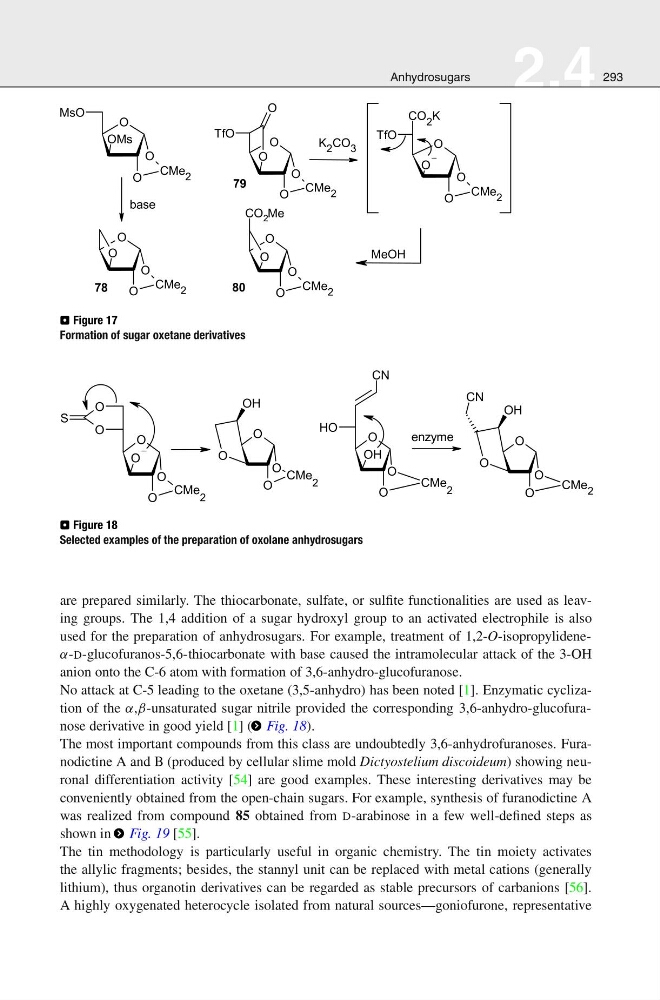
⊡ Figure 17
Formation of sugar oxetane derivatives
⊡ Figure 18
Selected examples of the preparation of oxolane anhydrosugars
are prepared similarly. The thiocarbonate, sulfate, or sulfite functionalities are used as leaving groups. The 1,4 addition of a sugar hydroxyl group to an activated electrophile is also
used for the preparation of anhydrosugars. For example, treatment of 1,2-O-isopropylideneα-D-glucofuranos-5,6-thiocarbonate with base caused the intramolecular attack of the 3-OH
anion onto the C-6 atom with formation of 3,6-anhydro-glucofuranose.
No attack at C-5 leading to the oxetane (3,5-anhydro) has been noted [1]. Enzymatic cyclization of the α,β-unsaturated sugar nitrile provided the corresponding 3,6-anhydro-glucofuranose derivative in good yield [1] ( > Fig. 18).
The most important compounds from this class are undoubtedly 3,6-anhydrofuranoses. Furanodictine A and B (produced by cellular slime mold Dictyostelium discoideum) showing neuronal differentiation activity [54] are good examples. These interesting derivatives may be
conveniently obtained from the open-chain sugars. For example, synthesis of furanodictine A
was realized from compound 85 obtained from D-arabinose in a few well-defined steps as
shown in > Fig. 19 [55].
The tin methodology is particularly useful in organic chemistry. The tin moiety activates
the allylic fragments; besides, the stannyl unit can be replaced with metal cations (generally
lithium), thus organotin derivatives can be regarded as stable precursors of carbanions [56].
A highly oxygenated heterocycle isolated from natural sources—goniofurone, representative
2.4
293
⊡ Figure 17
Formation of sugar oxetane derivatives
⊡ Figure 18
Selected examples of the preparation of oxolane anhydrosugars
are prepared similarly. The thiocarbonate, sulfate, or sulfite functionalities are used as leaving groups. The 1,4 addition of a sugar hydroxyl group to an activated electrophile is also
used for the preparation of anhydrosugars. For example, treatment of 1,2-O-isopropylideneα-D-glucofuranos-5,6-thiocarbonate with base caused the intramolecular attack of the 3-OH
anion onto the C-6 atom with formation of 3,6-anhydro-glucofuranose.
No attack at C-5 leading to the oxetane (3,5-anhydro) has been noted [1]. Enzymatic cyclization of the α,β-unsaturated sugar nitrile provided the corresponding 3,6-anhydro-glucofuranose derivative in good yield [1] ( > Fig. 18).
The most important compounds from this class are undoubtedly 3,6-anhydrofuranoses. Furanodictine A and B (produced by cellular slime mold Dictyostelium discoideum) showing neuronal differentiation activity [54] are good examples. These interesting derivatives may be
conveniently obtained from the open-chain sugars. For example, synthesis of furanodictine A
was realized from compound 85 obtained from D-arabinose in a few well-defined steps as
shown in > Fig. 19 [55].
The tin methodology is particularly useful in organic chemistry. The tin moiety activates
the allylic fragments; besides, the stannyl unit can be replaced with metal cations (generally
lithium), thus organotin derivatives can be regarded as stable precursors of carbanions [56].
A highly oxygenated heterocycle isolated from natural sources—goniofurone, representative