

Anhydrosugars
2.4
291
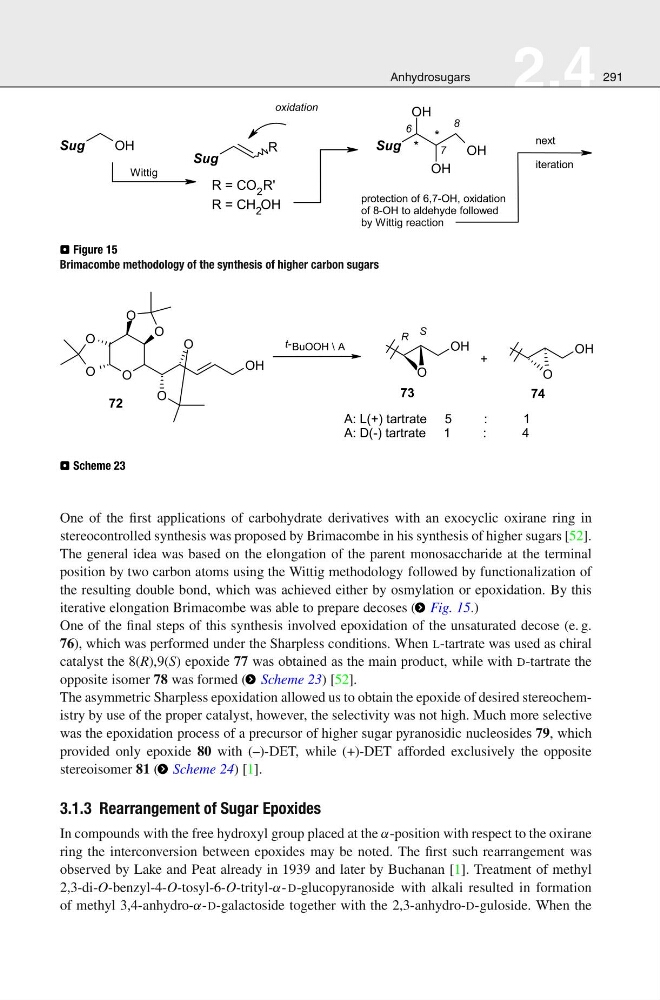
⊡ Figure 15
Brimacombe methodology of the synthesis of higher carbon sugars
⊡ Scheme 23
One of the first applications of carbohydrate derivatives with an exocyclic oxirane ring in
stereocontrolled synthesis was proposed by Brimacombe in his synthesis of higher sugars [52].
The general idea was based on the elongation of the parent monosaccharide at the terminal
position by two carbon atoms using the Wittig methodology followed by functionalization of
the resulting double bond, which was achieved either by osmylation or epoxidation. By this
iterative elongation Brimacombe was able to prepare decoses ( > Fig. 15.)
One of the final steps of this synthesis involved epoxidation of the unsaturated decose (e. g.
76), which was performed under the Sharpless conditions. When L-tartrate was used as chiral
catalyst the 8(R),9(S) epoxide 77 was obtained as the main product, while with D-tartrate the
opposite isomer 78 was formed ( > Scheme 23) [52].
The asymmetric Sharpless epoxidation allowed us to obtain the epoxide of desired stereochemistry by use of the proper catalyst, however, the selectivity was not high. Much more selective
was the epoxidation process of a precursor of higher sugar pyranosidic nucleosides 79, which
provided only epoxide 80 with (–)-DET, while (+)-DET afforded exclusively the opposite
stereoisomer 81 ( > Scheme 24) [1].
3.1.3 Rearrangement of Sugar Epoxides
In compounds with the free hydroxyl group placed at the α-position with respect to the oxirane
ring the interconversion between epoxides may be noted. The first such rearrangement was
observed by Lake and Peat already in 1939 and later by Buchanan [1]. Treatment of methyl
2,3-di-O-benzyl-4-O-tosyl-6-O-trityl-α- D-glucopyranoside with alkali resulted in formation
of methyl 3,4-anhydro-α-D-galactoside together with the 2,3-anhydro-D-guloside. When the
2.4
291
⊡ Figure 15
Brimacombe methodology of the synthesis of higher carbon sugars
⊡ Scheme 23
One of the first applications of carbohydrate derivatives with an exocyclic oxirane ring in
stereocontrolled synthesis was proposed by Brimacombe in his synthesis of higher sugars [52].
The general idea was based on the elongation of the parent monosaccharide at the terminal
position by two carbon atoms using the Wittig methodology followed by functionalization of
the resulting double bond, which was achieved either by osmylation or epoxidation. By this
iterative elongation Brimacombe was able to prepare decoses ( > Fig. 15.)
One of the final steps of this synthesis involved epoxidation of the unsaturated decose (e. g.
76), which was performed under the Sharpless conditions. When L-tartrate was used as chiral
catalyst the 8(R),9(S) epoxide 77 was obtained as the main product, while with D-tartrate the
opposite isomer 78 was formed ( > Scheme 23) [52].
The asymmetric Sharpless epoxidation allowed us to obtain the epoxide of desired stereochemistry by use of the proper catalyst, however, the selectivity was not high. Much more selective
was the epoxidation process of a precursor of higher sugar pyranosidic nucleosides 79, which
provided only epoxide 80 with (–)-DET, while (+)-DET afforded exclusively the opposite
stereoisomer 81 ( > Scheme 24) [1].
3.1.3 Rearrangement of Sugar Epoxides
In compounds with the free hydroxyl group placed at the α-position with respect to the oxirane
ring the interconversion between epoxides may be noted. The first such rearrangement was
observed by Lake and Peat already in 1939 and later by Buchanan [1]. Treatment of methyl
2,3-di-O-benzyl-4-O-tosyl-6-O-trityl-α- D-glucopyranoside with alkali resulted in formation
of methyl 3,4-anhydro-α-D-galactoside together with the 2,3-anhydro-D-guloside. When the