

Structure and Conformation of Carbohydrates
1.1
5
1.2 Conformations of Cycloalkanes and Heterocycles
1.2.1 Conformations of Cyclohexanes
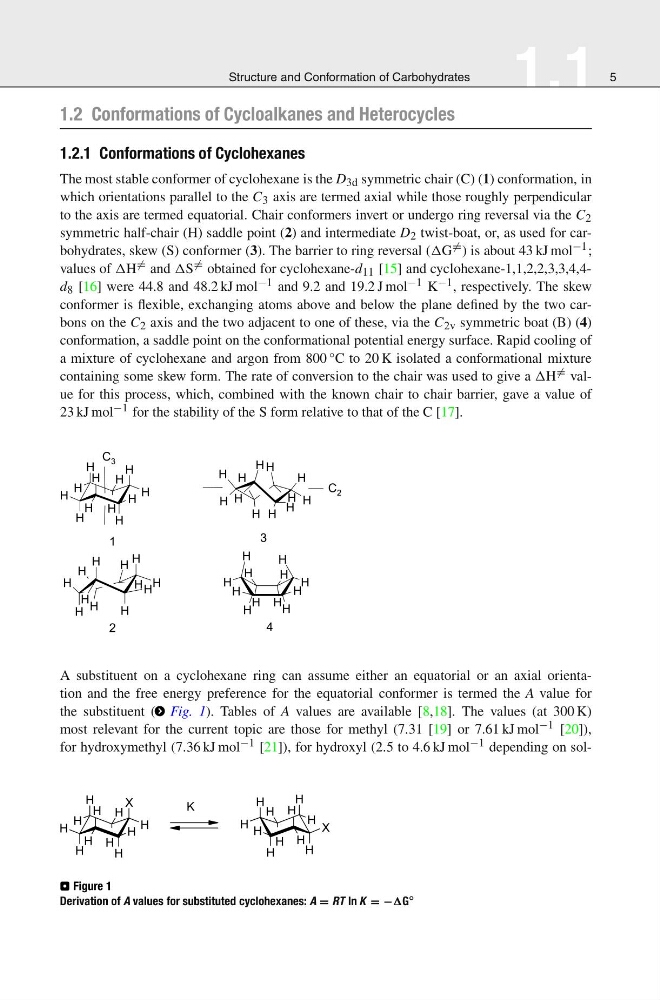
The most stable conformer of cyclohexane is the D 3d symmetric chair (C) (1) conformation, in
which orientations parallel to the C 3 axis are termed axial while those roughly perpendicular
to the axis are termed equatorial. Chair conformers invert or undergo ring reversal via the C 2
symmetric half-chair (H) saddle point (2) and intermediate D 2 twist-boat, or, as used for carbohydrates, skew (S) conformer (3). The barrier to ring reversal (G = ) is about 43 kJ mol −1 ;
values of H = and S = obtained for cyclohexane-d 11 [15] and cyclohexane-1,1,2,2,3,3,4,4d 8 [16] were 44.8 and 48.2 kJ mol −1 and 9.2 and 19.2 J mol −1 K −1 , respectively. The skew
conformer is flexible, exchanging atoms above and below the plane defined by the two carbons on the C 2 axis and the two adjacent to one of these, via the C 2v symmetric boat (B) (4)
conformation, a saddle point on the conformational potential energy surface. Rapid cooling of
a mixture of cyclohexane and argon from 800 °C to 20 K isolated a conformational mixture
containing some skew form. The rate of conversion to the chair was used to give a H = value for this process, which, combined with the known chair to chair barrier, gave a value of
23 kJ mol −1 for the stability of the S form relative to that of the C [17].
A substituent on a cyclohexane ring can assume either an equatorial or an axial orientation and the free energy preference for the equatorial conformer is termed the A value for
the substituent ( > Fig. 1). Tables of A values are available [8,18]. The values (at 300 K)
most relevant for the current topic are those for methyl (7.31 [19] or 7.61 kJ mol −1 [20]),
for hydroxymethyl (7.36 kJ mol −1 [21]), for hydroxyl (2.5 to 4.6 kJ mol −1 depending on sol⊡ Figure 1
Derivation of A values for substituted cyclohexanes: A = RT ln K = −G ◦
1.1
5
1.2 Conformations of Cycloalkanes and Heterocycles
1.2.1 Conformations of Cyclohexanes
The most stable conformer of cyclohexane is the D 3d symmetric chair (C) (1) conformation, in
which orientations parallel to the C 3 axis are termed axial while those roughly perpendicular
to the axis are termed equatorial. Chair conformers invert or undergo ring reversal via the C 2
symmetric half-chair (H) saddle point (2) and intermediate D 2 twist-boat, or, as used for carbohydrates, skew (S) conformer (3). The barrier to ring reversal (G = ) is about 43 kJ mol −1 ;
values of H = and S = obtained for cyclohexane-d 11 [15] and cyclohexane-1,1,2,2,3,3,4,4d 8 [16] were 44.8 and 48.2 kJ mol −1 and 9.2 and 19.2 J mol −1 K −1 , respectively. The skew
conformer is flexible, exchanging atoms above and below the plane defined by the two carbons on the C 2 axis and the two adjacent to one of these, via the C 2v symmetric boat (B) (4)
conformation, a saddle point on the conformational potential energy surface. Rapid cooling of
a mixture of cyclohexane and argon from 800 °C to 20 K isolated a conformational mixture
containing some skew form. The rate of conversion to the chair was used to give a H = value for this process, which, combined with the known chair to chair barrier, gave a value of
23 kJ mol −1 for the stability of the S form relative to that of the C [17].
A substituent on a cyclohexane ring can assume either an equatorial or an axial orientation and the free energy preference for the equatorial conformer is termed the A value for
the substituent ( > Fig. 1). Tables of A values are available [8,18]. The values (at 300 K)
most relevant for the current topic are those for methyl (7.31 [19] or 7.61 kJ mol −1 [20]),
for hydroxymethyl (7.36 kJ mol −1 [21]), for hydroxyl (2.5 to 4.6 kJ mol −1 depending on sol⊡ Figure 1
Derivation of A values for substituted cyclohexanes: A = RT ln K = −G ◦