

Anhydrosugars
2.4
279
Such derivatives, functionalized at the C-6 position, are convenient synthons for a variety of
interesting compounds.
2.1.2 1,6-Anhydrofuranoses
1,6-Anhydrofuranoses derived from all eight diastereoisomeric aldohexoses were described in
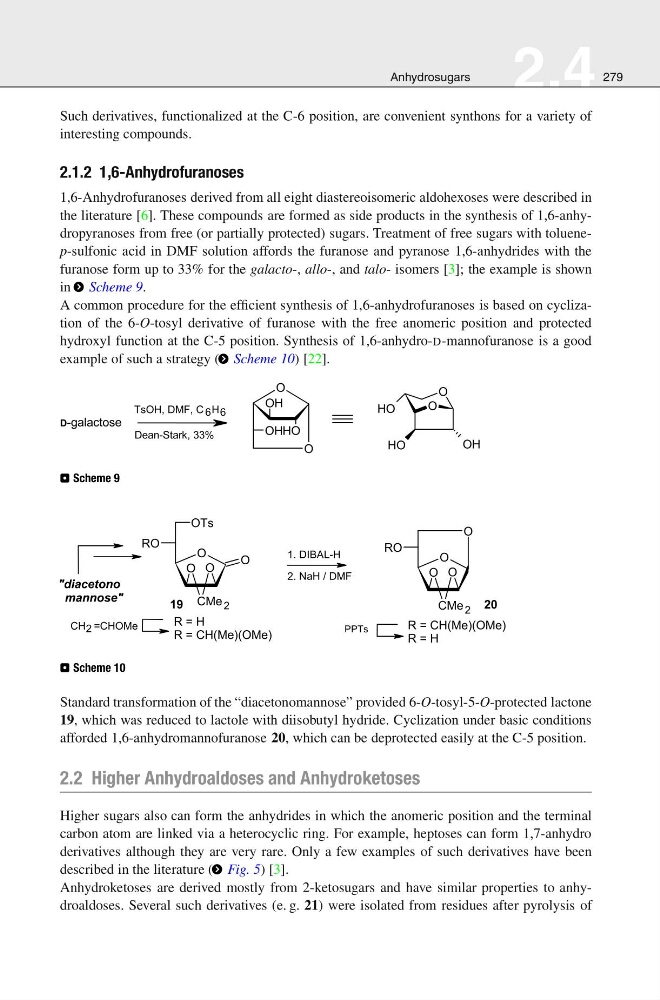
the literature [6]. These compounds are formed as side products in the synthesis of 1,6-anhydropyranoses from free (or partially protected) sugars. Treatment of free sugars with toluenep-sulfonic acid in DMF solution affords the furanose and pyranose 1,6-anhydrides with the
furanose form up to 33% for the galacto-, allo-, and talo- isomers [3]; the example is shown
in > Scheme 9.
A common procedure for the efficient synthesis of 1,6-anhydrofuranoses is based on cyclization of the 6-O-tosyl derivative of furanose with the free anomeric position and protected
hydroxyl function at the C-5 position. Synthesis of 1,6-anhydro-D-mannofuranose is a good
example of such a strategy ( > Scheme 10) [22].
⊡ Scheme 9
⊡ Scheme 10
Standard transformation of the “diacetonomannose” provided 6-O-tosyl-5-O-protected lactone
19, which was reduced to lactole with diisobutyl hydride. Cyclization under basic conditions
afforded 1,6-anhydromannofuranose 20, which can be deprotected easily at the C-5 position.
2.2 Higher Anhydroaldoses and Anhydroketoses
Higher sugars also can form the anhydrides in which the anomeric position and the terminal
carbon atom are linked via a heterocyclic ring. For example, heptoses can form 1,7-anhydro
derivatives although they are very rare. Only a few examples of such derivatives have been
described in the literature ( > Fig. 5) [3].
Anhydroketoses are derived mostly from 2-ketosugars and have similar properties to anhydroaldoses. Several such derivatives (e. g. 21) were isolated from residues after pyrolysis of
2.4
279
Such derivatives, functionalized at the C-6 position, are convenient synthons for a variety of
interesting compounds.
2.1.2 1,6-Anhydrofuranoses
1,6-Anhydrofuranoses derived from all eight diastereoisomeric aldohexoses were described in
the literature [6]. These compounds are formed as side products in the synthesis of 1,6-anhydropyranoses from free (or partially protected) sugars. Treatment of free sugars with toluenep-sulfonic acid in DMF solution affords the furanose and pyranose 1,6-anhydrides with the
furanose form up to 33% for the galacto-, allo-, and talo- isomers [3]; the example is shown
in > Scheme 9.
A common procedure for the efficient synthesis of 1,6-anhydrofuranoses is based on cyclization of the 6-O-tosyl derivative of furanose with the free anomeric position and protected
hydroxyl function at the C-5 position. Synthesis of 1,6-anhydro-D-mannofuranose is a good
example of such a strategy ( > Scheme 10) [22].
⊡ Scheme 9
⊡ Scheme 10
Standard transformation of the “diacetonomannose” provided 6-O-tosyl-5-O-protected lactone
19, which was reduced to lactole with diisobutyl hydride. Cyclization under basic conditions
afforded 1,6-anhydromannofuranose 20, which can be deprotected easily at the C-5 position.
2.2 Higher Anhydroaldoses and Anhydroketoses
Higher sugars also can form the anhydrides in which the anomeric position and the terminal
carbon atom are linked via a heterocyclic ring. For example, heptoses can form 1,7-anhydro
derivatives although they are very rare. Only a few examples of such derivatives have been
described in the literature ( > Fig. 5) [3].
Anhydroketoses are derived mostly from 2-ketosugars and have similar properties to anhydroaldoses. Several such derivatives (e. g. 21) were isolated from residues after pyrolysis of