

Anhydrosugars
2.4
273
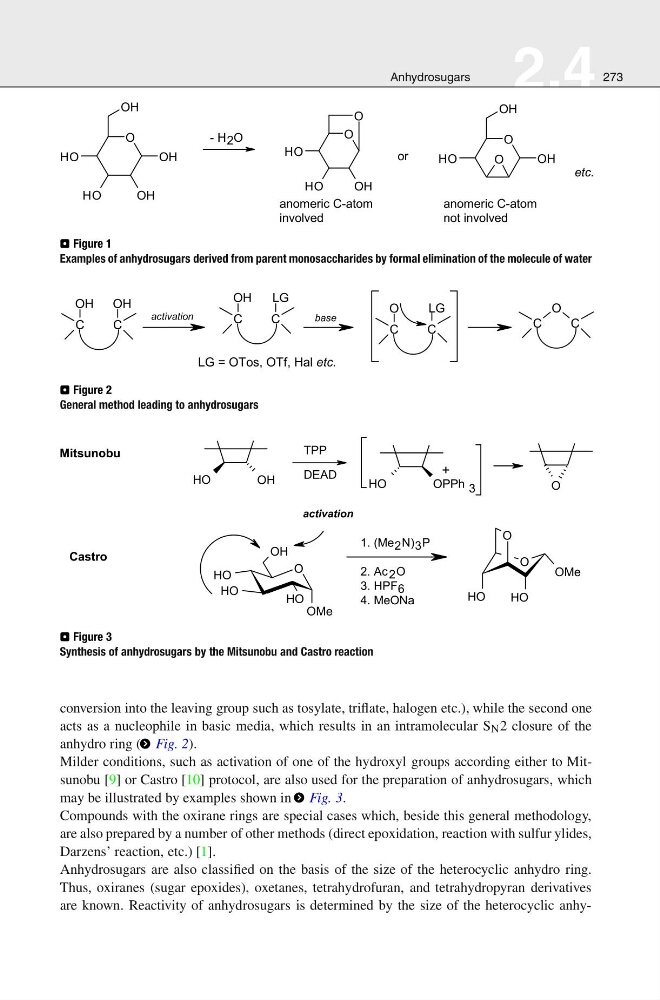
⊡ Figure 1
Examples of anhydrosugars derived from parent monosaccharides by formal elimination of the molecule of water
⊡ Figure 2
General method leading to anhydrosugars
⊡ Figure 3
Synthesis of anhydrosugars by the Mitsunobu and Castro reaction
conversion into the leaving group such as tosylate, triflate, halogen etc.), while the second one
acts as a nucleophile in basic media, which results in an intramolecular S N 2 closure of the
anhydro ring ( > Fig. 2).
Milder conditions, such as activation of one of the hydroxyl groups according either to Mitsunobu [9] or Castro [10] protocol, are also used for the preparation of anhydrosugars, which
may be illustrated by examples shown in > Fig. 3.
Compounds with the oxirane rings are special cases which, beside this general methodology,
are also prepared by a number of other methods (direct epoxidation, reaction with sulfur ylides,
Darzens’ reaction, etc.) [1].
Anhydrosugars are also classified on the basis of the size of the heterocyclic anhydro ring.
Thus, oxiranes (sugar epoxides), oxetanes, tetrahydrofuran, and tetrahydropyran derivatives
are known. Reactivity of anhydrosugars is determined by the size of the heterocyclic anhy-
2.4
273
⊡ Figure 1
Examples of anhydrosugars derived from parent monosaccharides by formal elimination of the molecule of water
⊡ Figure 2
General method leading to anhydrosugars
⊡ Figure 3
Synthesis of anhydrosugars by the Mitsunobu and Castro reaction
conversion into the leaving group such as tosylate, triflate, halogen etc.), while the second one
acts as a nucleophile in basic media, which results in an intramolecular S N 2 closure of the
anhydro ring ( > Fig. 2).
Milder conditions, such as activation of one of the hydroxyl groups according either to Mitsunobu [9] or Castro [10] protocol, are also used for the preparation of anhydrosugars, which
may be illustrated by examples shown in > Fig. 3.
Compounds with the oxirane rings are special cases which, beside this general methodology,
are also prepared by a number of other methods (direct epoxidation, reaction with sulfur ylides,
Darzens’ reaction, etc.) [1].
Anhydrosugars are also classified on the basis of the size of the heterocyclic anhydro ring.
Thus, oxiranes (sugar epoxides), oxetanes, tetrahydrofuran, and tetrahydropyran derivatives
are known. Reactivity of anhydrosugars is determined by the size of the heterocyclic anhy-