

262
2
General Synthetic Methods
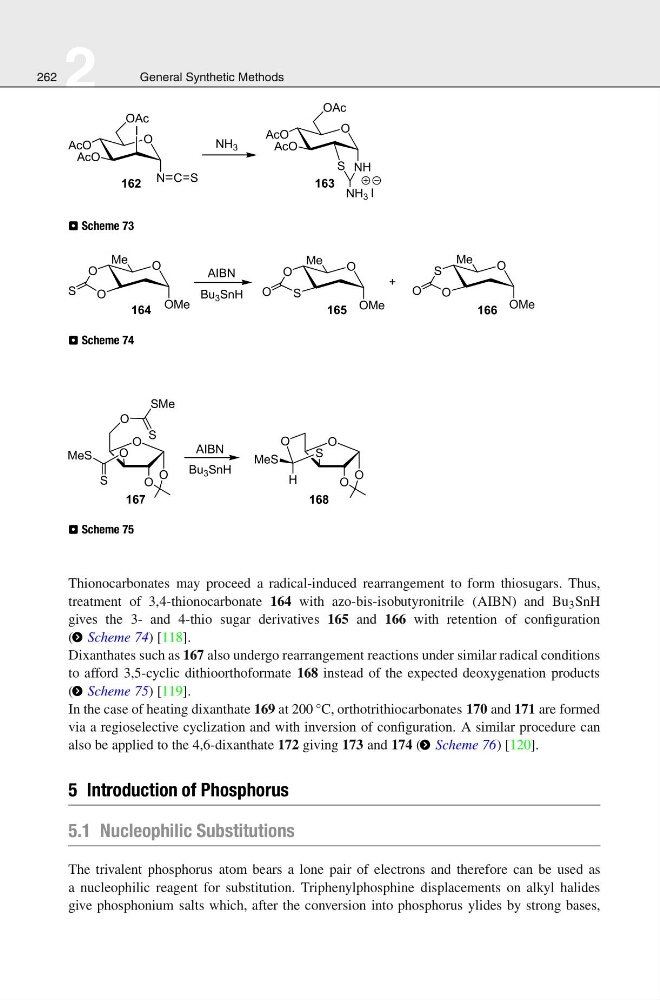
⊡ Scheme 73
⊡ Scheme 74
⊡ Scheme 75
Thionocarbonates may proceed a radical-induced rearrangement to form thiosugars. Thus,
treatment of 3,4-thionocarbonate 164 with azo-bis-isobutyronitrile (AIBN) and Bu 3 SnH
gives the 3- and 4-thio sugar derivatives 165 and 166 with retention of configuration
( > Scheme 74) [118].
Dixanthates such as 167 also undergo rearrangement reactions under similar radical conditions
to afford 3,5-cyclic dithioorthoformate 168 instead of the expected deoxygenation products
( > Scheme 75) [119].
In the case of heating dixanthate 169 at 200 °C, orthotrithiocarbonates 170 and 171 are formed
via a regioselective cyclization and with inversion of configuration. A similar procedure can
also be applied to the 4,6-dixanthate 172 giving 173 and 174 ( > Scheme 76) [120].
5 Introduction of Phosphorus
5.1 Nucleophilic Substitutions
The trivalent phosphorus atom bears a lone pair of electrons and therefore can be used as
a nucleophilic reagent for substitution. Triphenylphosphine displacements on alkyl halides
give phosphonium salts which, after the conversion into phosphorus ylides by strong bases,
2
General Synthetic Methods
⊡ Scheme 73
⊡ Scheme 74
⊡ Scheme 75
Thionocarbonates may proceed a radical-induced rearrangement to form thiosugars. Thus,
treatment of 3,4-thionocarbonate 164 with azo-bis-isobutyronitrile (AIBN) and Bu 3 SnH
gives the 3- and 4-thio sugar derivatives 165 and 166 with retention of configuration
( > Scheme 74) [118].
Dixanthates such as 167 also undergo rearrangement reactions under similar radical conditions
to afford 3,5-cyclic dithioorthoformate 168 instead of the expected deoxygenation products
( > Scheme 75) [119].
In the case of heating dixanthate 169 at 200 °C, orthotrithiocarbonates 170 and 171 are formed
via a regioselective cyclization and with inversion of configuration. A similar procedure can
also be applied to the 4,6-dixanthate 172 giving 173 and 174 ( > Scheme 76) [120].
5 Introduction of Phosphorus
5.1 Nucleophilic Substitutions
The trivalent phosphorus atom bears a lone pair of electrons and therefore can be used as
a nucleophilic reagent for substitution. Triphenylphosphine displacements on alkyl halides
give phosphonium salts which, after the conversion into phosphorus ylides by strong bases,