

Heteroatom Exchange
2.3
259
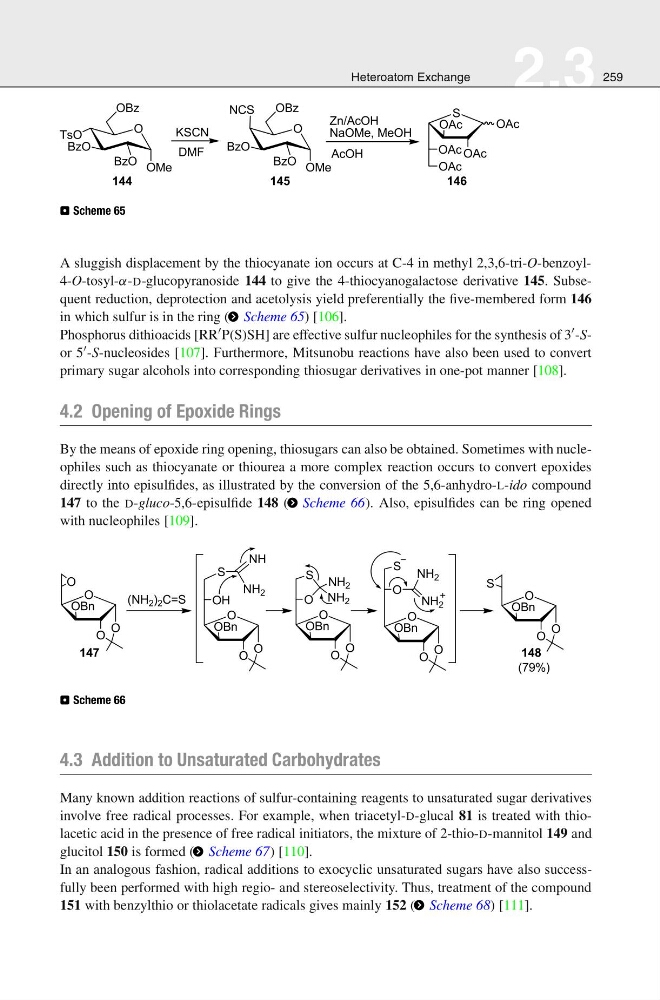
⊡ Scheme 65
A sluggish displacement by the thiocyanate ion occurs at C-4 in methyl 2,3,6-tri-O-benzoyl4-O-tosyl-α-D-glucopyranoside 144 to give the 4-thiocyanogalactose derivative 145. Subsequent reduction, deprotection and acetolysis yield preferentially the five-membered form 146
in which sulfur is in the ring ( > Scheme 65) [106].
Phosphorus dithioacids [RR P(S)SH] are effective sulfur nucleophiles for the synthesis of 3 -Sor 5 -S-nucleosides [107]. Furthermore, Mitsunobu reactions have also been used to convert
primary sugar alcohols into corresponding thiosugar derivatives in one-pot manner [108].
4.2 Opening of Epoxide Rings
By the means of epoxide ring opening, thiosugars can also be obtained. Sometimes with nucleophiles such as thiocyanate or thiourea a more complex reaction occurs to convert epoxides
directly into episulfides, as illustrated by the conversion of the 5,6-anhydro-L-ido compound
147 to the D-gluco-5,6-episulfide 148 ( > Scheme 66). Also, episulfides can be ring opened
with nucleophiles [109].
⊡ Scheme 66
4.3 Addition to Unsaturated Carbohydrates
Many known addition reactions of sulfur-containing reagents to unsaturated sugar derivatives
involve free radical processes. For example, when triacetyl-D-glucal 81 is treated with thiolacetic acid in the presence of free radical initiators, the mixture of 2-thio-D-mannitol 149 and
glucitol 150 is formed ( > Scheme 67) [110].
In an analogous fashion, radical additions to exocyclic unsaturated sugars have also successfully been performed with high regio- and stereoselectivity. Thus, treatment of the compound
151 with benzylthio or thiolacetate radicals gives mainly 152 ( > Scheme 68) [111].
2.3
259
⊡ Scheme 65
A sluggish displacement by the thiocyanate ion occurs at C-4 in methyl 2,3,6-tri-O-benzoyl4-O-tosyl-α-D-glucopyranoside 144 to give the 4-thiocyanogalactose derivative 145. Subsequent reduction, deprotection and acetolysis yield preferentially the five-membered form 146
in which sulfur is in the ring ( > Scheme 65) [106].
Phosphorus dithioacids [RR P(S)SH] are effective sulfur nucleophiles for the synthesis of 3 -Sor 5 -S-nucleosides [107]. Furthermore, Mitsunobu reactions have also been used to convert
primary sugar alcohols into corresponding thiosugar derivatives in one-pot manner [108].
4.2 Opening of Epoxide Rings
By the means of epoxide ring opening, thiosugars can also be obtained. Sometimes with nucleophiles such as thiocyanate or thiourea a more complex reaction occurs to convert epoxides
directly into episulfides, as illustrated by the conversion of the 5,6-anhydro-L-ido compound
147 to the D-gluco-5,6-episulfide 148 ( > Scheme 66). Also, episulfides can be ring opened
with nucleophiles [109].
⊡ Scheme 66
4.3 Addition to Unsaturated Carbohydrates
Many known addition reactions of sulfur-containing reagents to unsaturated sugar derivatives
involve free radical processes. For example, when triacetyl-D-glucal 81 is treated with thiolacetic acid in the presence of free radical initiators, the mixture of 2-thio-D-mannitol 149 and
glucitol 150 is formed ( > Scheme 67) [110].
In an analogous fashion, radical additions to exocyclic unsaturated sugars have also successfully been performed with high regio- and stereoselectivity. Thus, treatment of the compound
151 with benzylthio or thiolacetate radicals gives mainly 152 ( > Scheme 68) [111].