

Heteroatom Exchange
2.3
253
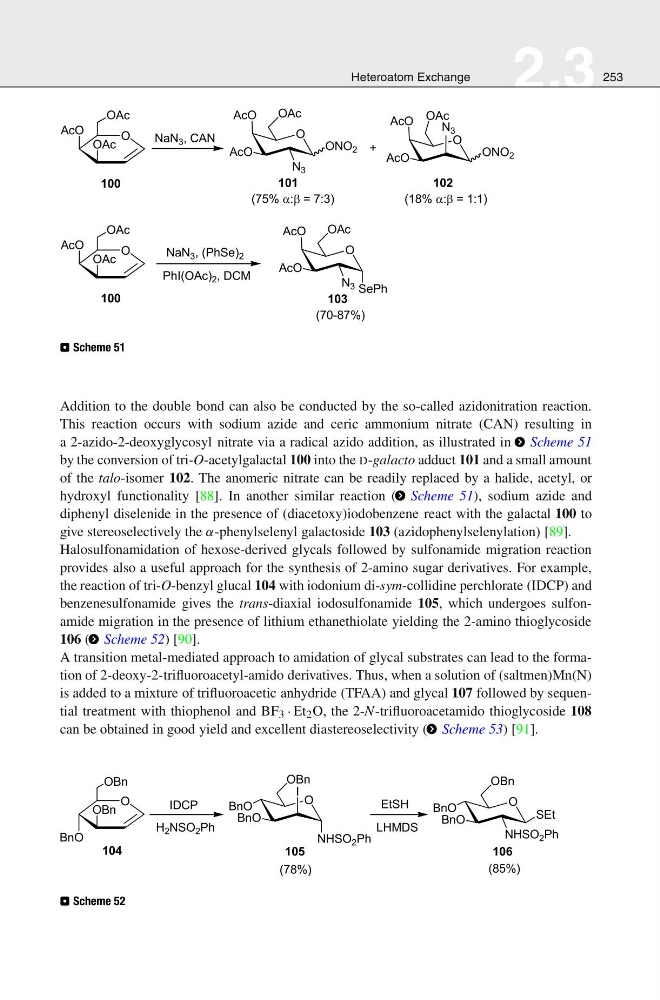
⊡ Scheme 51
Addition to the double bond can also be conducted by the so-called azidonitration reaction.
This reaction occurs with sodium azide and ceric ammonium nitrate (CAN) resulting in
a 2-azido-2-deoxyglycosyl nitrate via a radical azido addition, as illustrated in > Scheme 51
by the conversion of tri-O-acetylgalactal 100 into the D-galacto adduct 101 and a small amount
of the talo-isomer 102. The anomeric nitrate can be readily replaced by a halide, acetyl, or
hydroxyl functionality [88]. In another similar reaction ( > Scheme 51), sodium azide and
diphenyl diselenide in the presence of (diacetoxy)iodobenzene react with the galactal 100 to
give stereoselectively the α-phenylselenyl galactoside 103 (azidophenylselenylation) [89].
Halosulfonamidation of hexose-derived glycals followed by sulfonamide migration reaction
provides also a useful approach for the synthesis of 2-amino sugar derivatives. For example,
the reaction of tri-O-benzyl glucal 104 with iodonium di-sym-collidine perchlorate (IDCP) and
benzenesulfonamide gives the trans-diaxial iodosulfonamide 105, which undergoes sulfonamide migration in the presence of lithium ethanethiolate yielding the 2-amino thioglycoside
106 ( > Scheme 52) [90].
A transition metal-mediated approach to amidation of glycal substrates can lead to the formation of 2-deoxy-2-trifluoroacetyl-amido derivatives. Thus, when a solution of (saltmen)Mn(N)
is added to a mixture of trifluoroacetic anhydride (TFAA) and glycal 107 followed by sequential treatment with thiophenol and BF 3 · Et 2 O, the 2-N-trifluoroacetamido thioglycoside 108
can be obtained in good yield and excellent diastereoselectivity ( > Scheme 53) [91].
⊡ Scheme 52
2.3
253
⊡ Scheme 51
Addition to the double bond can also be conducted by the so-called azidonitration reaction.
This reaction occurs with sodium azide and ceric ammonium nitrate (CAN) resulting in
a 2-azido-2-deoxyglycosyl nitrate via a radical azido addition, as illustrated in > Scheme 51
by the conversion of tri-O-acetylgalactal 100 into the D-galacto adduct 101 and a small amount
of the talo-isomer 102. The anomeric nitrate can be readily replaced by a halide, acetyl, or
hydroxyl functionality [88]. In another similar reaction ( > Scheme 51), sodium azide and
diphenyl diselenide in the presence of (diacetoxy)iodobenzene react with the galactal 100 to
give stereoselectively the α-phenylselenyl galactoside 103 (azidophenylselenylation) [89].
Halosulfonamidation of hexose-derived glycals followed by sulfonamide migration reaction
provides also a useful approach for the synthesis of 2-amino sugar derivatives. For example,
the reaction of tri-O-benzyl glucal 104 with iodonium di-sym-collidine perchlorate (IDCP) and
benzenesulfonamide gives the trans-diaxial iodosulfonamide 105, which undergoes sulfonamide migration in the presence of lithium ethanethiolate yielding the 2-amino thioglycoside
106 ( > Scheme 52) [90].
A transition metal-mediated approach to amidation of glycal substrates can lead to the formation of 2-deoxy-2-trifluoroacetyl-amido derivatives. Thus, when a solution of (saltmen)Mn(N)
is added to a mixture of trifluoroacetic anhydride (TFAA) and glycal 107 followed by sequential treatment with thiophenol and BF 3 · Et 2 O, the 2-N-trifluoroacetamido thioglycoside 108
can be obtained in good yield and excellent diastereoselectivity ( > Scheme 53) [91].
⊡ Scheme 52