

Oxidation, Reduction, and Deoxygenation
2.2
219
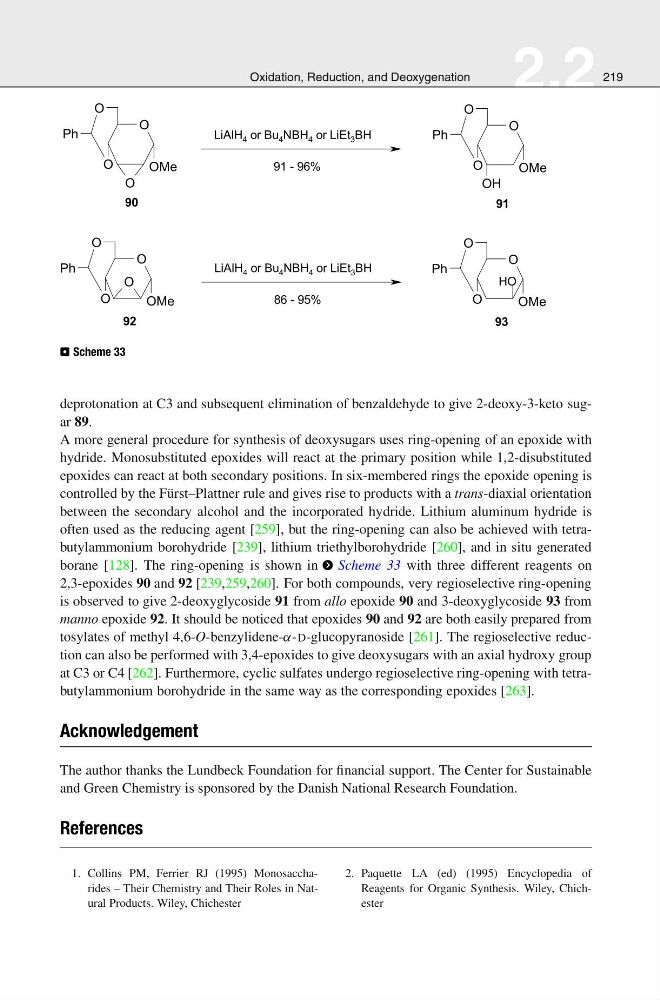
⊡ Scheme 33
deprotonation at C3 and subsequent elimination of benzaldehyde to give 2-deoxy-3-keto sugar 89.
A more general procedure for synthesis of deoxysugars uses ring-opening of an epoxide with
hydride. Monosubstituted epoxides will react at the primary position while 1,2-disubstituted
epoxides can react at both secondary positions. In six-membered rings the epoxide opening is
controlled by the Fürst–Plattner rule and gives rise to products with a trans-diaxial orientation
between the secondary alcohol and the incorporated hydride. Lithium aluminum hydride is
often used as the reducing agent [259], but the ring-opening can also be achieved with tetrabutylammonium borohydride [239], lithium triethylborohydride [260], and in situ generated
borane [128]. The ring-opening is shown in > Scheme 33 with three different reagents on
2,3-epoxides 90 and 92 [239,259,260]. For both compounds, very regioselective ring-opening
is observed to give 2-deoxyglycoside 91 from allo epoxide 90 and 3-deoxyglycoside 93 from
manno epoxide 92. It should be noticed that epoxides 90 and 92 are both easily prepared from
tosylates of methyl 4,6-O-benzylidene-α-D-glucopyranoside [261]. The regioselective reduction can also be performed with 3,4-epoxides to give deoxysugars with an axial hydroxy group
at C3 or C4 [262]. Furthermore, cyclic sulfates undergo regioselective ring-opening with tetrabutylammonium borohydride in the same way as the corresponding epoxides [263].
Acknowledgement
The author thanks the Lundbeck Foundation for financial support. The Center for Sustainable
and Green Chemistry is sponsored by the Danish National Research Foundation.
References
1. Collins PM, Ferrier RJ (1995) Monosaccharides – Their Chemistry and Their Roles in Natural Products. Wiley, Chichester
2. Paquette LA (ed) (1995) Encyclopedia of
Reagents for Organic Synthesis. Wiley, Chichester
2.2
219
⊡ Scheme 33
deprotonation at C3 and subsequent elimination of benzaldehyde to give 2-deoxy-3-keto sugar 89.
A more general procedure for synthesis of deoxysugars uses ring-opening of an epoxide with
hydride. Monosubstituted epoxides will react at the primary position while 1,2-disubstituted
epoxides can react at both secondary positions. In six-membered rings the epoxide opening is
controlled by the Fürst–Plattner rule and gives rise to products with a trans-diaxial orientation
between the secondary alcohol and the incorporated hydride. Lithium aluminum hydride is
often used as the reducing agent [259], but the ring-opening can also be achieved with tetrabutylammonium borohydride [239], lithium triethylborohydride [260], and in situ generated
borane [128]. The ring-opening is shown in > Scheme 33 with three different reagents on
2,3-epoxides 90 and 92 [239,259,260]. For both compounds, very regioselective ring-opening
is observed to give 2-deoxyglycoside 91 from allo epoxide 90 and 3-deoxyglycoside 93 from
manno epoxide 92. It should be noticed that epoxides 90 and 92 are both easily prepared from
tosylates of methyl 4,6-O-benzylidene-α-D-glucopyranoside [261]. The regioselective reduction can also be performed with 3,4-epoxides to give deoxysugars with an axial hydroxy group
at C3 or C4 [262]. Furthermore, cyclic sulfates undergo regioselective ring-opening with tetrabutylammonium borohydride in the same way as the corresponding epoxides [263].
Acknowledgement
The author thanks the Lundbeck Foundation for financial support. The Center for Sustainable
and Green Chemistry is sponsored by the Danish National Research Foundation.
References
1. Collins PM, Ferrier RJ (1995) Monosaccharides – Their Chemistry and Their Roles in Natural Products. Wiley, Chichester
2. Paquette LA (ed) (1995) Encyclopedia of
Reagents for Organic Synthesis. Wiley, Chichester