

Oxidation, Reduction, and Deoxygenation
2.2
213
4.1 Deoxygenation at the Anomeric Center
Deoxygenation of aldoses at C1 gives rise to 1,4- and 1,5-anhydroalditols which can be used
as chiral scaffolds for further synthesis. One of the preferred methods for deoxygenating
aldoses and their glycosides at C1 employs triethylsilane in the presence of trimethylsilyl
triflate [206]. The strong Lewis acid mediates the formation of an oxocarbenium ion at C1
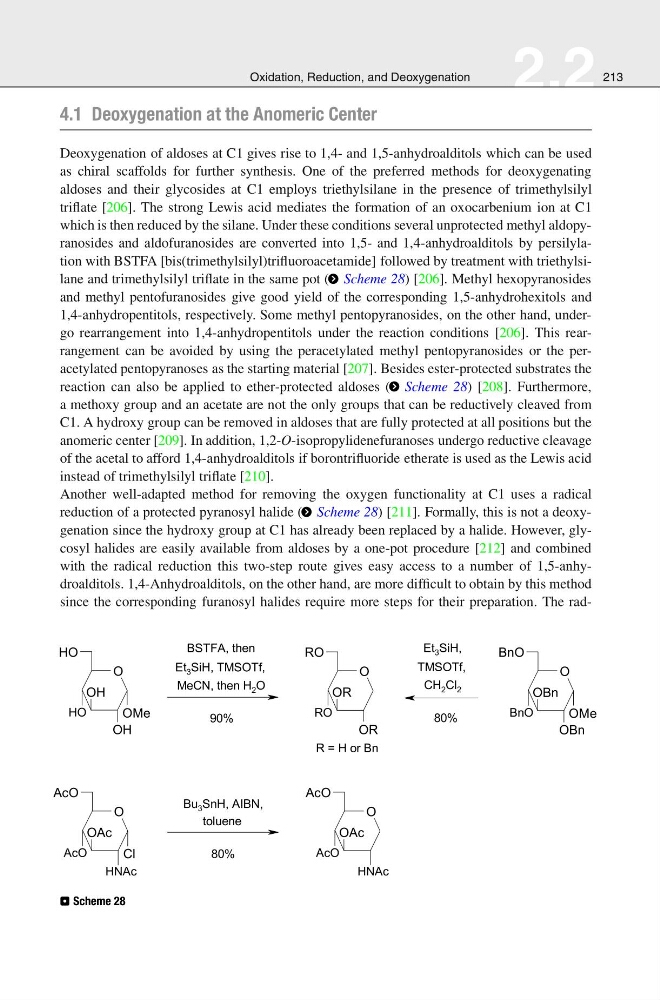
which is then reduced by the silane. Under these conditions several unprotected methyl aldopyranosides and aldofuranosides are converted into 1,5- and 1,4-anhydroalditols by persilylation with BSTFA [bis(trimethylsilyl)trifluoroacetamide] followed by treatment with triethylsilane and trimethylsilyl triflate in the same pot ( > Scheme 28) [206]. Methyl hexopyranosides
and methyl pentofuranosides give good yield of the corresponding 1,5-anhydrohexitols and
1,4-anhydropentitols, respectively. Some methyl pentopyranosides, on the other hand, undergo rearrangement into 1,4-anhydropentitols under the reaction conditions [206]. This rearrangement can be avoided by using the peracetylated methyl pentopyranosides or the peracetylated pentopyranoses as the starting material [207]. Besides ester-protected substrates the
reaction can also be applied to ether-protected aldoses ( > Scheme 28) [208]. Furthermore,
a methoxy group and an acetate are not the only groups that can be reductively cleaved from
C1. A hydroxy group can be removed in aldoses that are fully protected at all positions but the
anomeric center [209]. In addition, 1,2-O-isopropylidenefuranoses undergo reductive cleavage
of the acetal to afford 1,4-anhydroalditols if borontrifluoride etherate is used as the Lewis acid
instead of trimethylsilyl triflate [210].
Another well-adapted method for removing the oxygen functionality at C1 uses a radical
reduction of a protected pyranosyl halide ( > Scheme 28) [211]. Formally, this is not a deoxygenation since the hydroxy group at C1 has already been replaced by a halide. However, glycosyl halides are easily available from aldoses by a one-pot procedure [212] and combined
with the radical reduction this two-step route gives easy access to a number of 1,5-anhydroalditols. 1,4-Anhydroalditols, on the other hand, are more difficult to obtain by this method
since the corresponding furanosyl halides require more steps for their preparation. The rad⊡ Scheme 28
2.2
213
4.1 Deoxygenation at the Anomeric Center
Deoxygenation of aldoses at C1 gives rise to 1,4- and 1,5-anhydroalditols which can be used
as chiral scaffolds for further synthesis. One of the preferred methods for deoxygenating
aldoses and their glycosides at C1 employs triethylsilane in the presence of trimethylsilyl
triflate [206]. The strong Lewis acid mediates the formation of an oxocarbenium ion at C1
which is then reduced by the silane. Under these conditions several unprotected methyl aldopyranosides and aldofuranosides are converted into 1,5- and 1,4-anhydroalditols by persilylation with BSTFA [bis(trimethylsilyl)trifluoroacetamide] followed by treatment with triethylsilane and trimethylsilyl triflate in the same pot ( > Scheme 28) [206]. Methyl hexopyranosides
and methyl pentofuranosides give good yield of the corresponding 1,5-anhydrohexitols and
1,4-anhydropentitols, respectively. Some methyl pentopyranosides, on the other hand, undergo rearrangement into 1,4-anhydropentitols under the reaction conditions [206]. This rearrangement can be avoided by using the peracetylated methyl pentopyranosides or the peracetylated pentopyranoses as the starting material [207]. Besides ester-protected substrates the
reaction can also be applied to ether-protected aldoses ( > Scheme 28) [208]. Furthermore,
a methoxy group and an acetate are not the only groups that can be reductively cleaved from
C1. A hydroxy group can be removed in aldoses that are fully protected at all positions but the
anomeric center [209]. In addition, 1,2-O-isopropylidenefuranoses undergo reductive cleavage
of the acetal to afford 1,4-anhydroalditols if borontrifluoride etherate is used as the Lewis acid
instead of trimethylsilyl triflate [210].
Another well-adapted method for removing the oxygen functionality at C1 uses a radical
reduction of a protected pyranosyl halide ( > Scheme 28) [211]. Formally, this is not a deoxygenation since the hydroxy group at C1 has already been replaced by a halide. However, glycosyl halides are easily available from aldoses by a one-pot procedure [212] and combined
with the radical reduction this two-step route gives easy access to a number of 1,5-anhydroalditols. 1,4-Anhydroalditols, on the other hand, are more difficult to obtain by this method
since the corresponding furanosyl halides require more steps for their preparation. The rad⊡ Scheme 28