

Oxidation, Reduction, and Deoxygenation
2.2
197
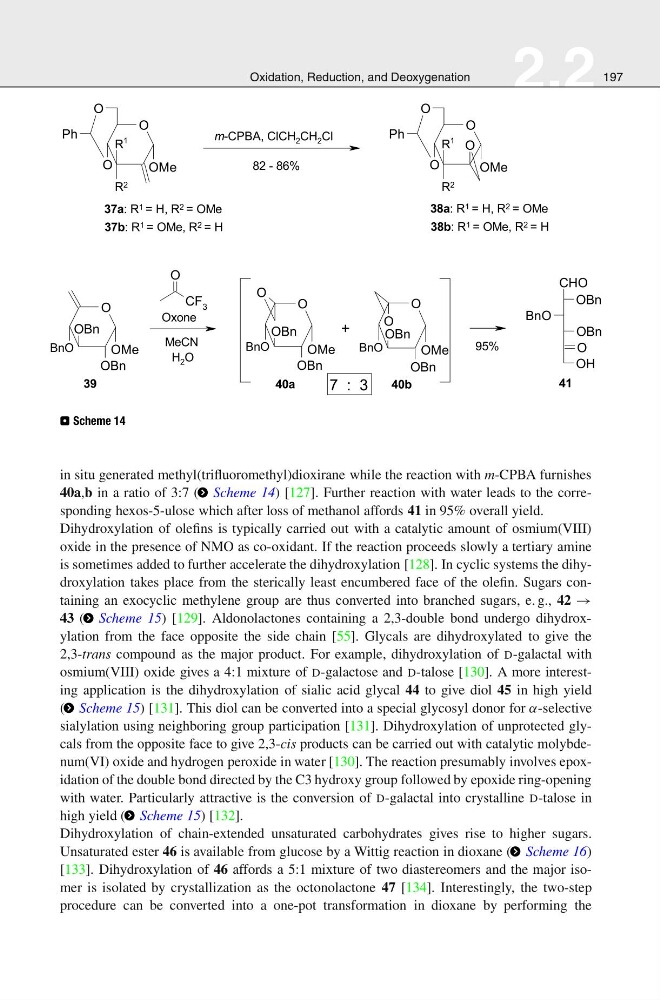
⊡ Scheme 14
in situ generated methyl(trifluoromethyl)dioxirane while the reaction with m-CPBA furnishes
40a,b in a ratio of 3:7 ( > Scheme 14) [127]. Further reaction with water leads to the corresponding hexos-5-ulose which after loss of methanol affords 41 in 95% overall yield.
Dihydroxylation of olefins is typically carried out with a catalytic amount of osmium(VIII)
oxide in the presence of NMO as co-oxidant. If the reaction proceeds slowly a tertiary amine
is sometimes added to further accelerate the dihydroxylation [128]. In cyclic systems the dihydroxylation takes place from the sterically least encumbered face of the olefin. Sugars containing an exocyclic methylene group are thus converted into branched sugars, e. g., 42 →
43 ( > Scheme 15) [129]. Aldonolactones containing a 2,3-double bond undergo dihydroxylation from the face opposite the side chain [55]. Glycals are dihydroxylated to give the
2,3-trans compound as the major product. For example, dihydroxylation of D-galactal with
osmium(VIII) oxide gives a 4:1 mixture of D-galactose and D-talose [130]. A more interesting application is the dihydroxylation of sialic acid glycal 44 to give diol 45 in high yield
( > Scheme 15) [131]. This diol can be converted into a special glycosyl donor for α-selective
sialylation using neighboring group participation [131]. Dihydroxylation of unprotected glycals from the opposite face to give 2,3-cis products can be carried out with catalytic molybdenum(VI) oxide and hydrogen peroxide in water [130]. The reaction presumably involves epoxidation of the double bond directed by the C3 hydroxy group followed by epoxide ring-opening
with water. Particularly attractive is the conversion of D-galactal into crystalline D-talose in
high yield ( > Scheme 15) [132].
Dihydroxylation of chain-extended unsaturated carbohydrates gives rise to higher sugars.
Unsaturated ester 46 is available from glucose by a Wittig reaction in dioxane ( > Scheme 16)
[133]. Dihydroxylation of 46 affords a 5:1 mixture of two diastereomers and the major isomer is isolated by crystallization as the octonolactone 47 [134]. Interestingly, the two-step
procedure can be converted into a one-pot transformation in dioxane by performing the
2.2
197
⊡ Scheme 14
in situ generated methyl(trifluoromethyl)dioxirane while the reaction with m-CPBA furnishes
40a,b in a ratio of 3:7 ( > Scheme 14) [127]. Further reaction with water leads to the corresponding hexos-5-ulose which after loss of methanol affords 41 in 95% overall yield.
Dihydroxylation of olefins is typically carried out with a catalytic amount of osmium(VIII)
oxide in the presence of NMO as co-oxidant. If the reaction proceeds slowly a tertiary amine
is sometimes added to further accelerate the dihydroxylation [128]. In cyclic systems the dihydroxylation takes place from the sterically least encumbered face of the olefin. Sugars containing an exocyclic methylene group are thus converted into branched sugars, e. g., 42 →
43 ( > Scheme 15) [129]. Aldonolactones containing a 2,3-double bond undergo dihydroxylation from the face opposite the side chain [55]. Glycals are dihydroxylated to give the
2,3-trans compound as the major product. For example, dihydroxylation of D-galactal with
osmium(VIII) oxide gives a 4:1 mixture of D-galactose and D-talose [130]. A more interesting application is the dihydroxylation of sialic acid glycal 44 to give diol 45 in high yield
( > Scheme 15) [131]. This diol can be converted into a special glycosyl donor for α-selective
sialylation using neighboring group participation [131]. Dihydroxylation of unprotected glycals from the opposite face to give 2,3-cis products can be carried out with catalytic molybdenum(VI) oxide and hydrogen peroxide in water [130]. The reaction presumably involves epoxidation of the double bond directed by the C3 hydroxy group followed by epoxide ring-opening
with water. Particularly attractive is the conversion of D-galactal into crystalline D-talose in
high yield ( > Scheme 15) [132].
Dihydroxylation of chain-extended unsaturated carbohydrates gives rise to higher sugars.
Unsaturated ester 46 is available from glucose by a Wittig reaction in dioxane ( > Scheme 16)
[133]. Dihydroxylation of 46 affords a 5:1 mixture of two diastereomers and the major isomer is isolated by crystallization as the octonolactone 47 [134]. Interestingly, the two-step
procedure can be converted into a one-pot transformation in dioxane by performing the