

168
2
General Synthetic Methods
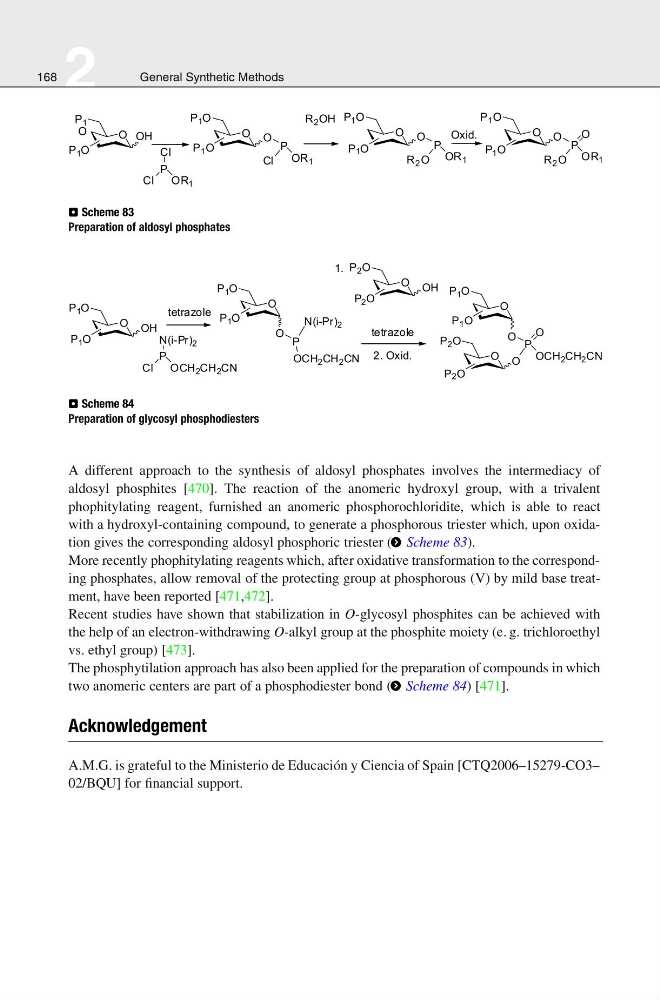
⊡ Scheme 83
Preparation of aldosyl phosphates
⊡ Scheme 84
Preparation of glycosyl phosphodiesters
A different approach to the synthesis of aldosyl phosphates involves the intermediacy of
aldosyl phosphites [470]. The reaction of the anomeric hydroxyl group, with a trivalent
phophitylating reagent, furnished an anomeric phosphorochloridite, which is able to react
with a hydroxyl-containing compound, to generate a phosphorous triester which, upon oxidation gives the corresponding aldosyl phosphoric triester ( > Scheme 83).
More recently phophitylating reagents which, after oxidative transformation to the corresponding phosphates, allow removal of the protecting group at phosphorous (V) by mild base treatment, have been reported [471,472].
Recent studies have shown that stabilization in O-glycosyl phosphites can be achieved with
the help of an electron-withdrawing O-alkyl group at the phosphite moiety (e. g. trichloroethyl
vs. ethyl group) [473].
The phosphytilation approach has also been applied for the preparation of compounds in which
two anomeric centers are part of a phosphodiester bond ( > Scheme 84) [471].
Acknowledgement
A.M.G. is grateful to the Ministerio de Educación y Ciencia of Spain [CTQ2006–15279-CO3–
02/BQU] for financial support.
2
General Synthetic Methods
⊡ Scheme 83
Preparation of aldosyl phosphates
⊡ Scheme 84
Preparation of glycosyl phosphodiesters
A different approach to the synthesis of aldosyl phosphates involves the intermediacy of
aldosyl phosphites [470]. The reaction of the anomeric hydroxyl group, with a trivalent
phophitylating reagent, furnished an anomeric phosphorochloridite, which is able to react
with a hydroxyl-containing compound, to generate a phosphorous triester which, upon oxidation gives the corresponding aldosyl phosphoric triester ( > Scheme 83).
More recently phophitylating reagents which, after oxidative transformation to the corresponding phosphates, allow removal of the protecting group at phosphorous (V) by mild base treatment, have been reported [471,472].
Recent studies have shown that stabilization in O-glycosyl phosphites can be achieved with
the help of an electron-withdrawing O-alkyl group at the phosphite moiety (e. g. trichloroethyl
vs. ethyl group) [473].
The phosphytilation approach has also been applied for the preparation of compounds in which
two anomeric centers are part of a phosphodiester bond ( > Scheme 84) [471].
Acknowledgement
A.M.G. is grateful to the Ministerio de Educación y Ciencia of Spain [CTQ2006–15279-CO3–
02/BQU] for financial support.