

Reactions at Oxygen Atoms
2.1
157
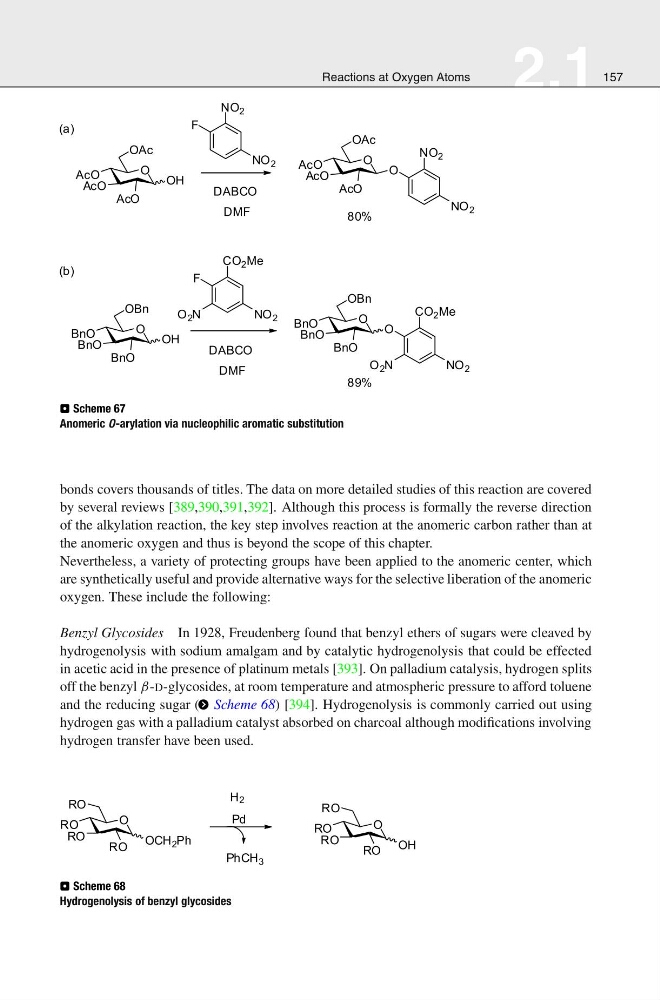
⊡ Scheme 67
Anomeric O-arylation via nucleophilic aromatic substitution
bonds covers thousands of titles. The data on more detailed studies of this reaction are covered
by several reviews [389,390,391,392]. Although this process is formally the reverse direction
of the alkylation reaction, the key step involves reaction at the anomeric carbon rather than at
the anomeric oxygen and thus is beyond the scope of this chapter.
Nevertheless, a variety of protecting groups have been applied to the anomeric center, which
are synthetically useful and provide alternative ways for the selective liberation of the anomeric
oxygen. These include the following:
Benzyl Glycosides In 1928, Freudenberg found that benzyl ethers of sugars were cleaved by
hydrogenolysis with sodium amalgam and by catalytic hydrogenolysis that could be effected
in acetic acid in the presence of platinum metals [393]. On palladium catalysis, hydrogen splits
off the benzyl β-D-glycosides, at room temperature and atmospheric pressure to afford toluene
and the reducing sugar ( > Scheme 68) [394]. Hydrogenolysis is commonly carried out using
hydrogen gas with a palladium catalyst absorbed on charcoal although modifications involving
hydrogen transfer have been used.
⊡ Scheme 68
Hydrogenolysis of benzyl glycosides
2.1
157
⊡ Scheme 67
Anomeric O-arylation via nucleophilic aromatic substitution
bonds covers thousands of titles. The data on more detailed studies of this reaction are covered
by several reviews [389,390,391,392]. Although this process is formally the reverse direction
of the alkylation reaction, the key step involves reaction at the anomeric carbon rather than at
the anomeric oxygen and thus is beyond the scope of this chapter.
Nevertheless, a variety of protecting groups have been applied to the anomeric center, which
are synthetically useful and provide alternative ways for the selective liberation of the anomeric
oxygen. These include the following:
Benzyl Glycosides In 1928, Freudenberg found that benzyl ethers of sugars were cleaved by
hydrogenolysis with sodium amalgam and by catalytic hydrogenolysis that could be effected
in acetic acid in the presence of platinum metals [393]. On palladium catalysis, hydrogen splits
off the benzyl β-D-glycosides, at room temperature and atmospheric pressure to afford toluene
and the reducing sugar ( > Scheme 68) [394]. Hydrogenolysis is commonly carried out using
hydrogen gas with a palladium catalyst absorbed on charcoal although modifications involving
hydrogen transfer have been used.
⊡ Scheme 68
Hydrogenolysis of benzyl glycosides