

154
2
General Synthetic Methods
3.1.1 Anomeric O-Alkylation and O-Arylation
The 1-O-alkylation of carbohydrates with simple alkylating agents, particularly methyl iodide
and dimethyl sulfate, has long been known [370,371,372]. The reactivity of pyranoses and
furanoses deprotonated at O-1 is, thus, analogous to that of alkoxides. Alkylation of fully
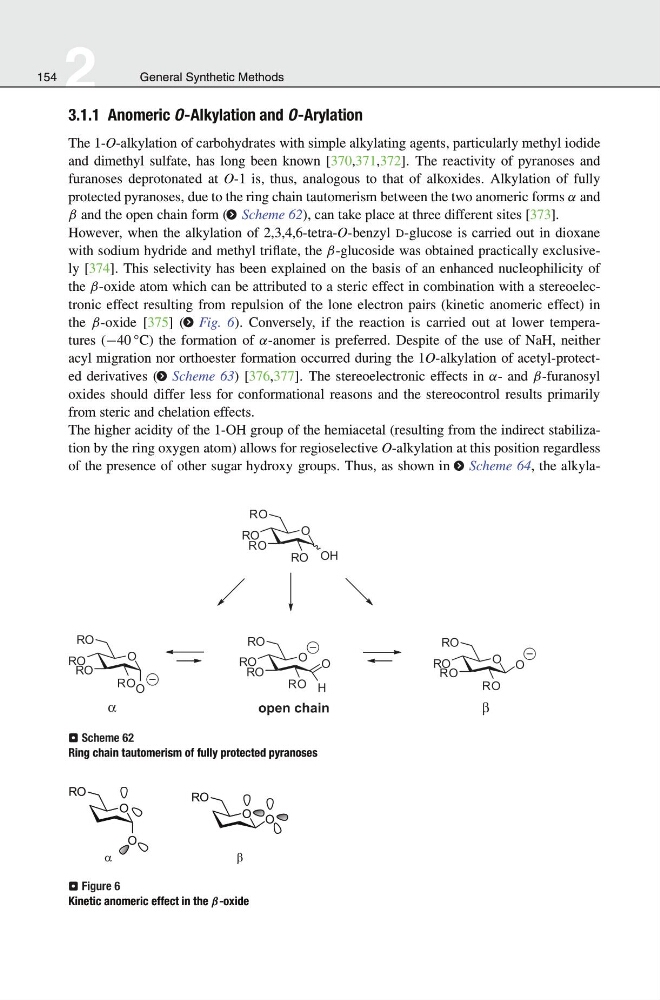
protected pyranoses, due to the ring chain tautomerism between the two anomeric forms α and
β and the open chain form ( > Scheme 62), can take place at three different sites [373].
However, when the alkylation of 2,3,4,6-tetra-O-benzyl D-glucose is carried out in dioxane
with sodium hydride and methyl triflate, the β-glucoside was obtained practically exclusively [374]. This selectivity has been explained on the basis of an enhanced nucleophilicity of
the β-oxide atom which can be attributed to a steric effect in combination with a stereoelectronic effect resulting from repulsion of the lone electron pairs (kinetic anomeric effect) in
the β-oxide [375] ( > Fig. 6). Conversely, if the reaction is carried out at lower temperatures (−40 °C) the formation of α-anomer is preferred. Despite of the use of NaH, neither
acyl migration nor orthoester formation occurred during the 1O-alkylation of acetyl-protected derivatives ( > Scheme 63) [376,377]. The stereoelectronic effects in α- and β-furanosyl
oxides should differ less for conformational reasons and the stereocontrol results primarily
from steric and chelation effects.
The higher acidity of the 1-OH group of the hemiacetal (resulting from the indirect stabilization by the ring oxygen atom) allows for regioselective O-alkylation at this position regardless
of the presence of other sugar hydroxy groups. Thus, as shown in > Scheme 64, the alkyla⊡ Scheme 62
Ring chain tautomerism of fully protected pyranoses
⊡ Figure 6
Kinetic anomeric effect in the β-oxide
2
General Synthetic Methods
3.1.1 Anomeric O-Alkylation and O-Arylation
The 1-O-alkylation of carbohydrates with simple alkylating agents, particularly methyl iodide
and dimethyl sulfate, has long been known [370,371,372]. The reactivity of pyranoses and
furanoses deprotonated at O-1 is, thus, analogous to that of alkoxides. Alkylation of fully
protected pyranoses, due to the ring chain tautomerism between the two anomeric forms α and
β and the open chain form ( > Scheme 62), can take place at three different sites [373].
However, when the alkylation of 2,3,4,6-tetra-O-benzyl D-glucose is carried out in dioxane
with sodium hydride and methyl triflate, the β-glucoside was obtained practically exclusively [374]. This selectivity has been explained on the basis of an enhanced nucleophilicity of
the β-oxide atom which can be attributed to a steric effect in combination with a stereoelectronic effect resulting from repulsion of the lone electron pairs (kinetic anomeric effect) in
the β-oxide [375] ( > Fig. 6). Conversely, if the reaction is carried out at lower temperatures (−40 °C) the formation of α-anomer is preferred. Despite of the use of NaH, neither
acyl migration nor orthoester formation occurred during the 1O-alkylation of acetyl-protected derivatives ( > Scheme 63) [376,377]. The stereoelectronic effects in α- and β-furanosyl
oxides should differ less for conformational reasons and the stereocontrol results primarily
from steric and chelation effects.
The higher acidity of the 1-OH group of the hemiacetal (resulting from the indirect stabilization by the ring oxygen atom) allows for regioselective O-alkylation at this position regardless
of the presence of other sugar hydroxy groups. Thus, as shown in > Scheme 64, the alkyla⊡ Scheme 62
Ring chain tautomerism of fully protected pyranoses
⊡ Figure 6
Kinetic anomeric effect in the β-oxide