

Reactions at Oxygen Atoms
2.1
149
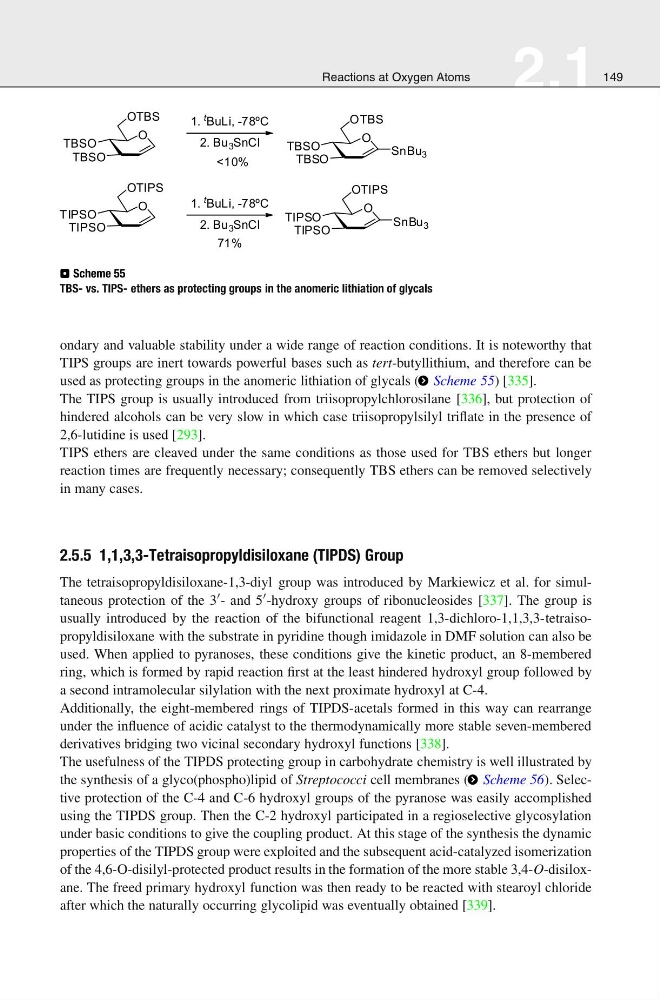
⊡ Scheme 55
TBS- vs. TIPS- ethers as protecting groups in the anomeric lithiation of glycals
ondary and valuable stability under a wide range of reaction conditions. It is noteworthy that
TIPS groups are inert towards powerful bases such as tert-butyllithium, and therefore can be
used as protecting groups in the anomeric lithiation of glycals ( > Scheme 55) [335].
The TIPS group is usually introduced from triisopropylchlorosilane [336], but protection of
hindered alcohols can be very slow in which case triisopropylsilyl triflate in the presence of
2,6-lutidine is used [293].
TIPS ethers are cleaved under the same conditions as those used for TBS ethers but longer
reaction times are frequently necessary; consequently TBS ethers can be removed selectively
in many cases.
2.5.5 1,1,3,3-Tetraisopropyldisiloxane (TIPDS) Group
The tetraisopropyldisiloxane-1,3-diyl group was introduced by Markiewicz et al. for simultaneous protection of the 3 - and 5 -hydroxy groups of ribonucleosides [337]. The group is
usually introduced by the reaction of the bifunctional reagent 1,3-dichloro-1,1,3,3-tetraisopropyldisiloxane with the substrate in pyridine though imidazole in DMF solution can also be
used. When applied to pyranoses, these conditions give the kinetic product, an 8-membered
ring, which is formed by rapid reaction first at the least hindered hydroxyl group followed by
a second intramolecular silylation with the next proximate hydroxyl at C-4.
Additionally, the eight-membered rings of TIPDS-acetals formed in this way can rearrange
under the influence of acidic catalyst to the thermodynamically more stable seven-membered
derivatives bridging two vicinal secondary hydroxyl functions [338].
The usefulness of the TIPDS protecting group in carbohydrate chemistry is well illustrated by
the synthesis of a glyco(phospho)lipid of Streptococci cell membranes ( > Scheme 56). Selective protection of the C-4 and C-6 hydroxyl groups of the pyranose was easily accomplished
using the TIPDS group. Then the C-2 hydroxyl participated in a regioselective glycosylation
under basic conditions to give the coupling product. At this stage of the synthesis the dynamic
properties of the TIPDS group were exploited and the subsequent acid-catalyzed isomerization
of the 4,6-O-disilyl-protected product results in the formation of the more stable 3,4-O-disiloxane. The freed primary hydroxyl function was then ready to be reacted with stearoyl chloride
after which the naturally occurring glycolipid was eventually obtained [339].
2.1
149
⊡ Scheme 55
TBS- vs. TIPS- ethers as protecting groups in the anomeric lithiation of glycals
ondary and valuable stability under a wide range of reaction conditions. It is noteworthy that
TIPS groups are inert towards powerful bases such as tert-butyllithium, and therefore can be
used as protecting groups in the anomeric lithiation of glycals ( > Scheme 55) [335].
The TIPS group is usually introduced from triisopropylchlorosilane [336], but protection of
hindered alcohols can be very slow in which case triisopropylsilyl triflate in the presence of
2,6-lutidine is used [293].
TIPS ethers are cleaved under the same conditions as those used for TBS ethers but longer
reaction times are frequently necessary; consequently TBS ethers can be removed selectively
in many cases.
2.5.5 1,1,3,3-Tetraisopropyldisiloxane (TIPDS) Group
The tetraisopropyldisiloxane-1,3-diyl group was introduced by Markiewicz et al. for simultaneous protection of the 3 - and 5 -hydroxy groups of ribonucleosides [337]. The group is
usually introduced by the reaction of the bifunctional reagent 1,3-dichloro-1,1,3,3-tetraisopropyldisiloxane with the substrate in pyridine though imidazole in DMF solution can also be
used. When applied to pyranoses, these conditions give the kinetic product, an 8-membered
ring, which is formed by rapid reaction first at the least hindered hydroxyl group followed by
a second intramolecular silylation with the next proximate hydroxyl at C-4.
Additionally, the eight-membered rings of TIPDS-acetals formed in this way can rearrange
under the influence of acidic catalyst to the thermodynamically more stable seven-membered
derivatives bridging two vicinal secondary hydroxyl functions [338].
The usefulness of the TIPDS protecting group in carbohydrate chemistry is well illustrated by
the synthesis of a glyco(phospho)lipid of Streptococci cell membranes ( > Scheme 56). Selective protection of the C-4 and C-6 hydroxyl groups of the pyranose was easily accomplished
using the TIPDS group. Then the C-2 hydroxyl participated in a regioselective glycosylation
under basic conditions to give the coupling product. At this stage of the synthesis the dynamic
properties of the TIPDS group were exploited and the subsequent acid-catalyzed isomerization
of the 4,6-O-disilyl-protected product results in the formation of the more stable 3,4-O-disiloxane. The freed primary hydroxyl function was then ready to be reacted with stearoyl chloride
after which the naturally occurring glycolipid was eventually obtained [339].