

142
2
General Synthetic Methods
2.4.5 Fluoren-9-ylmethoxycarbonyl (Fmoc) Group
The Fmoc group is a well-established amino-protecting group [277] often used in peptide
synthesis, but only recently has been recognized as a temporary hydroxyl protecting group for
oligosaccharide synthesis [277,278,279,280].
The Fmoc group is readily introduced under standard conditions using FmocCl and a catalytic
amount of DMAP in pyridine. The resulting carbonates are exceptionally stable under acidic
conditions and therefore survive glycosylation reactions.
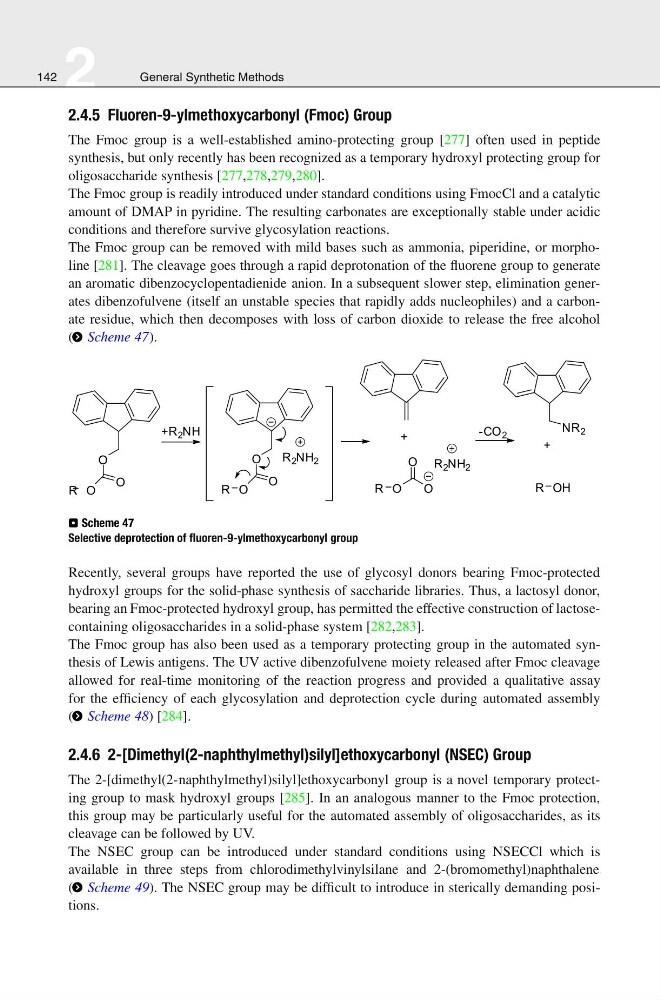
The Fmoc group can be removed with mild bases such as ammonia, piperidine, or morpholine [281]. The cleavage goes through a rapid deprotonation of the fluorene group to generate
an aromatic dibenzocyclopentadienide anion. In a subsequent slower step, elimination generates dibenzofulvene (itself an unstable species that rapidly adds nucleophiles) and a carbonate residue, which then decomposes with loss of carbon dioxide to release the free alcohol
( > Scheme 47).
⊡ Scheme 47
Selective deprotection of fluoren-9-ylmethoxycarbonyl group
Recently, several groups have reported the use of glycosyl donors bearing Fmoc-protected
hydroxyl groups for the solid-phase synthesis of saccharide libraries. Thus, a lactosyl donor,
bearing an Fmoc-protected hydroxyl group, has permitted the effective construction of lactosecontaining oligosaccharides in a solid-phase system [282,283].
The Fmoc group has also been used as a temporary protecting group in the automated synthesis of Lewis antigens. The UV active dibenzofulvene moiety released after Fmoc cleavage
allowed for real-time monitoring of the reaction progress and provided a qualitative assay
for the efficiency of each glycosylation and deprotection cycle during automated assembly
( > Scheme 48) [284].
2.4.6 2-[Dimethyl(2-naphthylmethyl)silyl]ethoxycarbonyl (NSEC) Group
The 2-[dimethyl(2-naphthylmethyl)silyl]ethoxycarbonyl group is a novel temporary protecting group to mask hydroxyl groups [285]. In an analogous manner to the Fmoc protection,
this group may be particularly useful for the automated assembly of oligosaccharides, as its
cleavage can be followed by UV.
The NSEC group can be introduced under standard conditions using NSECCl which is
available in three steps from chlorodimethylvinylsilane and 2-(bromomethyl)naphthalene
( > Scheme 49). The NSEC group may be difficult to introduce in sterically demanding positions.
2
General Synthetic Methods
2.4.5 Fluoren-9-ylmethoxycarbonyl (Fmoc) Group
The Fmoc group is a well-established amino-protecting group [277] often used in peptide
synthesis, but only recently has been recognized as a temporary hydroxyl protecting group for
oligosaccharide synthesis [277,278,279,280].
The Fmoc group is readily introduced under standard conditions using FmocCl and a catalytic
amount of DMAP in pyridine. The resulting carbonates are exceptionally stable under acidic
conditions and therefore survive glycosylation reactions.
The Fmoc group can be removed with mild bases such as ammonia, piperidine, or morpholine [281]. The cleavage goes through a rapid deprotonation of the fluorene group to generate
an aromatic dibenzocyclopentadienide anion. In a subsequent slower step, elimination generates dibenzofulvene (itself an unstable species that rapidly adds nucleophiles) and a carbonate residue, which then decomposes with loss of carbon dioxide to release the free alcohol
( > Scheme 47).
⊡ Scheme 47
Selective deprotection of fluoren-9-ylmethoxycarbonyl group
Recently, several groups have reported the use of glycosyl donors bearing Fmoc-protected
hydroxyl groups for the solid-phase synthesis of saccharide libraries. Thus, a lactosyl donor,
bearing an Fmoc-protected hydroxyl group, has permitted the effective construction of lactosecontaining oligosaccharides in a solid-phase system [282,283].
The Fmoc group has also been used as a temporary protecting group in the automated synthesis of Lewis antigens. The UV active dibenzofulvene moiety released after Fmoc cleavage
allowed for real-time monitoring of the reaction progress and provided a qualitative assay
for the efficiency of each glycosylation and deprotection cycle during automated assembly
( > Scheme 48) [284].
2.4.6 2-[Dimethyl(2-naphthylmethyl)silyl]ethoxycarbonyl (NSEC) Group
The 2-[dimethyl(2-naphthylmethyl)silyl]ethoxycarbonyl group is a novel temporary protecting group to mask hydroxyl groups [285]. In an analogous manner to the Fmoc protection,
this group may be particularly useful for the automated assembly of oligosaccharides, as its
cleavage can be followed by UV.
The NSEC group can be introduced under standard conditions using NSECCl which is
available in three steps from chlorodimethylvinylsilane and 2-(bromomethyl)naphthalene
( > Scheme 49). The NSEC group may be difficult to introduce in sterically demanding positions.