

General Properties, Occurrence, and Preparation
1.2
85
10.2 Pathogenic Bacterial Capsular Polysaccharides
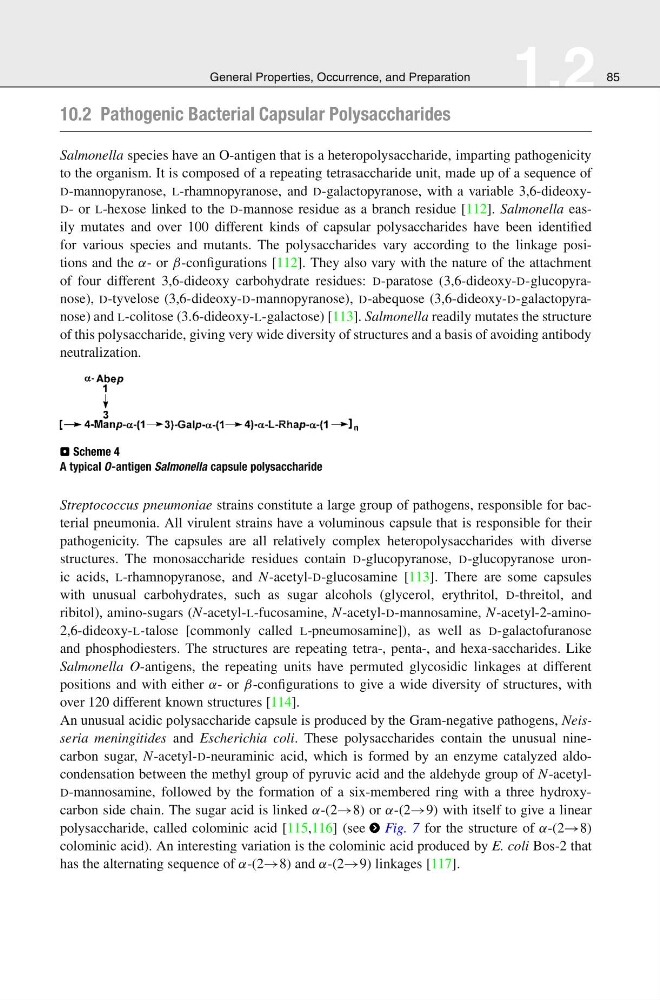
Salmonella species have an O-antigen that is a heteropolysaccharide, imparting pathogenicity
to the organism. It is composed of a repeating tetrasaccharide unit, made up of a sequence of
D-mannopyranose, L-rhamnopyranose, and D-galactopyranose, with a variable 3,6-dideoxyD- or L-hexose linked to the D-mannose residue as a branch residue [112]. Salmonella easily mutates and over 100 different kinds of capsular polysaccharides have been identified
for various species and mutants. The polysaccharides vary according to the linkage positions and the α- or β-configurations [112]. They also vary with the nature of the attachment
of four different 3,6-dideoxy carbohydrate residues: D-paratose (3,6-dideoxy-D-glucopyranose), D-tyvelose (3,6-dideoxy-D-mannopyranose), D-abequose (3,6-dideoxy-D-galactopyranose) and L-colitose (3.6-dideoxy-L-galactose) [113]. Salmonella readily mutates the structure
of this polysaccharide, giving very wide diversity of structures and a basis of avoiding antibody
neutralization.
⊡ Scheme 4
A typical O-antigen Salmonella capsule polysaccharide
Streptococcus pneumoniae strains constitute a large group of pathogens, responsible for bacterial pneumonia. All virulent strains have a voluminous capsule that is responsible for their
pathogenicity. The capsules are all relatively complex heteropolysaccharides with diverse
structures. The monosaccharide residues contain D-glucopyranose, D-glucopyranose uronic acids, L-rhamnopyranose, and N-acetyl-D-glucosamine [113]. There are some capsules
with unusual carbohydrates, such as sugar alcohols (glycerol, erythritol, D-threitol, and
ribitol), amino-sugars (N-acetyl-L-fucosamine, N-acetyl-D-mannosamine, N-acetyl-2-amino2,6-dideoxy-L-talose [commonly called L-pneumosamine]), as well as D-galactofuranose
and phosphodiesters. The structures are repeating tetra-, penta-, and hexa-saccharides. Like
Salmonella O-antigens, the repeating units have permuted glycosidic linkages at different
positions and with either α- or β-configurations to give a wide diversity of structures, with
over 120 different known structures [114].
An unusual acidic polysaccharide capsule is produced by the Gram-negative pathogens, Neisseria meningitides and Escherichia coli. These polysaccharides contain the unusual ninecarbon sugar, N-acetyl-D-neuraminic acid, which is formed by an enzyme catalyzed aldocondensation between the methyl group of pyruvic acid and the aldehyde group of N-acetylD-mannosamine, followed by the formation of a six-membered ring with a three hydroxycarbon side chain. The sugar acid is linked α-(2→8) or α-(2→9) with itself to give a linear
polysaccharide, called colominic acid [115,116] (see > Fig. 7 for the structure of α-(2→8)
colominic acid). An interesting variation is the colominic acid produced by E. coli Bos-2 that
has the alternating sequence of α-(2→8) and α-(2→9) linkages [117].
1.2
85
10.2 Pathogenic Bacterial Capsular Polysaccharides
Salmonella species have an O-antigen that is a heteropolysaccharide, imparting pathogenicity
to the organism. It is composed of a repeating tetrasaccharide unit, made up of a sequence of
D-mannopyranose, L-rhamnopyranose, and D-galactopyranose, with a variable 3,6-dideoxyD- or L-hexose linked to the D-mannose residue as a branch residue [112]. Salmonella easily mutates and over 100 different kinds of capsular polysaccharides have been identified
for various species and mutants. The polysaccharides vary according to the linkage positions and the α- or β-configurations [112]. They also vary with the nature of the attachment
of four different 3,6-dideoxy carbohydrate residues: D-paratose (3,6-dideoxy-D-glucopyranose), D-tyvelose (3,6-dideoxy-D-mannopyranose), D-abequose (3,6-dideoxy-D-galactopyranose) and L-colitose (3.6-dideoxy-L-galactose) [113]. Salmonella readily mutates the structure
of this polysaccharide, giving very wide diversity of structures and a basis of avoiding antibody
neutralization.
⊡ Scheme 4
A typical O-antigen Salmonella capsule polysaccharide
Streptococcus pneumoniae strains constitute a large group of pathogens, responsible for bacterial pneumonia. All virulent strains have a voluminous capsule that is responsible for their
pathogenicity. The capsules are all relatively complex heteropolysaccharides with diverse
structures. The monosaccharide residues contain D-glucopyranose, D-glucopyranose uronic acids, L-rhamnopyranose, and N-acetyl-D-glucosamine [113]. There are some capsules
with unusual carbohydrates, such as sugar alcohols (glycerol, erythritol, D-threitol, and
ribitol), amino-sugars (N-acetyl-L-fucosamine, N-acetyl-D-mannosamine, N-acetyl-2-amino2,6-dideoxy-L-talose [commonly called L-pneumosamine]), as well as D-galactofuranose
and phosphodiesters. The structures are repeating tetra-, penta-, and hexa-saccharides. Like
Salmonella O-antigens, the repeating units have permuted glycosidic linkages at different
positions and with either α- or β-configurations to give a wide diversity of structures, with
over 120 different known structures [114].
An unusual acidic polysaccharide capsule is produced by the Gram-negative pathogens, Neisseria meningitides and Escherichia coli. These polysaccharides contain the unusual ninecarbon sugar, N-acetyl-D-neuraminic acid, which is formed by an enzyme catalyzed aldocondensation between the methyl group of pyruvic acid and the aldehyde group of N-acetylD-mannosamine, followed by the formation of a six-membered ring with a three hydroxycarbon side chain. The sugar acid is linked α-(2→8) or α-(2→9) with itself to give a linear
polysaccharide, called colominic acid [115,116] (see > Fig. 7 for the structure of α-(2→8)
colominic acid). An interesting variation is the colominic acid produced by E. coli Bos-2 that
has the alternating sequence of α-(2→8) and α-(2→9) linkages [117].