

General Properties, Occurrence, and Preparation
1.2
83
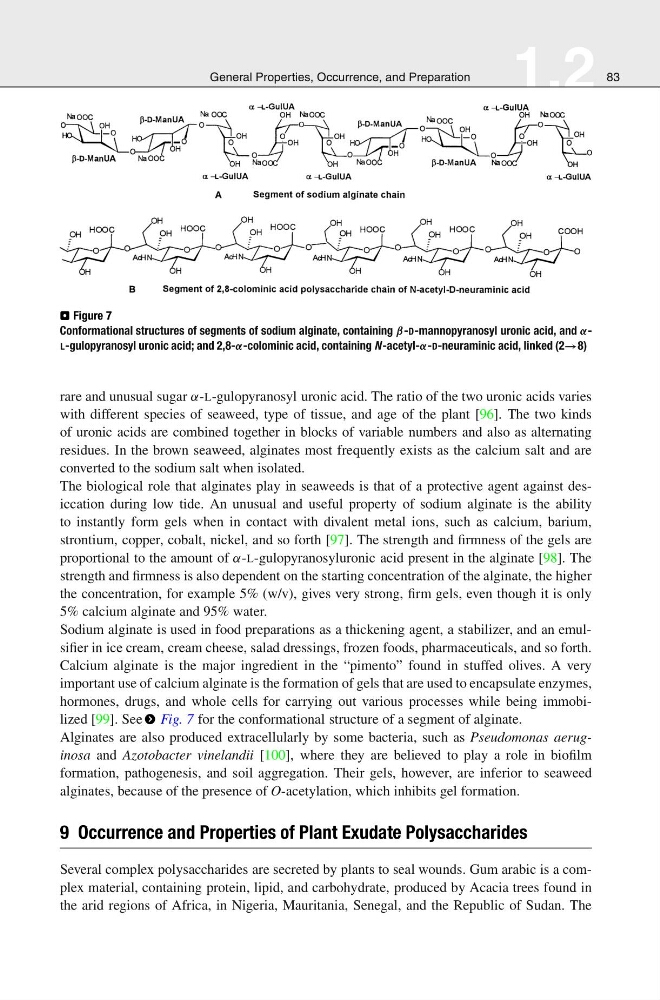
⊡ Figure 7
Conformational structures of segments of sodium alginate, containing β-D-mannopyranosyl uronic acid, and αL-gulopyranosyl uronic acid; and 2,8-α-colominic acid, containing N -acetyl-α-D-neuraminic acid, linked (2→8)
rare and unusual sugar α-L-gulopyranosyl uronic acid. The ratio of the two uronic acids varies
with different species of seaweed, type of tissue, and age of the plant [96]. The two kinds
of uronic acids are combined together in blocks of variable numbers and also as alternating
residues. In the brown seaweed, alginates most frequently exists as the calcium salt and are
converted to the sodium salt when isolated.
The biological role that alginates play in seaweeds is that of a protective agent against desiccation during low tide. An unusual and useful property of sodium alginate is the ability
to instantly form gels when in contact with divalent metal ions, such as calcium, barium,
strontium, copper, cobalt, nickel, and so forth [97]. The strength and firmness of the gels are
proportional to the amount of α-L-gulopyranosyluronic acid present in the alginate [98]. The
strength and firmness is also dependent on the starting concentration of the alginate, the higher
the concentration, for example 5% (w/v), gives very strong, firm gels, even though it is only
5% calcium alginate and 95% water.
Sodium alginate is used in food preparations as a thickening agent, a stabilizer, and an emulsifier in ice cream, cream cheese, salad dressings, frozen foods, pharmaceuticals, and so forth.
Calcium alginate is the major ingredient in the “pimento” found in stuffed olives. A very
important use of calcium alginate is the formation of gels that are used to encapsulate enzymes,
hormones, drugs, and whole cells for carrying out various processes while being immobilized [99]. See > Fig. 7 for the conformational structure of a segment of alginate.
Alginates are also produced extracellularly by some bacteria, such as Pseudomonas aeruginosa and Azotobacter vinelandii [100], where they are believed to play a role in biofilm
formation, pathogenesis, and soil aggregation. Their gels, however, are inferior to seaweed
alginates, because of the presence of O-acetylation, which inhibits gel formation.
9 Occurrence and Properties of Plant Exudate Polysaccharides
Several complex polysaccharides are secreted by plants to seal wounds. Gum arabic is a complex material, containing protein, lipid, and carbohydrate, produced by Acacia trees found in
the arid regions of Africa, in Nigeria, Mauritania, Senegal, and the Republic of Sudan. The
1.2
83
⊡ Figure 7
Conformational structures of segments of sodium alginate, containing β-D-mannopyranosyl uronic acid, and αL-gulopyranosyl uronic acid; and 2,8-α-colominic acid, containing N -acetyl-α-D-neuraminic acid, linked (2→8)
rare and unusual sugar α-L-gulopyranosyl uronic acid. The ratio of the two uronic acids varies
with different species of seaweed, type of tissue, and age of the plant [96]. The two kinds
of uronic acids are combined together in blocks of variable numbers and also as alternating
residues. In the brown seaweed, alginates most frequently exists as the calcium salt and are
converted to the sodium salt when isolated.
The biological role that alginates play in seaweeds is that of a protective agent against desiccation during low tide. An unusual and useful property of sodium alginate is the ability
to instantly form gels when in contact with divalent metal ions, such as calcium, barium,
strontium, copper, cobalt, nickel, and so forth [97]. The strength and firmness of the gels are
proportional to the amount of α-L-gulopyranosyluronic acid present in the alginate [98]. The
strength and firmness is also dependent on the starting concentration of the alginate, the higher
the concentration, for example 5% (w/v), gives very strong, firm gels, even though it is only
5% calcium alginate and 95% water.
Sodium alginate is used in food preparations as a thickening agent, a stabilizer, and an emulsifier in ice cream, cream cheese, salad dressings, frozen foods, pharmaceuticals, and so forth.
Calcium alginate is the major ingredient in the “pimento” found in stuffed olives. A very
important use of calcium alginate is the formation of gels that are used to encapsulate enzymes,
hormones, drugs, and whole cells for carrying out various processes while being immobilized [99]. See > Fig. 7 for the conformational structure of a segment of alginate.
Alginates are also produced extracellularly by some bacteria, such as Pseudomonas aeruginosa and Azotobacter vinelandii [100], where they are believed to play a role in biofilm
formation, pathogenesis, and soil aggregation. Their gels, however, are inferior to seaweed
alginates, because of the presence of O-acetylation, which inhibits gel formation.
9 Occurrence and Properties of Plant Exudate Polysaccharides
Several complex polysaccharides are secreted by plants to seal wounds. Gum arabic is a complex material, containing protein, lipid, and carbohydrate, produced by Acacia trees found in
the arid regions of Africa, in Nigeria, Mauritania, Senegal, and the Republic of Sudan. The