

86
4. Finite Volume Methods
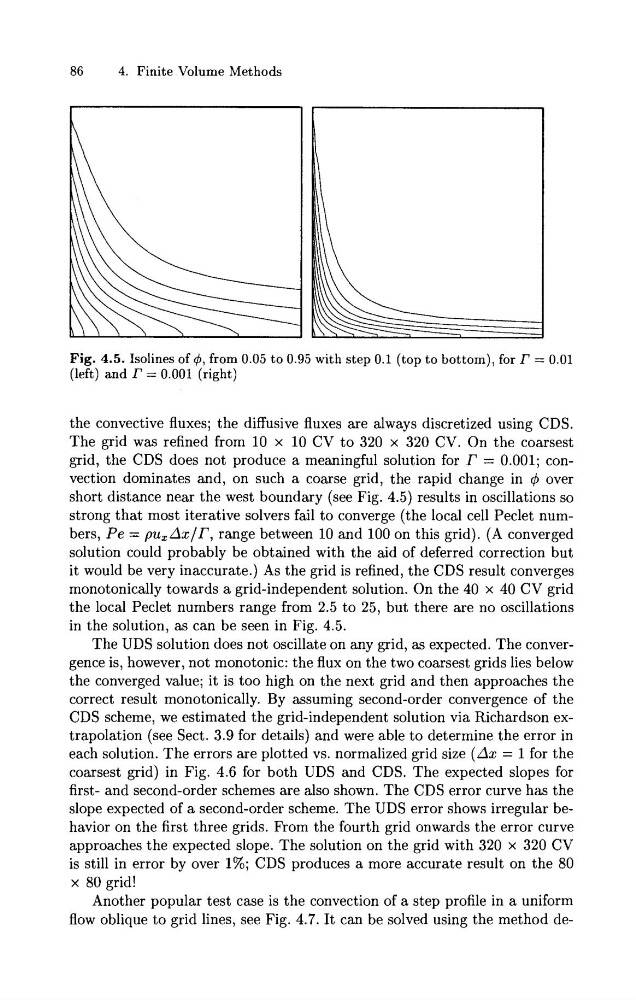
Fig. 4.5. Isolines of 4, from 0.05 to 0.95 with step 0.1 (top to bottom), for r = 0.01
(left) and r = 0.001 (right)
the convective fluxes; the diffusive fluxes are always discretized using CDS.
The grid was refined from 10 x 10 CV to 320 x 320 CV. On the coarsest
grid, the CDS does not produce a meaningful solution for r = 0.001; convection dominates and, on such a coarse grid, the rapid change in $ over
short distance near the west boundary (see Fig. 4.5) results in oscillations so
strong that most iterative solvers fail to converge (the local cell Peclet numbers, P e = pu,Ax/F, range between 10 and 100 on this grid). (A converged
solution could probably be obtained with the aid of deferred correction but
it would be very inaccurate.) As the grid is refined, the CDS result converges
monotonically towards a grid-independent solution. On the 40 x 40 CV grid
the local Peclet numbers range from 2.5 to 25, but there are no oscillations
in the solution, as can be seen in Fig. 4.5.
The UDS solution does not oscillate on any grid, as expected. The convergence is, however, not monotonic: the flux on the two coarsest grids lies below
the converged value; it is too high on the next grid and then approaches the
correct result monotonically. By assuming second-order convergence of the
CDS scheme, we estimated the grid-independent solution via Richardson extrapolation (see Sect. 3.9 for details) and were able to determine the error in
each solution. The errors are plotted vs. normalized grid size (Ax = 1 for the
coarsest grid) in Fig. 4.6 for both UDS and CDS. The expected slopes for
first- and second-order schemes are also shown. The CDS error curve has the
slope expected of a second-order scheme. The UDS error shows irregular behavior on the first three grids. From the fourth grid onwards the error curve
approaches the expected slope. The solution on the grid with 320 x 320 CV
is still in error by over 1%; CDS produces a more accurate result on the 80
x 80 grid!
Another popular test case is the convection of a step profile in a uniform
flow oblique to grid lines, see Fig. 4.7. It can be solved using the method de-
4. Finite Volume Methods
Fig. 4.5. Isolines of 4, from 0.05 to 0.95 with step 0.1 (top to bottom), for r = 0.01
(left) and r = 0.001 (right)
the convective fluxes; the diffusive fluxes are always discretized using CDS.
The grid was refined from 10 x 10 CV to 320 x 320 CV. On the coarsest
grid, the CDS does not produce a meaningful solution for r = 0.001; convection dominates and, on such a coarse grid, the rapid change in $ over
short distance near the west boundary (see Fig. 4.5) results in oscillations so
strong that most iterative solvers fail to converge (the local cell Peclet numbers, P e = pu,Ax/F, range between 10 and 100 on this grid). (A converged
solution could probably be obtained with the aid of deferred correction but
it would be very inaccurate.) As the grid is refined, the CDS result converges
monotonically towards a grid-independent solution. On the 40 x 40 CV grid
the local Peclet numbers range from 2.5 to 25, but there are no oscillations
in the solution, as can be seen in Fig. 4.5.
The UDS solution does not oscillate on any grid, as expected. The convergence is, however, not monotonic: the flux on the two coarsest grids lies below
the converged value; it is too high on the next grid and then approaches the
correct result monotonically. By assuming second-order convergence of the
CDS scheme, we estimated the grid-independent solution via Richardson extrapolation (see Sect. 3.9 for details) and were able to determine the error in
each solution. The errors are plotted vs. normalized grid size (Ax = 1 for the
coarsest grid) in Fig. 4.6 for both UDS and CDS. The expected slopes for
first- and second-order schemes are also shown. The CDS error curve has the
slope expected of a second-order scheme. The UDS error shows irregular behavior on the first three grids. From the fourth grid onwards the error curve
approaches the expected slope. The solution on the grid with 320 x 320 CV
is still in error by over 1%; CDS produces a more accurate result on the 80
x 80 grid!
Another popular test case is the convection of a step profile in a uniform
flow oblique to grid lines, see Fig. 4.7. It can be solved using the method de-