

4.4 Interpolation and Differentiation Practices
79
second-order accuracy (the accuracy of the quadrature approximation). Although the QUICK approximation is slightly more accurate than CDS, both
schemes converge asymptotically in a second-order manner and the differences are rarely large.
4.4.4 Higher-Order Schemes
Interpolation of order higher than third makes sense only if the integrals
are approximated using higher-order formulae. If one uses Simpson's rule in
2D for surface integrals, one has to interpolate with polynomials of at least
degree three, which leads to interpolation errors of fourth order. For example,
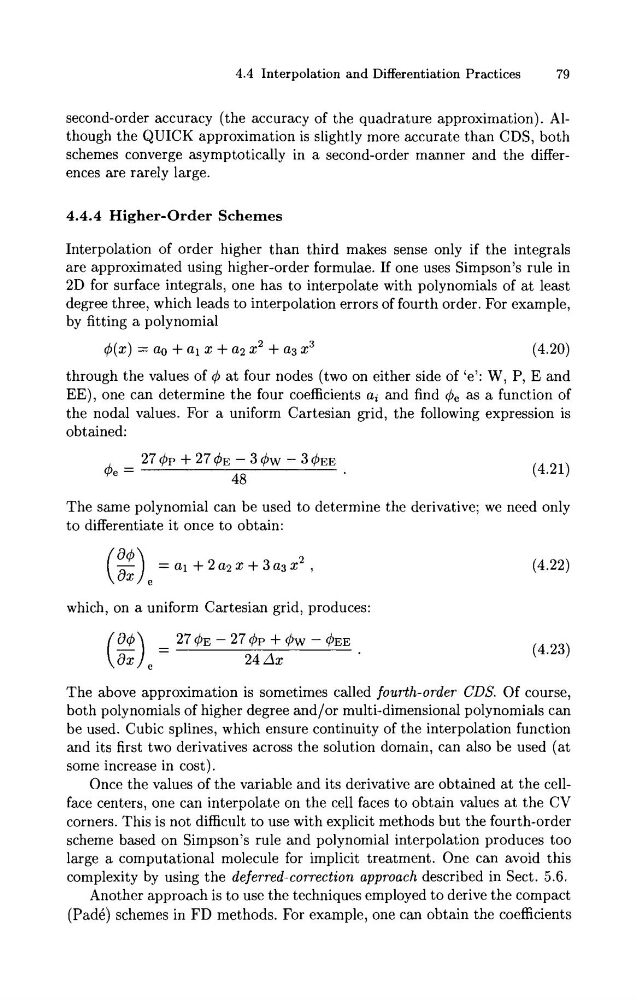
by fitting a polynomial
through the values of $ at four nodes (two on either side of 'e': W, P, E and
EE), one can determine the four coefficients ai and find 4, as a function of
the nodal values. For a uniform Cartesian grid, the following expression is
obtained:
The same polynomial can be used to determine the derivative; we need only
to differentiate it once to obtain:
which, on a uniform Cartesian grid, produces:
The above approximation is sometimes called fourth-order CDS. Of course,
both polynomials of higher degree and/or multi-dimensional polynomials can
be used. Cubic splines, which ensure continuity of the interpolation function
and its first two derivatives across the solution domain, can also be used (at
some increase in cost).
Once the values of the variable and its derivative are obtained at the cellface centers, one can interpolate on the cell faces to obtain values at the CV
corners. This is not difficult to use with explicit methods but the fourth-order
scheme based on Simpson's rule and polynomial interpolation produces too
large a computational molecule for implicit treatment. One can avoid this
complexity by using the deferred-correction approach described in Sect. 5.6.
Another approach is to use the techniques employed to derive the compact
(Pad6) schemes in FD methods. For example, one can obtain the coefficients
79
second-order accuracy (the accuracy of the quadrature approximation). Although the QUICK approximation is slightly more accurate than CDS, both
schemes converge asymptotically in a second-order manner and the differences are rarely large.
4.4.4 Higher-Order Schemes
Interpolation of order higher than third makes sense only if the integrals
are approximated using higher-order formulae. If one uses Simpson's rule in
2D for surface integrals, one has to interpolate with polynomials of at least
degree three, which leads to interpolation errors of fourth order. For example,
by fitting a polynomial
through the values of $ at four nodes (two on either side of 'e': W, P, E and
EE), one can determine the four coefficients ai and find 4, as a function of
the nodal values. For a uniform Cartesian grid, the following expression is
obtained:
The same polynomial can be used to determine the derivative; we need only
to differentiate it once to obtain:
which, on a uniform Cartesian grid, produces:
The above approximation is sometimes called fourth-order CDS. Of course,
both polynomials of higher degree and/or multi-dimensional polynomials can
be used. Cubic splines, which ensure continuity of the interpolation function
and its first two derivatives across the solution domain, can also be used (at
some increase in cost).
Once the values of the variable and its derivative are obtained at the cellface centers, one can interpolate on the cell faces to obtain values at the CV
corners. This is not difficult to use with explicit methods but the fourth-order
scheme based on Simpson's rule and polynomial interpolation produces too
large a computational molecule for implicit treatment. One can avoid this
complexity by using the deferred-correction approach described in Sect. 5.6.
Another approach is to use the techniques employed to derive the compact
(Pad6) schemes in FD methods. For example, one can obtain the coefficients