

66
3. Finite Difference Methods
The CDS contributions to the coefficients of Eq. (3.64) are:
The total coefficients are the sums of the convection and diffusion contributions, AC and Ad.
The values of 4 at boundary nodes are specified: = 40 and 4~ = q5L,
where N is the number of nodes including the two at the boundaries. This
means that, for the node at i = 2, the term
can be calculated and
added to Qz, the right hand side, and we set the coefficient A& in that
equation to zero. Analogously, we add the product A E - ~ ~ N
for the node
i = N - 1 to Q N - ~ and set the coefficient A;-'
= 0.
The resulting tridiagonal system is easily solved. We shall only discuss the
solutions here; the solver used to obtain them will be introduced in Chap. 5.
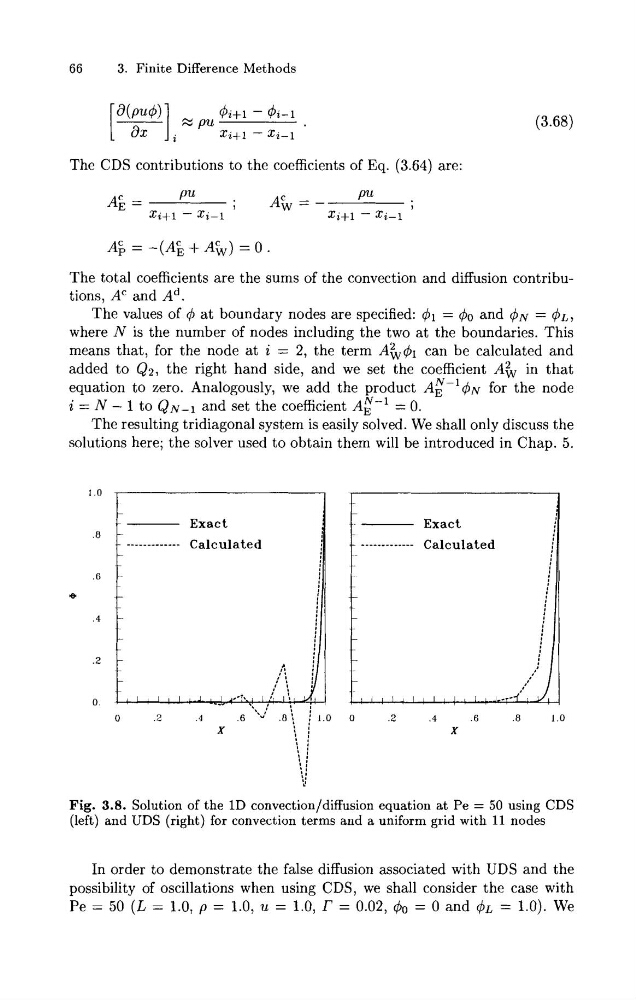
Fig. 3.8. Solution of the 1D convection/diffusion equation at Pe = 50 using CDS
(left) and UDS (right) for convection terms and a uniform grid with 11 nodes
In order to demonstrate the false diffusion associated with UDS and the
possibility of oscillations when using CDS, we shall consider the case with
P e = 50 ( L = l . O , p = 1.0, u = 1.0, r = 0.02, = Oand 4~ = 1.0). We
3. Finite Difference Methods
The CDS contributions to the coefficients of Eq. (3.64) are:
The total coefficients are the sums of the convection and diffusion contributions, AC and Ad.
The values of 4 at boundary nodes are specified: = 40 and 4~ = q5L,
where N is the number of nodes including the two at the boundaries. This
means that, for the node at i = 2, the term
can be calculated and
added to Qz, the right hand side, and we set the coefficient A& in that
equation to zero. Analogously, we add the product A E - ~ ~ N
for the node
i = N - 1 to Q N - ~ and set the coefficient A;-'
= 0.
The resulting tridiagonal system is easily solved. We shall only discuss the
solutions here; the solver used to obtain them will be introduced in Chap. 5.
Fig. 3.8. Solution of the 1D convection/diffusion equation at Pe = 50 using CDS
(left) and UDS (right) for convection terms and a uniform grid with 11 nodes
In order to demonstrate the false diffusion associated with UDS and the
possibility of oscillations when using CDS, we shall consider the case with
P e = 50 ( L = l . O , p = 1.0, u = 1.0, r = 0.02, = Oand 4~ = 1.0). We