

3.4 Approximation of the Second Derivative
49
(Axi)2h = (Axi)h + (Axi-l)h = (re + l)h(Axi-1)h .
When these are inserted in Eq. (3.24), taking into account Eq. (3.23), it
follows that the first-order truncation error of the CDS is reduced by a factor
when the grid is refined. This factor has the value 4 when re = 1, i.e. when
the grid is uniform. When re > 1 (expanding grid) or re < 1 (contracting
grid), this factor is r, > 4, which means that the error due to the first-order
term decreases faster than the second-order error term! Since, in this method,
re -+ 1 as the grid is refined, the convergence becomes asymptotically second
order. This will be demonstrated in the examples presented later.
A similar analysis can be performed for any scheme with the same conclusion: systematic refinement of non-uniform grids gives a rate of reduction
of truncation error that has the same order as for a uniform grid.
For a given number of grid points, smaller errors are almost always obtained with non-uniform spacing. This is their purpose. However, for the grid
to do its job, the user must know where smaller spacing is needed or an
automatic means of grid adaptation to the solution needs to be used. An
experienced user can identify regions that require fine grids; see Chap. 11
for a discussion of this issue. Methods which provide automatic error-guided
grid refinement will also be presented there. It should be emphasized that
grid generation becomes more difficult as the dimension of the problem is
increased. Indeed, the generation of effective grids remains one of the most
difficult problems in computational fluid dynamics.
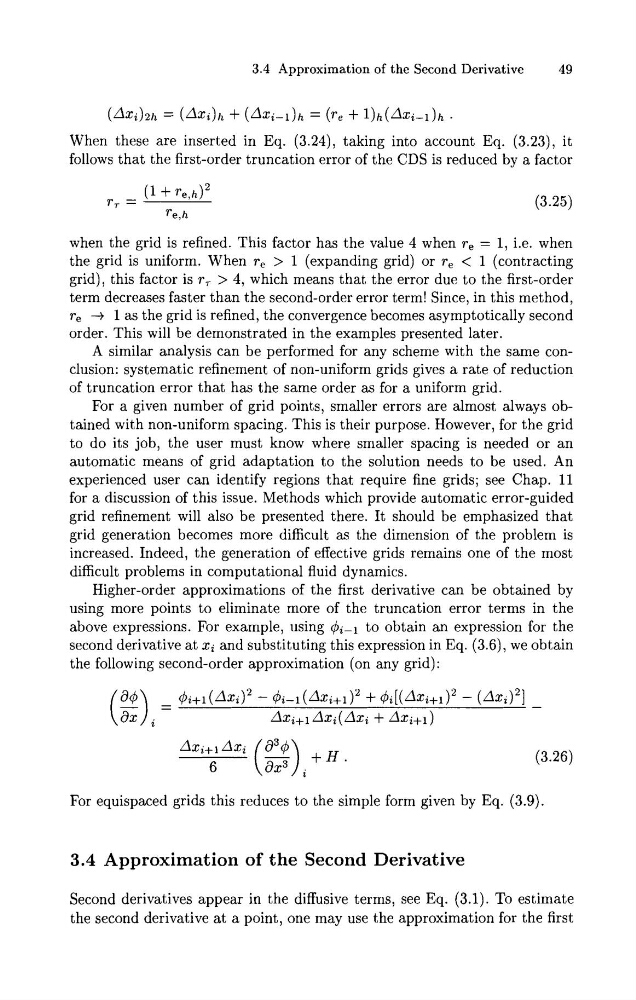
Higher-order approximations of the first derivative can be obtained by
using more points to eliminate more of the truncation error terms in the
above expressions. For example, using $i-l to obtain an expression for the
second derivative a t xi and substituting this expression in Eq. (3.6), we obtain
the following second-order approximation (on any grid):
For equispaced grids this reduces to the simple form given by Eq. (3.9).
3.4 Approximation of the Second Derivative
Second derivatives appear in the diffusive terms, see Eq. (3.1). To estimate
the second derivative a t a point, one may use the approximation for the first
49
(Axi)2h = (Axi)h + (Axi-l)h = (re + l)h(Axi-1)h .
When these are inserted in Eq. (3.24), taking into account Eq. (3.23), it
follows that the first-order truncation error of the CDS is reduced by a factor
when the grid is refined. This factor has the value 4 when re = 1, i.e. when
the grid is uniform. When re > 1 (expanding grid) or re < 1 (contracting
grid), this factor is r, > 4, which means that the error due to the first-order
term decreases faster than the second-order error term! Since, in this method,
re -+ 1 as the grid is refined, the convergence becomes asymptotically second
order. This will be demonstrated in the examples presented later.
A similar analysis can be performed for any scheme with the same conclusion: systematic refinement of non-uniform grids gives a rate of reduction
of truncation error that has the same order as for a uniform grid.
For a given number of grid points, smaller errors are almost always obtained with non-uniform spacing. This is their purpose. However, for the grid
to do its job, the user must know where smaller spacing is needed or an
automatic means of grid adaptation to the solution needs to be used. An
experienced user can identify regions that require fine grids; see Chap. 11
for a discussion of this issue. Methods which provide automatic error-guided
grid refinement will also be presented there. It should be emphasized that
grid generation becomes more difficult as the dimension of the problem is
increased. Indeed, the generation of effective grids remains one of the most
difficult problems in computational fluid dynamics.
Higher-order approximations of the first derivative can be obtained by
using more points to eliminate more of the truncation error terms in the
above expressions. For example, using $i-l to obtain an expression for the
second derivative a t xi and substituting this expression in Eq. (3.6), we obtain
the following second-order approximation (on any grid):
For equispaced grids this reduces to the simple form given by Eq. (3.9).
3.4 Approximation of the Second Derivative
Second derivatives appear in the diffusive terms, see Eq. (3.1). To estimate
the second derivative a t a point, one may use the approximation for the first