

46
3. Finite Difference Methods
so that
By writing Eq. (3.15) for x = xi, x = xi+l, and x = xi-1, and Eq. (3.16) for
x = xi+l and x = xi-1, we obtain after some rearrangement:
A polynomial of degree six can be used if the variable values at nodes i + 2 and
i - 2 are added and one of degree eight can be employed if the derivatives at
these two nodes are also used. An equation like Eq. (3.18) may be written at
each point. The complete set of equations is actually a tridiagonal system of
equations for the derivatives at the grid points. To compute the derivatives,
this system has to be solved.
A family of compact centered approximations of up to sixth order can be
written:
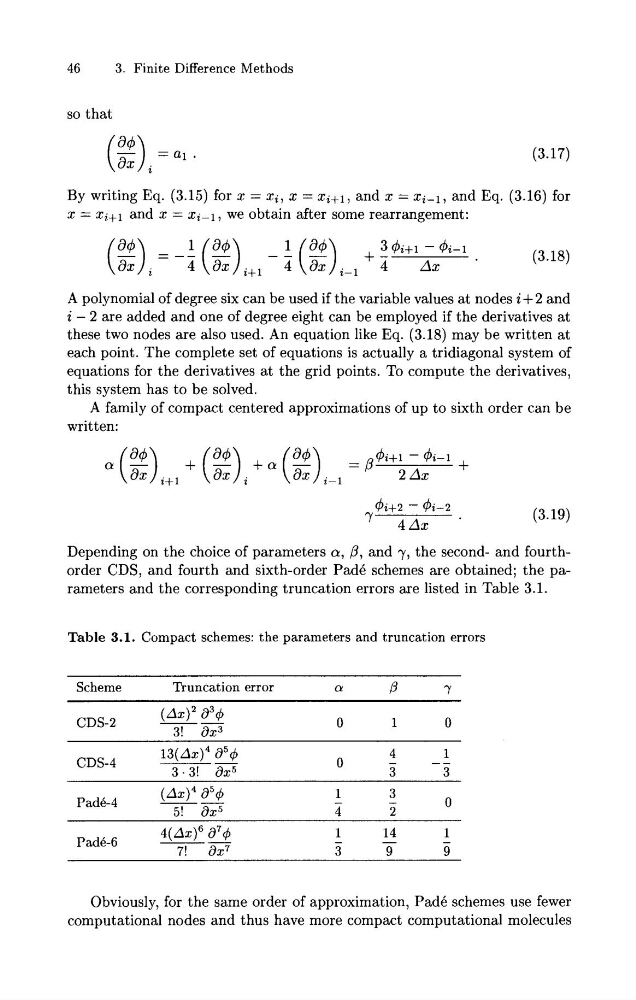
Depending on the choice of parameters a , P, and y, the second- and fourthorder CDS, and fourth and sixth-order Pad6 schemes are obtained; the parameters and the corresponding truncation errors are listed in Table 3.1.
Table 3.1. Compact schemes: the parameters and truncation errors
Scheme
Truncation error
(Y
P
Y
Obviously, for the same order of approximation, Pad6 schemes use fewer
computational nodes and thus have more compact computational molecules
3. Finite Difference Methods
so that
By writing Eq. (3.15) for x = xi, x = xi+l, and x = xi-1, and Eq. (3.16) for
x = xi+l and x = xi-1, we obtain after some rearrangement:
A polynomial of degree six can be used if the variable values at nodes i + 2 and
i - 2 are added and one of degree eight can be employed if the derivatives at
these two nodes are also used. An equation like Eq. (3.18) may be written at
each point. The complete set of equations is actually a tridiagonal system of
equations for the derivatives at the grid points. To compute the derivatives,
this system has to be solved.
A family of compact centered approximations of up to sixth order can be
written:
Depending on the choice of parameters a , P, and y, the second- and fourthorder CDS, and fourth and sixth-order Pad6 schemes are obtained; the parameters and the corresponding truncation errors are listed in Table 3.1.
Table 3.1. Compact schemes: the parameters and truncation errors
Scheme
Truncation error
(Y
P
Y
Obviously, for the same order of approximation, Pad6 schemes use fewer
computational nodes and thus have more compact computational molecules