

3.3 Approximation of the First Derivative
43
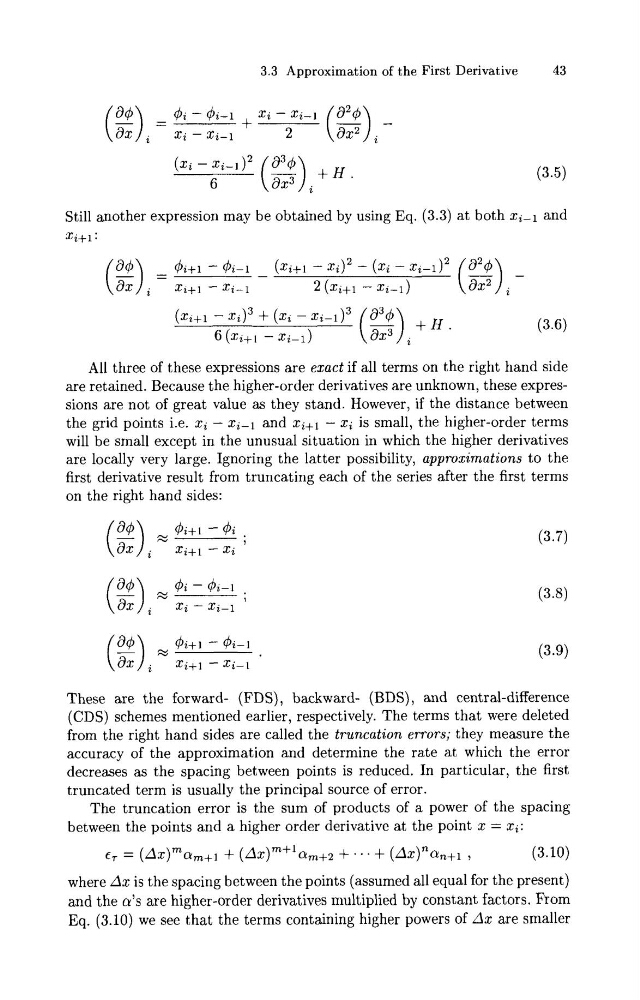
Still another expression may be obtained by using Eq, (3.3) at both xi-1 and
Xi+l:
All three of these expressions are exact if all terms on the right hand side
are retained. Because the higher-order derivatives are unknown, these expressions are not of great value as they stand. However, if the distance between
the grid points i.e. xi - xi-1 and xi+l - xi is small, the higher-order terms
will be small except in the unusual situation in which the higher derivatives
are locally very large. Ignoring the latter possibility, approximations to the
first derivative result from truncating each of the series after the first terms
on the right hand sides:
These are the forward- (FDS), backward- (BDS), and central-difference
(CDS) schemes mentioned earlier, respectively. The terms that were deleted
from the right hand sides are called the truncation errors; they measure the
accuracy of the approximation and determine the rate at which the error
decreases as the spacing between points is reduced. In particular, the first
truncated term is usually the principal source of error.
The truncation error is the sum of products of a power of the spacing
between the points and a higher order derivative at the point x = xi:
where Ax is the spacing between the points (assumed all equal for the present)
and the a's are higher-order derivatives multiplied by constant factors. From
Eq. (3.10) we see that the terms containing higher powers of Ax are smaller
43
Still another expression may be obtained by using Eq, (3.3) at both xi-1 and
Xi+l:
All three of these expressions are exact if all terms on the right hand side
are retained. Because the higher-order derivatives are unknown, these expressions are not of great value as they stand. However, if the distance between
the grid points i.e. xi - xi-1 and xi+l - xi is small, the higher-order terms
will be small except in the unusual situation in which the higher derivatives
are locally very large. Ignoring the latter possibility, approximations to the
first derivative result from truncating each of the series after the first terms
on the right hand sides:
These are the forward- (FDS), backward- (BDS), and central-difference
(CDS) schemes mentioned earlier, respectively. The terms that were deleted
from the right hand sides are called the truncation errors; they measure the
accuracy of the approximation and determine the rate at which the error
decreases as the spacing between points is reduced. In particular, the first
truncated term is usually the principal source of error.
The truncation error is the sum of products of a power of the spacing
between the points and a higher order derivative at the point x = xi:
where Ax is the spacing between the points (assumed all equal for the present)
and the a's are higher-order derivatives multiplied by constant factors. From
Eq. (3.10) we see that the terms containing higher powers of Ax are smaller