

2.4 Components of a Numerical Solution Method
29
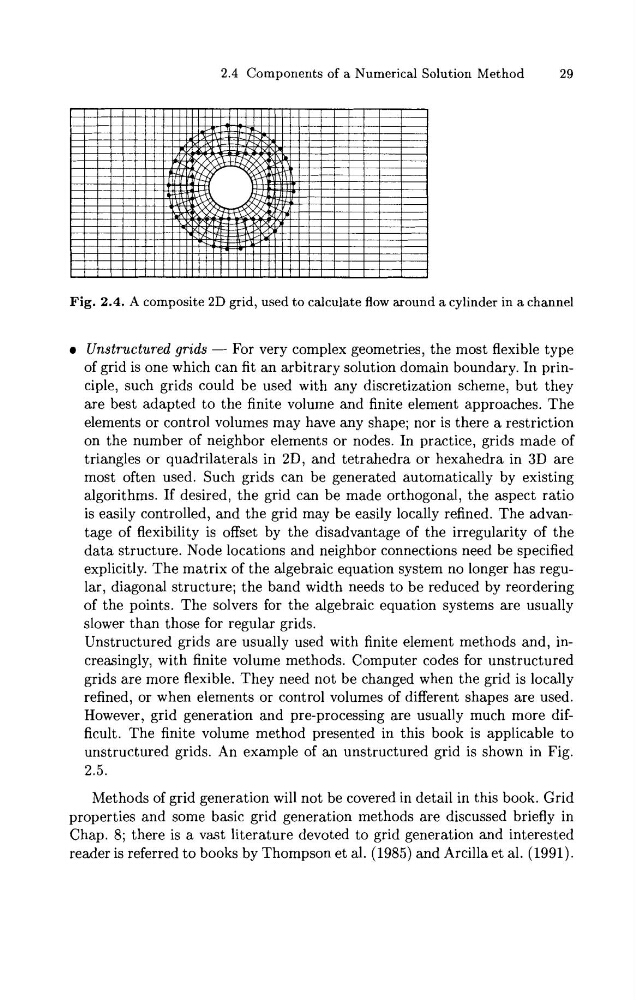
Fig. 2.4. A composite 2D grid, used to calculate flow around a cylinder in a channel
Unstructured grids - For very complex geometries, the most flexible type
of grid is one which can fit an arbitrary solution domain boundary. In principle, such grids could be used with any discretization scheme, but they
are best adapted to the finite volume and finite element approaches. The
elements or control volumes may have any shape; nor is there a restriction
on the number of neighbor elements or nodes. In practice, grids made of
triangles or quadrilaterals in 2D, and tetrahedra or hexahedra in 3D are
most often used. Such grids can be generated automatically by existing
algorithms. If desired, the grid can be made orthogonal, the aspect ratio
is easily controlled, and the grid may be easily locally refined. The advantage of flexibility is offset by the disadvantage of the irregularity of the
data structure. Node locations and neighbor connections need be specified
explicitly. The matrix of the algebraic equation system no longer has regular, diagonal structure; the band width needs to be reduced by reordering
of the points. The solvers for the algebraic equation systems are usually
slower than those for regular grids.
Unstructured grids are usually used with finite element methods and, increasingly, with finite volume methods. Computer codes for unstructured
grids are more flexible. They need not be changed when the grid is locally
refined, or when elements or control volumes of different shapes are used.
However, grid generation and pre-processing are usually much more difficult. The finite volume method presented in this book is applicable to
unstructured grids. An example of an unstructured grid is shown in Fig.
2.5.
Methods of grid generation will not be covered in detail in this book. Grid
properties and some basic grid generation methods are discussed briefly in
Chap. 8; there is a vast literature devoted to grid generation and interested
reader is referred to books by Thompson et al. (1985) and Arcilla et al. (1991).
29
Fig. 2.4. A composite 2D grid, used to calculate flow around a cylinder in a channel
Unstructured grids - For very complex geometries, the most flexible type
of grid is one which can fit an arbitrary solution domain boundary. In principle, such grids could be used with any discretization scheme, but they
are best adapted to the finite volume and finite element approaches. The
elements or control volumes may have any shape; nor is there a restriction
on the number of neighbor elements or nodes. In practice, grids made of
triangles or quadrilaterals in 2D, and tetrahedra or hexahedra in 3D are
most often used. Such grids can be generated automatically by existing
algorithms. If desired, the grid can be made orthogonal, the aspect ratio
is easily controlled, and the grid may be easily locally refined. The advantage of flexibility is offset by the disadvantage of the irregularity of the
data structure. Node locations and neighbor connections need be specified
explicitly. The matrix of the algebraic equation system no longer has regular, diagonal structure; the band width needs to be reduced by reordering
of the points. The solvers for the algebraic equation systems are usually
slower than those for regular grids.
Unstructured grids are usually used with finite element methods and, increasingly, with finite volume methods. Computer codes for unstructured
grids are more flexible. They need not be changed when the grid is locally
refined, or when elements or control volumes of different shapes are used.
However, grid generation and pre-processing are usually much more difficult. The finite volume method presented in this book is applicable to
unstructured grids. An example of an unstructured grid is shown in Fig.
2.5.
Methods of grid generation will not be covered in detail in this book. Grid
properties and some basic grid generation methods are discussed briefly in
Chap. 8; there is a vast literature devoted to grid generation and interested
reader is referred to books by Thompson et al. (1985) and Arcilla et al. (1991).