

12.8 Combustion
403
of Spalding (1978). Models of this type are in common use for the prediction
of the performance of industrial furnaces.
Another type of model for non-premixed combustion is the laminar
flamelet model. Under stagnant conditions, a non-premixed flame would
slowly decay as its thickness increases with time. To prevent this from happening, there must be a compressive strain on the flame. The state of the
flame is determined by this strain rate or, its more commonly used surrogate,
the rate of scalar dissipation, X . Then it is assumed that the local structure
of a flame is determined by just a few parameters; a t minimum, one needs
the local concentrations of the reactants and the scalar dissipation rate. The
data on flame structure is tabulated. Then the volumetric reaction rate is
computed as the product of the reaction rate obtained by table look-up and
the flame area per unit volume. A number of versions of the equation for
the flame area have been given. We shall not present one here but it should
suffice to say that these models contain terms describing the increase of the
flame area by stretching of the flame and destruction of flame area.
For premixed flames, which propagate relative to the flow, the equivalent
of the flamelet model is a kind of level-set method. If the flame is assumed
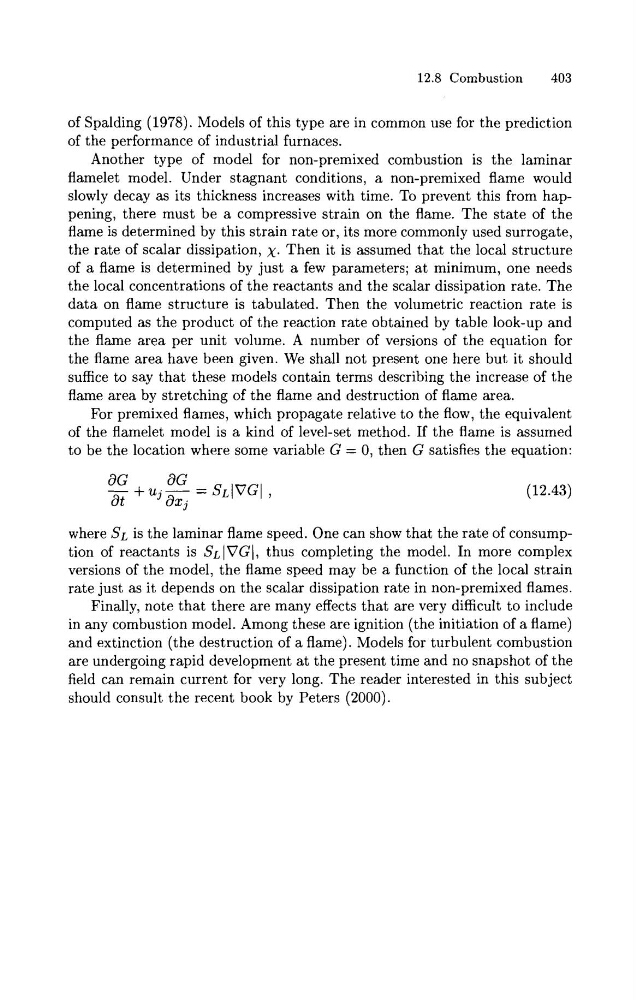
to be the location where some variable G = 0, then G satisfies the equation:
where SL is the laminar flame speed. One can show that the rate of consumption of reactants is SLIVGJ, thus completing the model. In more complex
versions of the model, the flame speed may be a function of the local strain
rate just as it depends on the scalar dissipation rate in non-premixed flames.
Finally, note that there are many effects that are very difficult to include
in any combustion model. Among these are ignition (the initiation of a flame)
and extinction (the destruction of a flame). Models for turbulent combustion
are undergoing rapid development a t the present time and no snapshot of the
field can remain current for very long. The reader interested in this subject
should consult the recent book by Peters (2000).
403
of Spalding (1978). Models of this type are in common use for the prediction
of the performance of industrial furnaces.
Another type of model for non-premixed combustion is the laminar
flamelet model. Under stagnant conditions, a non-premixed flame would
slowly decay as its thickness increases with time. To prevent this from happening, there must be a compressive strain on the flame. The state of the
flame is determined by this strain rate or, its more commonly used surrogate,
the rate of scalar dissipation, X . Then it is assumed that the local structure
of a flame is determined by just a few parameters; a t minimum, one needs
the local concentrations of the reactants and the scalar dissipation rate. The
data on flame structure is tabulated. Then the volumetric reaction rate is
computed as the product of the reaction rate obtained by table look-up and
the flame area per unit volume. A number of versions of the equation for
the flame area have been given. We shall not present one here but it should
suffice to say that these models contain terms describing the increase of the
flame area by stretching of the flame and destruction of flame area.
For premixed flames, which propagate relative to the flow, the equivalent
of the flamelet model is a kind of level-set method. If the flame is assumed
to be the location where some variable G = 0, then G satisfies the equation:
where SL is the laminar flame speed. One can show that the rate of consumption of reactants is SLIVGJ, thus completing the model. In more complex
versions of the model, the flame speed may be a function of the local strain
rate just as it depends on the scalar dissipation rate in non-premixed flames.
Finally, note that there are many effects that are very difficult to include
in any combustion model. Among these are ignition (the initiation of a flame)
and extinction (the destruction of a flame). Models for turbulent combustion
are undergoing rapid development a t the present time and no snapshot of the
field can remain current for very long. The reader interested in this subject
should consult the recent book by Peters (2000).