

382
12. Special Topics
where 'fs' denotes the free surface. This states that the normal component
of the fluid velocity at the surface is the normal component of the velocity
of the free surface, see Eq. (12.18).
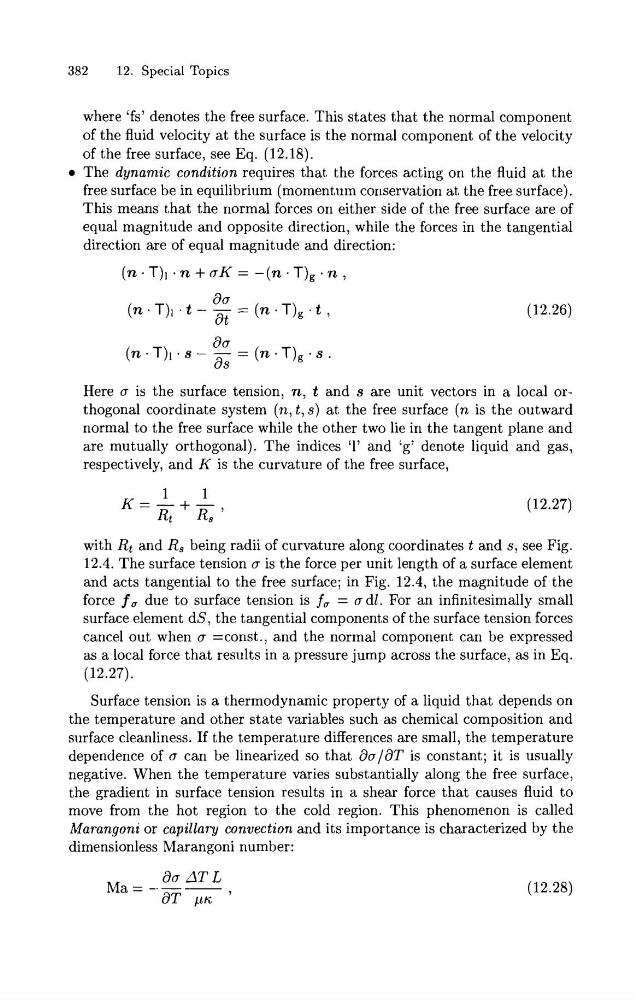
0 The dynamic condition requires that the forces acting on the fluid a t the
free surface be in equilibrium (momentum conservation a t the free surface).
This means that the normal forces on either side of the free surface are of
equal magnitude and opposite direction, while the forces in the tangential
direction are of equal magnitude and direction:
Here u is the surface tension, n , t and s are unit vectors in a local orthogonal coordinate system (n, t, s) a t the free surface (n is the outward
normal to the free surface while the other two lie in the tangent plane and
are mutually orthogonal). The indices '1' and 'g' denote liquid and gas,
respectively, and K is the curvature of the free surface,
with Rt and R, being radii of curvature along coordinates t and s, see Fig.
12.4. The surface tension a is the force per unit length of a surface element
and acts tangential to the free surface; in Fig. 12.4, the magnitude of the
force f, due to surface tension is f, = udl. For an infinitesimally small
surface element dS, the tangential components of the surface tension forces
cancel out when u =const., and the normal component can be expressed
as a local force that results in a pressure jump across the surface, as in Eq.
(12.27).
Surface tension is a thermodynamic property of a liquid that depends on
the temperature and other state variables such as chemical composition and
surface cleanliness. If the temperature differences are small, the temperature
dependence of u can be linearized so that da/dT is constant; it is usually
negative. When the temperature varies substantially along the free surface,
the gradient in surface tension results in a shear force that causes fluid to
move from the hot region to the cold region. This phenomenon is called
Marangoni or capillary convection and its importance is characterized by the
dimensionless Marangoni number:
12. Special Topics
where 'fs' denotes the free surface. This states that the normal component
of the fluid velocity at the surface is the normal component of the velocity
of the free surface, see Eq. (12.18).
0 The dynamic condition requires that the forces acting on the fluid a t the
free surface be in equilibrium (momentum conservation a t the free surface).
This means that the normal forces on either side of the free surface are of
equal magnitude and opposite direction, while the forces in the tangential
direction are of equal magnitude and direction:
Here u is the surface tension, n , t and s are unit vectors in a local orthogonal coordinate system (n, t, s) a t the free surface (n is the outward
normal to the free surface while the other two lie in the tangent plane and
are mutually orthogonal). The indices '1' and 'g' denote liquid and gas,
respectively, and K is the curvature of the free surface,
with Rt and R, being radii of curvature along coordinates t and s, see Fig.
12.4. The surface tension a is the force per unit length of a surface element
and acts tangential to the free surface; in Fig. 12.4, the magnitude of the
force f, due to surface tension is f, = udl. For an infinitesimally small
surface element dS, the tangential components of the surface tension forces
cancel out when u =const., and the normal component can be expressed
as a local force that results in a pressure jump across the surface, as in Eq.
(12.27).
Surface tension is a thermodynamic property of a liquid that depends on
the temperature and other state variables such as chemical composition and
surface cleanliness. If the temperature differences are small, the temperature
dependence of u can be linearized so that da/dT is constant; it is usually
negative. When the temperature varies substantially along the free surface,
the gradient in surface tension results in a shear force that causes fluid to
move from the hot region to the cold region. This phenomenon is called
Marangoni or capillary convection and its importance is characterized by the
dimensionless Marangoni number: