

12.4 Moving Grids
377
Old .
pos~tlon :
_.--x
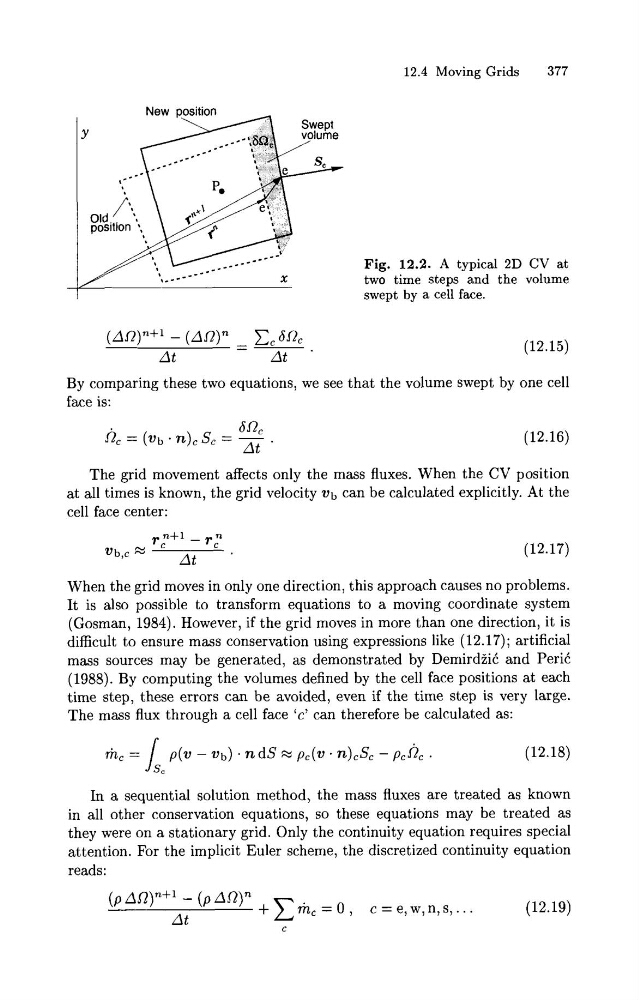
Fig. 12.2. A typical 2D CV at
two time steps and the volume
swept by a cell face.
By comparing these two equations, we see that the volume swept by one cell
face is:
The grid movement affects only the mass fluxes. When the CV position
at all times is known, the grid velocity v b can be calculated explicitly. At the
cell face center:
When the grid moves in only one direction, this approach causes no problems.
It is also possible to transform equations to a moving coordinate system
(Gosman, 1984). However, if the grid moves in more than one direction, it is
difficult to ensure mass conservation using expressions like (12.17); artificial
mass sources may be generated, as demonstrated by Demirdiik and Perik
(1988). By computing the volumes defined by the cell face positions at each
time step, these errors can be avoided, even if the time step is very large.
The mass flux through a cell face 'c' can therefore be calculated as:
In a sequential solution method, the mass fluxes are treated as known
in all other conservation equations, so these equations may be treated as
they were on a stationary grid. Only the continuity equation requires special
attention. For the implicit Euler scheme, the discretized continuity equation
reads:
377
Old .
pos~tlon :
_.--x
Fig. 12.2. A typical 2D CV at
two time steps and the volume
swept by a cell face.
By comparing these two equations, we see that the volume swept by one cell
face is:
The grid movement affects only the mass fluxes. When the CV position
at all times is known, the grid velocity v b can be calculated explicitly. At the
cell face center:
When the grid moves in only one direction, this approach causes no problems.
It is also possible to transform equations to a moving coordinate system
(Gosman, 1984). However, if the grid moves in more than one direction, it is
difficult to ensure mass conservation using expressions like (12.17); artificial
mass sources may be generated, as demonstrated by Demirdiik and Perik
(1988). By computing the volumes defined by the cell face positions at each
time step, these errors can be avoided, even if the time step is very large.
The mass flux through a cell face 'c' can therefore be calculated as:
In a sequential solution method, the mass fluxes are treated as known
in all other conservation equations, so these equations may be treated as
they were on a stationary grid. Only the continuity equation requires special
attention. For the implicit Euler scheme, the discretized continuity equation
reads: