

2. Introduction to Numerical Methods
2.1 Approaches to Fluid Dynamical Problems
As the first chapter stated, the equations of fluid mechanics - which have been
known for over a century - are solvable for only a limited number of flows.
The known solutions are extremely useful in helping to understand fluid flow
but rarely can they be used directly in engineering analysis or design. The
engineer has traditionally been forced to use other approaches.
In the most common approach, simplifications of the equations are used.
These are usually based on a combination of approximations and dimensional
analysis; empirical input is almost always required. For example, dimensional
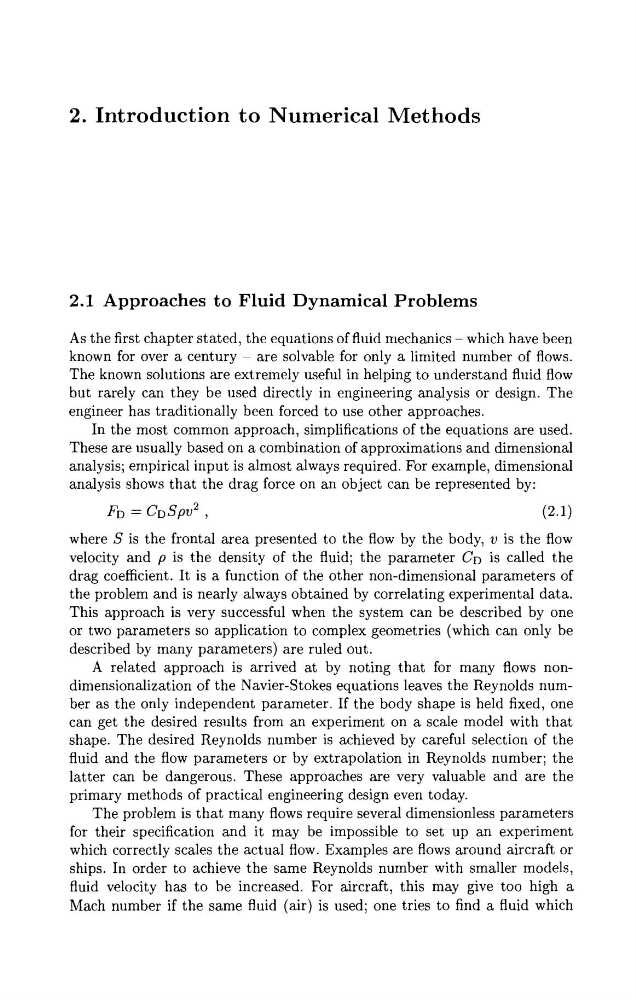
analysis shows that the drag force on an object can be represented by:
where S is the frontal area presented to the flow by the body, v is the flow
velocity and p is the density of the fluid; the parameter CD is called the
drag coefficient. It is a function of the other non-dimensional parameters of
the problem and is nearly always obtained by correlating experimental data.
This approach is very successful when the system can be described by one
or two parameters so application to complex geometries (which can only be
described by many parameters) are ruled out.
A related approach is arrived at by noting that for many flows nondimensionalization of the Navier-Stokes equations leaves the Reynolds number as the only independent parameter. If the body shape is held fixed, one
can get the desired results from an experiment on a scale model with that
shape. The desired Reynolds number is achieved by careful selection of the
fluid and the flow parameters or by extrapolation in Reynolds number; the
latter can be dangerous. These approaches are very valuable and are the
primary methods of practical engineering design even today.
The problem is that many flows require several dimensionless parameters
for their specification and it may be impossible to set up an experiment
which correctly scales the actual flow. Examples are flows around aircraft or
ships. In order to achieve the same Reynolds number with smaller models,
fluid velocity has t o be increased. For aircraft, this may give too high a
Mach number if the same fluid (air) is used; one tries to find a fluid which
2.1 Approaches to Fluid Dynamical Problems
As the first chapter stated, the equations of fluid mechanics - which have been
known for over a century - are solvable for only a limited number of flows.
The known solutions are extremely useful in helping to understand fluid flow
but rarely can they be used directly in engineering analysis or design. The
engineer has traditionally been forced to use other approaches.
In the most common approach, simplifications of the equations are used.
These are usually based on a combination of approximations and dimensional
analysis; empirical input is almost always required. For example, dimensional
analysis shows that the drag force on an object can be represented by:
where S is the frontal area presented to the flow by the body, v is the flow
velocity and p is the density of the fluid; the parameter CD is called the
drag coefficient. It is a function of the other non-dimensional parameters of
the problem and is nearly always obtained by correlating experimental data.
This approach is very successful when the system can be described by one
or two parameters so application to complex geometries (which can only be
described by many parameters) are ruled out.
A related approach is arrived at by noting that for many flows nondimensionalization of the Navier-Stokes equations leaves the Reynolds number as the only independent parameter. If the body shape is held fixed, one
can get the desired results from an experiment on a scale model with that
shape. The desired Reynolds number is achieved by careful selection of the
fluid and the flow parameters or by extrapolation in Reynolds number; the
latter can be dangerous. These approaches are very valuable and are the
primary methods of practical engineering design even today.
The problem is that many flows require several dimensionless parameters
for their specification and it may be impossible to set up an experiment
which correctly scales the actual flow. Examples are flows around aircraft or
ships. In order to achieve the same Reynolds number with smaller models,
fluid velocity has t o be increased. For aircraft, this may give too high a
Mach number if the same fluid (air) is used; one tries to find a fluid which