

10.2 Pressure-Correction Methods for Arbitrary Mach Number
313
where n is the coordinate in the direction of the outward normal to the cell
face. Since the coefficient Ap is the same for any Cartesian velocity component, we can take A> = A;.
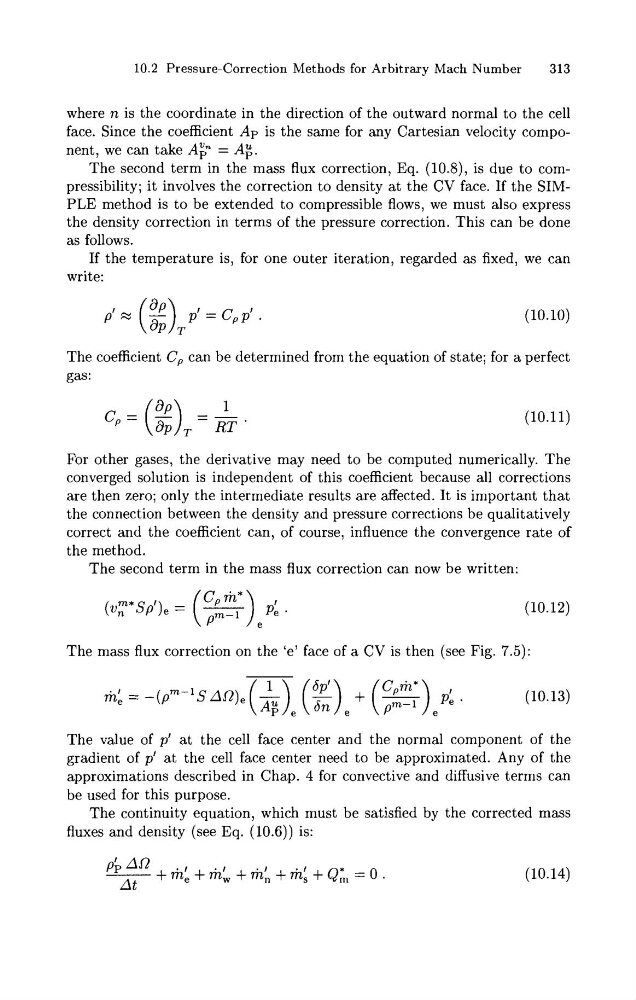
The second term in the mass flux correction, Eq. (10.8), is due to compressibility; it involves the correction to density a t the CV face. If the SIMPLE method is to be extended to compressible flows, we must also express
the density correction in terms of the pressure correction. This can be done
as follows.
If the temperature is, for one outer iteration, regarded as fixed, we can
write:
The coefficient Cp can be determined from the equation of state; for a perfect
gas:
For other gases, the derivative may need to be computed numerically. The
converged solution is independent of this coefficient because all corrections
are then zero; only the intermediate results are affected. It is important that
the connection between the density and pressure corrections be qualitatively
correct and the coefficient can, of course, influence the convergence rate of
the method.
The second term in the mass flux correction can now be written:
The mass flux correction on the 'e' face of a CV is then (see Fig. 7.5):
The value of p' a t the cell face center and the normal component of the
gradient of p' a t the cell face center need to be approximated. Any of the
approximations described in Chap. 4 for convective and diffusive terms can
be used for this purpose.
The continuity equation, which must be satisfied by the corrected mass
fluxes and density (see Eq. (10.6)) is:
313
where n is the coordinate in the direction of the outward normal to the cell
face. Since the coefficient Ap is the same for any Cartesian velocity component, we can take A> = A;.
The second term in the mass flux correction, Eq. (10.8), is due to compressibility; it involves the correction to density a t the CV face. If the SIMPLE method is to be extended to compressible flows, we must also express
the density correction in terms of the pressure correction. This can be done
as follows.
If the temperature is, for one outer iteration, regarded as fixed, we can
write:
The coefficient Cp can be determined from the equation of state; for a perfect
gas:
For other gases, the derivative may need to be computed numerically. The
converged solution is independent of this coefficient because all corrections
are then zero; only the intermediate results are affected. It is important that
the connection between the density and pressure corrections be qualitatively
correct and the coefficient can, of course, influence the convergence rate of
the method.
The second term in the mass flux correction can now be written:
The mass flux correction on the 'e' face of a CV is then (see Fig. 7.5):
The value of p' a t the cell face center and the normal component of the
gradient of p' a t the cell face center need to be approximated. Any of the
approximations described in Chap. 4 for convective and diffusive terms can
be used for this purpose.
The continuity equation, which must be satisfied by the corrected mass
fluxes and density (see Eq. (10.6)) is: