

290
9. Turbulent Flows
while the one associated with the shear is the inverse of the shear rate S :
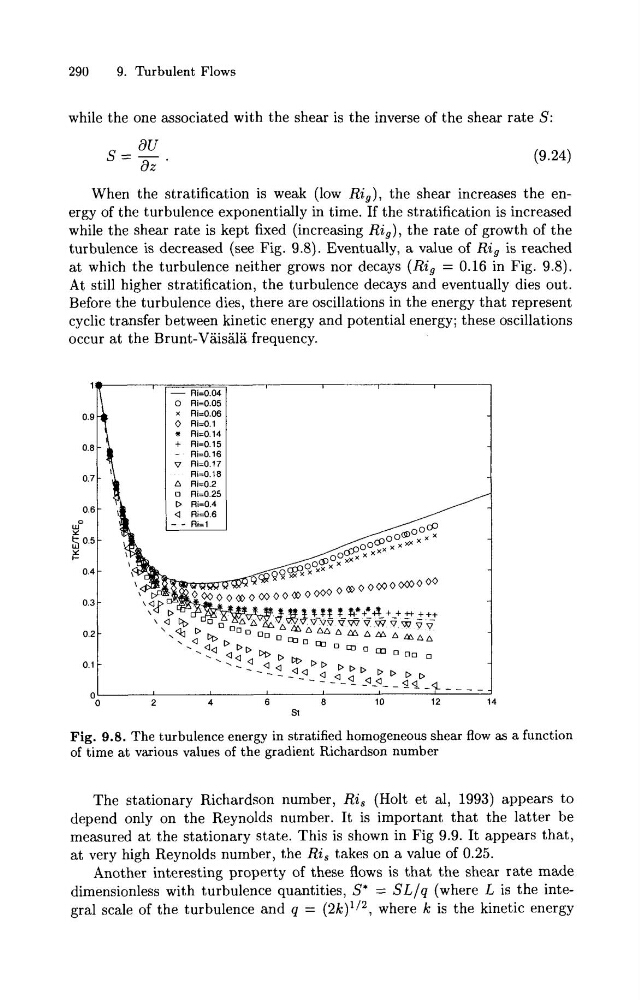
When the stratification is weak (low Ri,), the shear increases the energy of the turbulence exponentially in time. If the stratification is increased
while the shear rate is kept fixed (increasing Ri,), the rate of growth of the
turbulence is decreased (see Fig. 9.8). Eventually, a value of Ri, is reached
at which the turbulence neither grows nor decays (Ri, = 0.16 in Fig. 9.8).
At still higher stratification, the turbulence decays and eventually dies out.
Before the turbulence dies, there are oscillations in the energy that represent
cyclic transfer between kinetic energy and potential energy; these oscillations
occur at the Brunt-Vaisala frequency.
Fig. 9.8. The turbulence energy in stratified homogeneous shear flow as a function
of time at various values of the gradient Richardson number
The stationary Richardson number, Ri, (Holt et all 1993) appears to
depend only on the Reynolds number. It is important that the latter be
measured a t the stationary state. This is shown in Fig 9.9. It appears that,
at very high Reynolds number, the Ri, takes on a value of 0.25.
Another interesting property of these flows is that the shear rate made
dimensionless with turbulence quantities, S* = SLIq (where L is the integral scale of the turbulence and q = (2k)'/', where k is the kinetic energy
9. Turbulent Flows
while the one associated with the shear is the inverse of the shear rate S :
When the stratification is weak (low Ri,), the shear increases the energy of the turbulence exponentially in time. If the stratification is increased
while the shear rate is kept fixed (increasing Ri,), the rate of growth of the
turbulence is decreased (see Fig. 9.8). Eventually, a value of Ri, is reached
at which the turbulence neither grows nor decays (Ri, = 0.16 in Fig. 9.8).
At still higher stratification, the turbulence decays and eventually dies out.
Before the turbulence dies, there are oscillations in the energy that represent
cyclic transfer between kinetic energy and potential energy; these oscillations
occur at the Brunt-Vaisala frequency.
Fig. 9.8. The turbulence energy in stratified homogeneous shear flow as a function
of time at various values of the gradient Richardson number
The stationary Richardson number, Ri, (Holt et all 1993) appears to
depend only on the Reynolds number. It is important that the latter be
measured a t the stationary state. This is shown in Fig 9.9. It appears that,
at very high Reynolds number, the Ri, takes on a value of 0.25.
Another interesting property of these flows is that the shear rate made
dimensionless with turbulence quantities, S* = SLIq (where L is the integral scale of the turbulence and q = (2k)'/', where k is the kinetic energy