

9.3 Large Eddy Simulation (LES)
281
The smallest scales that are resolved in a simulation are similar in many
ways to the still smaller scales that are treated via the model. This idea leads
to an alternative subgrid-scale model, the scale-similarity model (Bardina et
al., 1980). The principal argument is that the important interactions between
the resolved and unresolved scales involve the smallest eddies of the former
and the largest eddies of the latter i.e., eddies that are a little larger or a
little smaller than the length scale, A, associated with the filter. Arguments
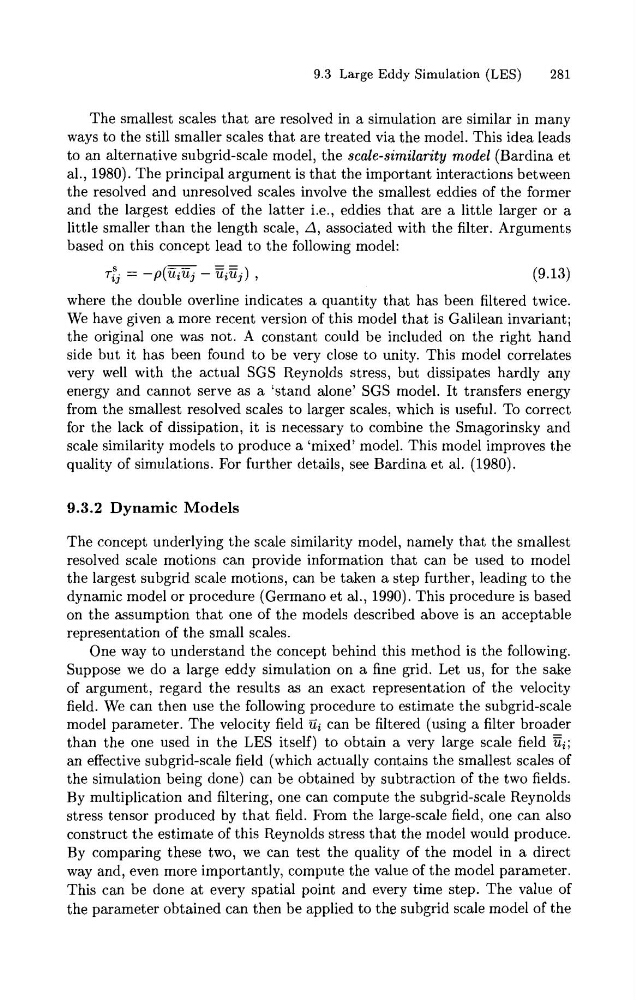
based on this concept lead to the following model:
where the double overline indicates a quantity that has been filtered twice.
We have given a more recent version of this model that is Galilean invariant;
the original one was not. A constant could be included on the right hand
side but it has been found t o be very close to unity. This model correlates
very well with the actual SGS Reynolds stress, but dissipates hardly any
energy and cannot serve as a 'stand alone' SGS model. It transfers energy
from the smallest resolved scales to larger scales, which is useful. To correct
for the lack of dissipation, it is necessary to combine the Smagorinsky and
scale similarity models to produce a 'mixed' model. This model improves the
quality of simulations. For further details, see Bardina et al. (1980).
9.3.2 Dynamic Models
The concept underlying the scale similarity model, namely that the smallest
resolved scale motions can provide information that can be used to model
the largest subgrid scale motions, can be taken a step further, leading to the
dynamic model or procedure (Germano et al., 1990). This procedure is based
on the assumption that one of the models described above is an acceptable
representation of the small scales.
One way to understand the concept behind this method is the following.
Suppose we do a large eddy simulation on a fine grid. Let us, for the sake
of argument, regard the results as an exact representation of the velocity
field. We can then use the following procedure to estimate the subgrid-scale
model parameter. The velocity field iii can be filtered (using a filter broader
than the one used in the LES itself) to obtain a very large scale field Ei;
an effective subgrid-scale field (which actually contains the smallest scales of
the simulation being done) can be obtained by subtraction of the two fields.
By multiplication and filtering, one can compute the subgrid-scale Reynolds
stress tensor produced by that field. R o m the large-scale field, one can also
construct the estimate of this Reynolds stress that the model would produce.
By comparing these two, we can test the quality of the model in a direct
way and, even more importantly, compute the value of the model parameter.
This can be done a t every spatial point and every time step. The value of
the parameter obtained can then be applied to the subgrid scale model of the
281
The smallest scales that are resolved in a simulation are similar in many
ways to the still smaller scales that are treated via the model. This idea leads
to an alternative subgrid-scale model, the scale-similarity model (Bardina et
al., 1980). The principal argument is that the important interactions between
the resolved and unresolved scales involve the smallest eddies of the former
and the largest eddies of the latter i.e., eddies that are a little larger or a
little smaller than the length scale, A, associated with the filter. Arguments
based on this concept lead to the following model:
where the double overline indicates a quantity that has been filtered twice.
We have given a more recent version of this model that is Galilean invariant;
the original one was not. A constant could be included on the right hand
side but it has been found t o be very close to unity. This model correlates
very well with the actual SGS Reynolds stress, but dissipates hardly any
energy and cannot serve as a 'stand alone' SGS model. It transfers energy
from the smallest resolved scales to larger scales, which is useful. To correct
for the lack of dissipation, it is necessary to combine the Smagorinsky and
scale similarity models to produce a 'mixed' model. This model improves the
quality of simulations. For further details, see Bardina et al. (1980).
9.3.2 Dynamic Models
The concept underlying the scale similarity model, namely that the smallest
resolved scale motions can provide information that can be used to model
the largest subgrid scale motions, can be taken a step further, leading to the
dynamic model or procedure (Germano et al., 1990). This procedure is based
on the assumption that one of the models described above is an acceptable
representation of the small scales.
One way to understand the concept behind this method is the following.
Suppose we do a large eddy simulation on a fine grid. Let us, for the sake
of argument, regard the results as an exact representation of the velocity
field. We can then use the following procedure to estimate the subgrid-scale
model parameter. The velocity field iii can be filtered (using a filter broader
than the one used in the LES itself) to obtain a very large scale field Ei;
an effective subgrid-scale field (which actually contains the smallest scales of
the simulation being done) can be obtained by subtraction of the two fields.
By multiplication and filtering, one can compute the subgrid-scale Reynolds
stress tensor produced by that field. R o m the large-scale field, one can also
construct the estimate of this Reynolds stress that the model would produce.
By comparing these two, we can test the quality of the model in a direct
way and, even more importantly, compute the value of the model parameter.
This can be done a t every spatial point and every time step. The value of
the parameter obtained can then be applied to the subgrid scale model of the