

9.2 Direct Numerical Simulation (DNS)
273
spectrum which sets the amplitude of the Fourier mode i.e., (Qi(k)J. The requirement of continuity k . Qi(k) places another restriction on that mode.
This leaves just one random number to be chosen to completely define &(k);
it is usually a phase angle. The simulation must then be run for about two
eddy turnover times before it can be considered to represent real turbulence.
The best initial conditions for other flows are obtained from the results
of previous simulations. For example, for homogeneous turbulence subjected
to strain, the best initial conditions are taken from developed isotropic turbulence. For channel flow, the best choice has been found to be a mixture of
the mean velocity, instability modes (which have nearly the right structure),
and noise. For a curved channel, one can take the results of a fully developed
plane channel flow as the initial condition.
Similar considerations apply to the boundary conditions where the flow
enters the domain (inflow conditions). The correct conditions must contain
the complete velocity field on a plane (or other surface) of a turbulent flow
at each time step which is difficult to construct. As an example, one way this
can be done for the developing flow in a curved channel is to use results for
the flow in a plane channel. A simulation of a plane channel flow is made
(either simultaneously or in advance) and the velocity components on one
plane normal to the main flow direction provide the inflow condition for the
curved channel.
As already noted, for flows which do not vary (in the statistical sense) in
a given direction, one can use periodic boundary conditions in that direction.
These are easy to use, fit especially well with spectral methods, and provide
conditions at the nominal boundary that are as realistic as possible.
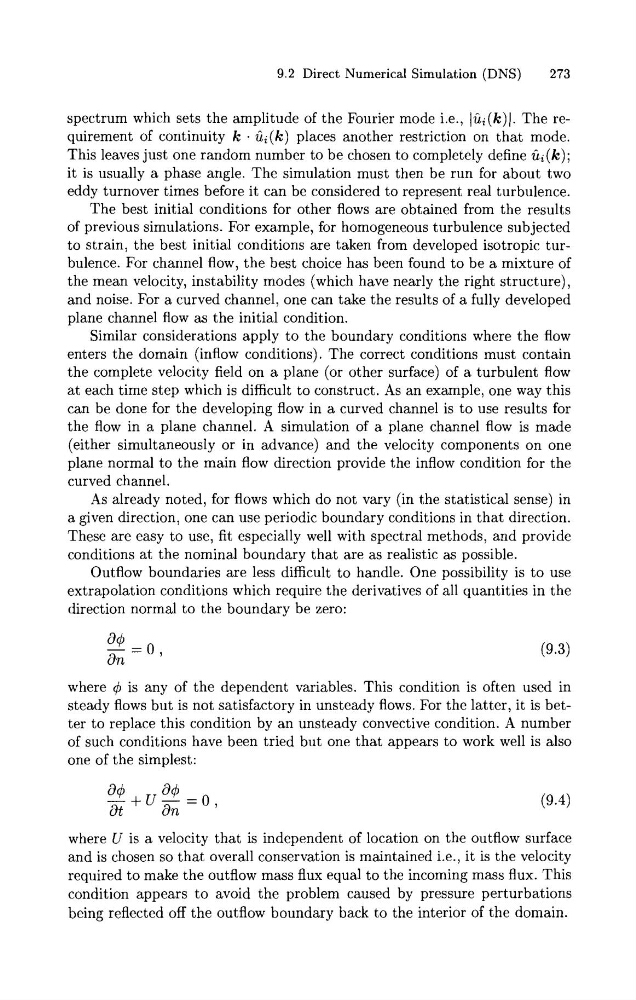
Outflow boundaries are less difficult to handle. One possibility is to use
extrapolation conditions which require the derivatives of all quantities in the
direction normal to the boundary be zero:
where 4 is any of the dependent variables. This condition is often used in
steady flows but is not satisfactory in unsteady flows. For the latter, it is better to replace this condition by an unsteady convective condition. A number
of such conditions have been tried but one that appears to work well is also
one of the simplest:
where U is a velocity that is independent of location on the outflow surface
and is chosen so that overall conservation is maintained i.e., it is the velocity
required to make the outflow mass flux equal to the incoming mass flux. This
condition appears t o avoid the problem caused by pressure perturbations
being reflected off the outflow boundary back to the interior of the domain.
273
spectrum which sets the amplitude of the Fourier mode i.e., (Qi(k)J. The requirement of continuity k . Qi(k) places another restriction on that mode.
This leaves just one random number to be chosen to completely define &(k);
it is usually a phase angle. The simulation must then be run for about two
eddy turnover times before it can be considered to represent real turbulence.
The best initial conditions for other flows are obtained from the results
of previous simulations. For example, for homogeneous turbulence subjected
to strain, the best initial conditions are taken from developed isotropic turbulence. For channel flow, the best choice has been found to be a mixture of
the mean velocity, instability modes (which have nearly the right structure),
and noise. For a curved channel, one can take the results of a fully developed
plane channel flow as the initial condition.
Similar considerations apply to the boundary conditions where the flow
enters the domain (inflow conditions). The correct conditions must contain
the complete velocity field on a plane (or other surface) of a turbulent flow
at each time step which is difficult to construct. As an example, one way this
can be done for the developing flow in a curved channel is to use results for
the flow in a plane channel. A simulation of a plane channel flow is made
(either simultaneously or in advance) and the velocity components on one
plane normal to the main flow direction provide the inflow condition for the
curved channel.
As already noted, for flows which do not vary (in the statistical sense) in
a given direction, one can use periodic boundary conditions in that direction.
These are easy to use, fit especially well with spectral methods, and provide
conditions at the nominal boundary that are as realistic as possible.
Outflow boundaries are less difficult to handle. One possibility is to use
extrapolation conditions which require the derivatives of all quantities in the
direction normal to the boundary be zero:
where 4 is any of the dependent variables. This condition is often used in
steady flows but is not satisfactory in unsteady flows. For the latter, it is better to replace this condition by an unsteady convective condition. A number
of such conditions have been tried but one that appears to work well is also
one of the simplest:
where U is a velocity that is independent of location on the outflow surface
and is chosen so that overall conservation is maintained i.e., it is the velocity
required to make the outflow mass flux equal to the incoming mass flux. This
condition appears t o avoid the problem caused by pressure perturbations
being reflected off the outflow boundary back to the interior of the domain.