

1.7 Simplified Mathematical Models
13
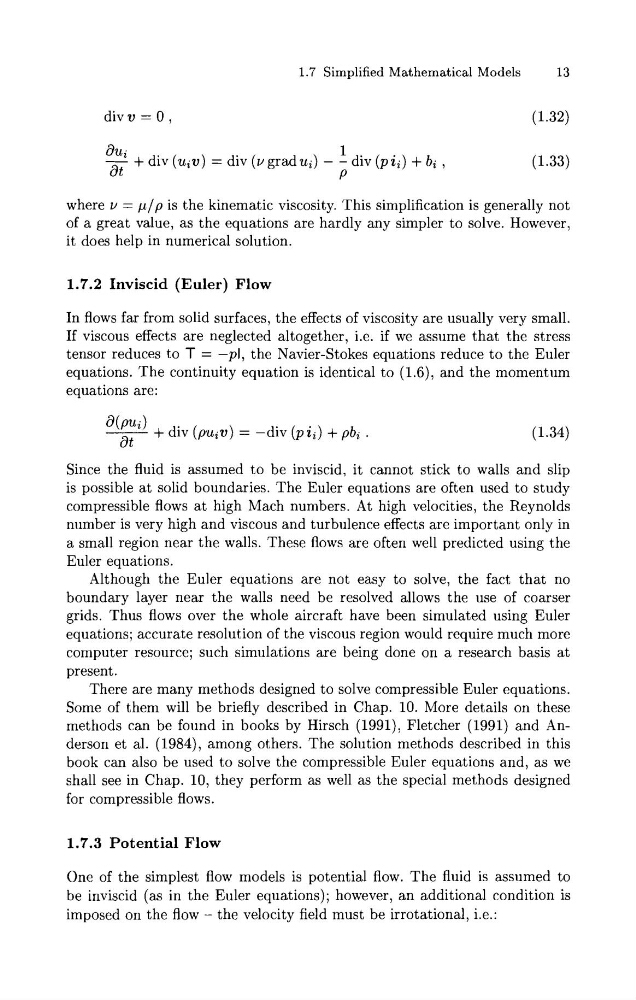
div v = 0 ,
(1.32)
a u
1
- + div (uiv) = div (u grad ui) - - div ( p i i ) + bi ,
a t
(1.33)
P
where u = p / p is the kinematic viscosity. This simplification is generally not
of a great value, as the equations are hardly any simpler to solve. However,
it does help in numerical solution.
1.7.2 Inviscid (Euler) Flow
In flows far from solid surfaces, the effects of viscosity are usually very small.
If viscous effects are neglected altogether, i.e. if we assume that the stress
tensor reduces to T = -pl, the Navier-Stokes equations reduce to the Euler
equations. The continuity equation is identical to (1.6), and the momentum
equations are:
a(pui) + div (puiv) =
a t
Since the fluid is assumed to be inviscid, it cannot stick to walls and slip
is possible at solid boundaries. The Euler equations are often used to study
compressible flows at high Mach numbers. At high velocities, the Reynolds
number is very high and viscous and turbulence effects are important only in
a small region near the walls. These flows are often well predicted using the
Euler equations.
Although the Euler equations are not easy to solve, the fact that no
boundary layer near the walls need be resolved allows the use of coarser
grids. Thus flows over the whole aircraft have been simulated using Euler
equations; accurate resolution of the viscous region would require much more
computer resource; such simulations are being done on a research basis at
present.
There are many methods designed to solve compressible Euler equations.
Some of them will be briefly described in Chap. 10. More details on these
methods can be found in books by Hirsch (1991), Fletcher (1991) and Anderson et al. (1984), among others. The solution methods described in this
book can also be used to solve the compressible Euler equations and, as we
shall see in Chap. 10, they perform as well as the special methods designed
for compressible flows.
1.7.3 Potential Flow
One of the simplest flow models is potential flow. The fluid is assumed to
be inviscid (as in the Euler equations); however, an additional condition is
imposed on the flow - the velocity field must be irrotational, i.e.:
13
div v = 0 ,
(1.32)
a u
1
- + div (uiv) = div (u grad ui) - - div ( p i i ) + bi ,
a t
(1.33)
P
where u = p / p is the kinematic viscosity. This simplification is generally not
of a great value, as the equations are hardly any simpler to solve. However,
it does help in numerical solution.
1.7.2 Inviscid (Euler) Flow
In flows far from solid surfaces, the effects of viscosity are usually very small.
If viscous effects are neglected altogether, i.e. if we assume that the stress
tensor reduces to T = -pl, the Navier-Stokes equations reduce to the Euler
equations. The continuity equation is identical to (1.6), and the momentum
equations are:
a(pui) + div (puiv) =
a t
Since the fluid is assumed to be inviscid, it cannot stick to walls and slip
is possible at solid boundaries. The Euler equations are often used to study
compressible flows at high Mach numbers. At high velocities, the Reynolds
number is very high and viscous and turbulence effects are important only in
a small region near the walls. These flows are often well predicted using the
Euler equations.
Although the Euler equations are not easy to solve, the fact that no
boundary layer near the walls need be resolved allows the use of coarser
grids. Thus flows over the whole aircraft have been simulated using Euler
equations; accurate resolution of the viscous region would require much more
computer resource; such simulations are being done on a research basis at
present.
There are many methods designed to solve compressible Euler equations.
Some of them will be briefly described in Chap. 10. More details on these
methods can be found in books by Hirsch (1991), Fletcher (1991) and Anderson et al. (1984), among others. The solution methods described in this
book can also be used to solve the compressible Euler equations and, as we
shall see in Chap. 10, they perform as well as the special methods designed
for compressible flows.
1.7.3 Potential Flow
One of the simplest flow models is potential flow. The fluid is assumed to
be inviscid (as in the Euler equations); however, an additional condition is
imposed on the flow - the velocity field must be irrotational, i.e.: