

8.10 Implementation of Boundary Conditions
257
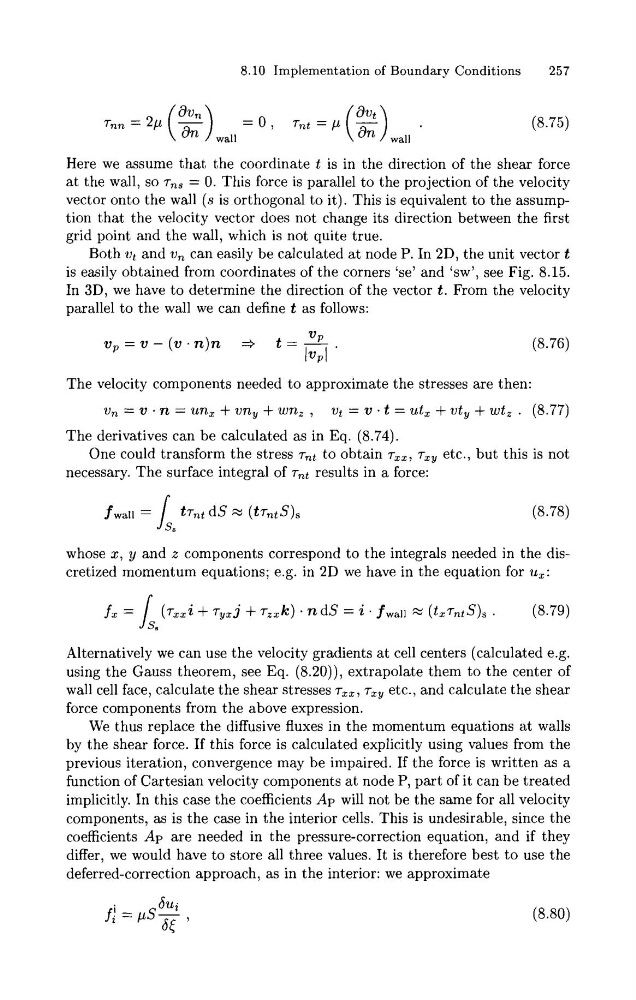
Here we assume that the coordinate t is in the direction of the shear force
at the wall, so rn, = 0. This force is parallel to the projection of the velocity
vector onto the wall (s is orthogonal to it). This is equivalent to the assumption that the velocity vector does not change its direction between the first
grid point and the wall, which is not quite true.
Both ut and vn can easily be calculated at node P. In 2D, the unit vector t
is easily obtained from coordinates of the corners 'se' and 'sw', see Fig. 8.15.
In 3D, we have to determine the direction of the vector t . From the velocity
parallel to the wall we can define t as follows:
The velocity components needed to approximate the stresses are then:
vn = v . n = un, + uny + wn, , vt = v . t = ut, + uty + wto . (8.77)
The derivatives can be calculated as in Eq. (8.74).
One could transform the stress r n t to obtain r,,, rXy etc., but this is not
necessary. The surface integral of r,t results in a force:
whose x, y and z components correspond to the integrals needed in the discretized momentum equations; e.g. in 2D we have in the equation for u,:
F
Alternatively we can use the velocity gradients at cell centers (calculated e.g.
using the Gauss theorem, see Eq. (8.20)), extrapolate them to the center of
wall cell face, calculate the shear stresses r,,, rXy etc., and calculate the shear
force components from the above expression.
We thus replace the diffusive fluxes in the momentum equations at walls
by the shear force. If this force is calculated explicitly using values from the
previous iteration, convergence may be impaired. If the force is written as a
function of Cartesian velocity components at node P, part of it can be treated
implicitly. In this case the coefficients Ap will not be the same for all velocity
components, as is the case in the interior cells. This is undesirable, since the
coefficients Ap are needed in the pressure-correction equation, and if they
differ, we would have to store all three values. It is therefore best t o use the
deferred-correction approach, as in the interior: we approximate
&Li
f,! = ps- ,
@
257
Here we assume that the coordinate t is in the direction of the shear force
at the wall, so rn, = 0. This force is parallel to the projection of the velocity
vector onto the wall (s is orthogonal to it). This is equivalent to the assumption that the velocity vector does not change its direction between the first
grid point and the wall, which is not quite true.
Both ut and vn can easily be calculated at node P. In 2D, the unit vector t
is easily obtained from coordinates of the corners 'se' and 'sw', see Fig. 8.15.
In 3D, we have to determine the direction of the vector t . From the velocity
parallel to the wall we can define t as follows:
The velocity components needed to approximate the stresses are then:
vn = v . n = un, + uny + wn, , vt = v . t = ut, + uty + wto . (8.77)
The derivatives can be calculated as in Eq. (8.74).
One could transform the stress r n t to obtain r,,, rXy etc., but this is not
necessary. The surface integral of r,t results in a force:
whose x, y and z components correspond to the integrals needed in the discretized momentum equations; e.g. in 2D we have in the equation for u,:
F
Alternatively we can use the velocity gradients at cell centers (calculated e.g.
using the Gauss theorem, see Eq. (8.20)), extrapolate them to the center of
wall cell face, calculate the shear stresses r,,, rXy etc., and calculate the shear
force components from the above expression.
We thus replace the diffusive fluxes in the momentum equations at walls
by the shear force. If this force is calculated explicitly using values from the
previous iteration, convergence may be impaired. If the force is written as a
function of Cartesian velocity components at node P, part of it can be treated
implicitly. In this case the coefficients Ap will not be the same for all velocity
components, as is the case in the interior cells. This is undesirable, since the
coefficients Ap are needed in the pressure-correction equation, and if they
differ, we would have to store all three values. It is therefore best t o use the
deferred-correction approach, as in the interior: we approximate
&Li
f,! = ps- ,
@