

8.9 Axi-Symmetric Problems
253
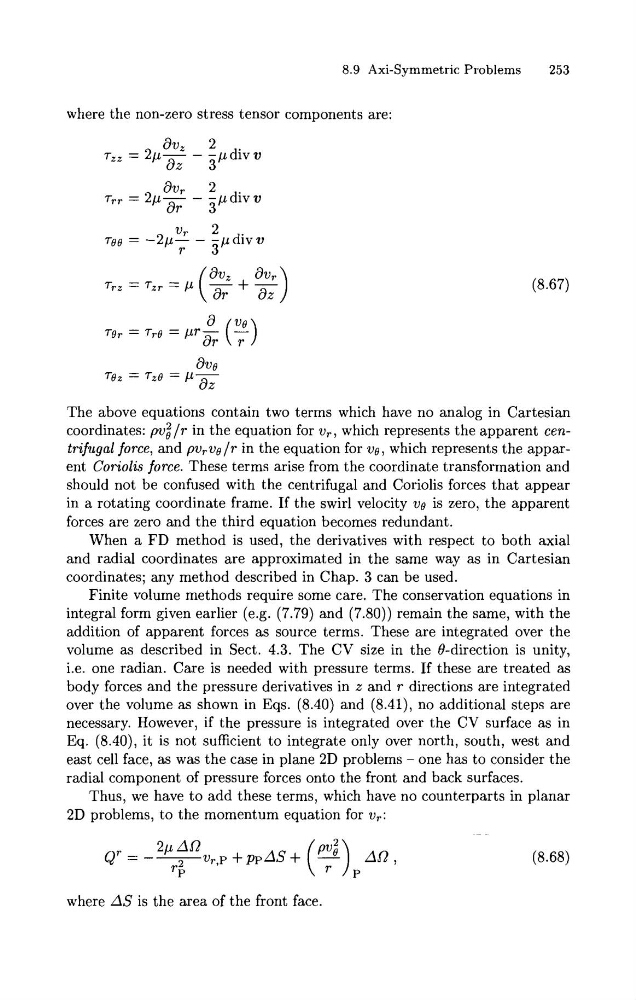
where the non-zero stress tensor components are:
dv,
2
T,, = 2p- -pdivv
da
3
dv,
2
T,, = 2p- -pdivv
d r
3
The above equations contain two terms which have no analog in Cartesian
coordinates: pvi/r in the equation for v,, which represents the apparent centrifugal force, and pv,ve/r in the equation for ve, which represents the apparent Coriolis force. These terms arise from the coordinate transformation and
should not be confused with the centrifugal and Coriolis forces that appear
in a rotating coordinate frame. If the swirl velocity ve is zero, the apparent
forces are zero and the third equation becomes redundant.
When a FD method is used, the derivatives with respect to both axial
and radial coordinates are approximated in the same way as in Cartesian
coordinates; any method described in Chap. 3 can be used.
Finite volume methods require some care. The conservation equations in
integral form given earlier (e.g. (7.79) and (7.80)) remain the same, with the
addition of apparent forces as source terms. These are integrated over the
volume as described in Sect. 4.3. The CV size in the &direction is unity,
i.e. one radian. Care is needed with pressure terms. If these are treated as
body forces and the pressure derivatives in a and r directions are integrated
over the volume as shown in Eqs. (8.40) and (8.41), no additional steps are
necessary. However, if the pressure is integrated over the CV surface as in
Eq. (8.40), it is not sufficient to integrate only over north, south, west and
east cell face, as was the case in plane 2D problems - one has to consider the
radial component of pressure forces onto the front and back surfaces.
Thus, we have to add these terms, which have no counterparts in planar
2D problems, to the momentum equation for v,:
where A S is the area of the front face.
253
where the non-zero stress tensor components are:
dv,
2
T,, = 2p- -pdivv
da
3
dv,
2
T,, = 2p- -pdivv
d r
3
The above equations contain two terms which have no analog in Cartesian
coordinates: pvi/r in the equation for v,, which represents the apparent centrifugal force, and pv,ve/r in the equation for ve, which represents the apparent Coriolis force. These terms arise from the coordinate transformation and
should not be confused with the centrifugal and Coriolis forces that appear
in a rotating coordinate frame. If the swirl velocity ve is zero, the apparent
forces are zero and the third equation becomes redundant.
When a FD method is used, the derivatives with respect to both axial
and radial coordinates are approximated in the same way as in Cartesian
coordinates; any method described in Chap. 3 can be used.
Finite volume methods require some care. The conservation equations in
integral form given earlier (e.g. (7.79) and (7.80)) remain the same, with the
addition of apparent forces as source terms. These are integrated over the
volume as described in Sect. 4.3. The CV size in the &direction is unity,
i.e. one radian. Care is needed with pressure terms. If these are treated as
body forces and the pressure derivatives in a and r directions are integrated
over the volume as shown in Eqs. (8.40) and (8.41), no additional steps are
necessary. However, if the pressure is integrated over the CV surface as in
Eq. (8.40), it is not sufficient to integrate only over north, south, west and
east cell face, as was the case in plane 2D problems - one has to consider the
radial component of pressure forces onto the front and back surfaces.
Thus, we have to add these terms, which have no counterparts in planar
2D problems, to the momentum equation for v,:
where A S is the area of the front face.