

8.8 Pressure-Correction Equation
247
8.8 Pressure-Correction Equation
The SIMPLE-algorithm (see Sect. 7.5.2) needs to be modified when the grid
is non-orthogonal and/or unstructured. The approach is described in this
section.
For any grid type, the discretized momentum equations have the following
form:
The source term Q ~ , P contains the discretized pressure gradient term. Irrespective of how this term is approximated, one can write:
If the pressure term is approximated in a conservative way (as a sum of
surface forces), the mean pressure gradient over the CV can be expressed as:
As always, the correction takes the form of a pressure gradient and the
pressure is derived from a Poisson-like equation obtained by imposing the
continuity constraint. The objective is to satisfy continuity i.e. the net mass
flux into every CV must be zero. In order to calculate the mass flux, we
need velocities a t the cell face centers. In a staggered arrangement these are
available. On colocated grids, they are obtained by interpolation.
It was shown in Chap. 7 that, when interpolated velocities a t cell faces
are used to derive the pressure-correction equation, a large computational
molecule results as can oscillations in the pressure and/or velocities. We
described a way to modify the interpolated velocity that yields a compact
pressure-correction equation and avoids oscillatory solutions. We shall describe briefly an extension of the approach presented in Sect. 7.5.2 to nonorthogonal grids. The method described below is valid for both conservative
and non-conservative treatment of the pressure gradient terms in the momentum equations, and with a little modification can be applied to FD schemes
on non-orthogonal grids. It is also valid for arbitrarily shaped CVs, although
we shall consider the 'e' face of a regular CV.
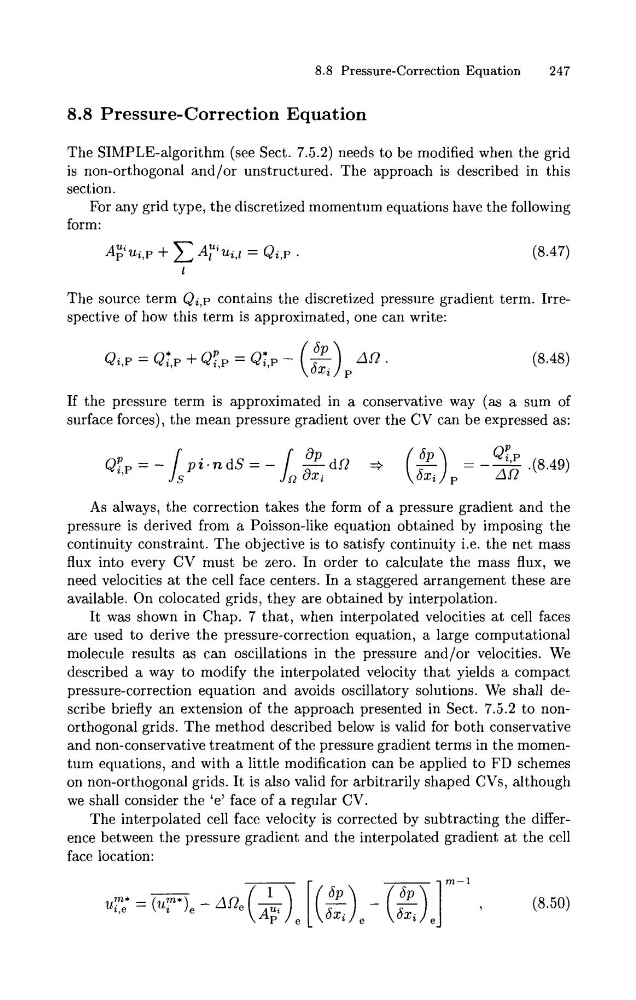
The interpolated cell face velocity is corrected by subtracting the difference between the pressure gradient and the interpolated gradient at the cell
face location:
247
8.8 Pressure-Correction Equation
The SIMPLE-algorithm (see Sect. 7.5.2) needs to be modified when the grid
is non-orthogonal and/or unstructured. The approach is described in this
section.
For any grid type, the discretized momentum equations have the following
form:
The source term Q ~ , P contains the discretized pressure gradient term. Irrespective of how this term is approximated, one can write:
If the pressure term is approximated in a conservative way (as a sum of
surface forces), the mean pressure gradient over the CV can be expressed as:
As always, the correction takes the form of a pressure gradient and the
pressure is derived from a Poisson-like equation obtained by imposing the
continuity constraint. The objective is to satisfy continuity i.e. the net mass
flux into every CV must be zero. In order to calculate the mass flux, we
need velocities a t the cell face centers. In a staggered arrangement these are
available. On colocated grids, they are obtained by interpolation.
It was shown in Chap. 7 that, when interpolated velocities a t cell faces
are used to derive the pressure-correction equation, a large computational
molecule results as can oscillations in the pressure and/or velocities. We
described a way to modify the interpolated velocity that yields a compact
pressure-correction equation and avoids oscillatory solutions. We shall describe briefly an extension of the approach presented in Sect. 7.5.2 to nonorthogonal grids. The method described below is valid for both conservative
and non-conservative treatment of the pressure gradient terms in the momentum equations, and with a little modification can be applied to FD schemes
on non-orthogonal grids. It is also valid for arbitrarily shaped CVs, although
we shall consider the 'e' face of a regular CV.
The interpolated cell face velocity is corrected by subtracting the difference between the pressure gradient and the interpolated gradient at the cell
face location: