

8.7 Control-Volume-Based Finite Element Methods
245
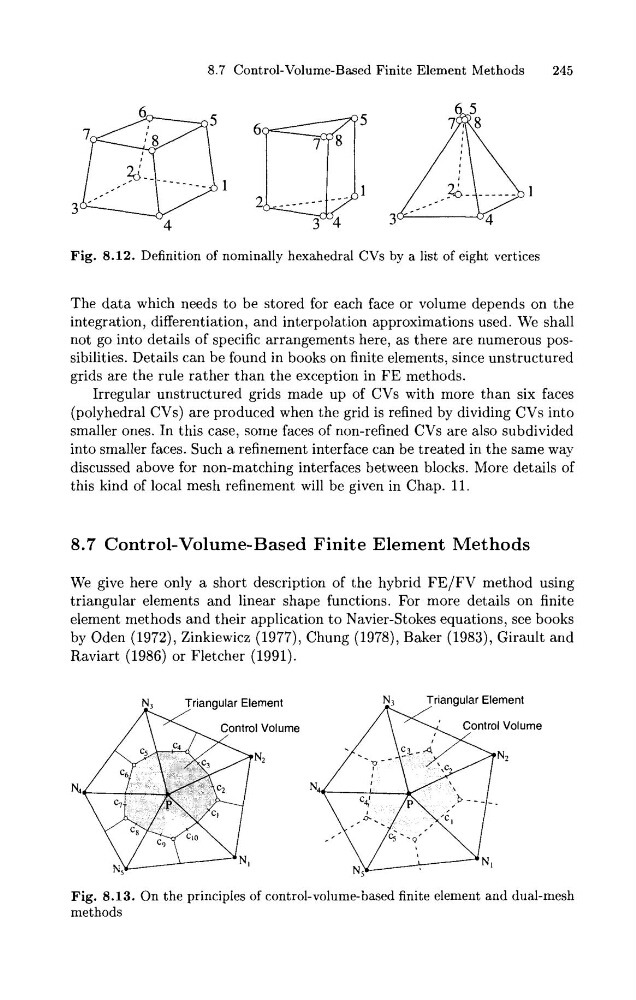
Fig. 8.12. Definition of nominally hexahedral CVs by a list of eight vertices
The data which needs to be stored for each face or volume depends on the
integration, differentiation, and interpolation approximations used. We shall
not go into details of specific arrangements here, as there are numerous possibilities. Details can be found in books on finite elements, since unstructured
grids are the rule rather than the exception in FE methods.
Irregular unstructured grids made up of CVs with more than six faces
(polyhedral CVs) are produced when the grid is refined by dividing CVs into
smaller ones. In this case, some faces of non-refined CVs are also subdivided
into smaller faces. Such a refinement interface can be treated in the same way
discussed above for non-matching interfaces between blocks. More details of
this kind of local mesh refinement will be given in Chap. 11.
8.7 Control-Volume-Based Finite Element Methods
We give here only a short description of the hybrid FE/FV method using
triangular elements and linear shape functions. For more details on finite
element methods and their application t o Navier-Stokes equations, see books
by Oden (1972), Zinkiewicz (1977), Chung (1978), Baker (1983), Girault and
Raviart (1986) or Fletcher (1991).
N
Trtangular Element
Fig. 8.13. On the principles of control-volume-based finite element and dual-mesh
methods
245
Fig. 8.12. Definition of nominally hexahedral CVs by a list of eight vertices
The data which needs to be stored for each face or volume depends on the
integration, differentiation, and interpolation approximations used. We shall
not go into details of specific arrangements here, as there are numerous possibilities. Details can be found in books on finite elements, since unstructured
grids are the rule rather than the exception in FE methods.
Irregular unstructured grids made up of CVs with more than six faces
(polyhedral CVs) are produced when the grid is refined by dividing CVs into
smaller ones. In this case, some faces of non-refined CVs are also subdivided
into smaller faces. Such a refinement interface can be treated in the same way
discussed above for non-matching interfaces between blocks. More details of
this kind of local mesh refinement will be given in Chap. 11.
8.7 Control-Volume-Based Finite Element Methods
We give here only a short description of the hybrid FE/FV method using
triangular elements and linear shape functions. For more details on finite
element methods and their application t o Navier-Stokes equations, see books
by Oden (1972), Zinkiewicz (1977), Chung (1978), Baker (1983), Girault and
Raviart (1986) or Fletcher (1991).
N
Trtangular Element
Fig. 8.13. On the principles of control-volume-based finite element and dual-mesh
methods