

240
8. Complex Geometries
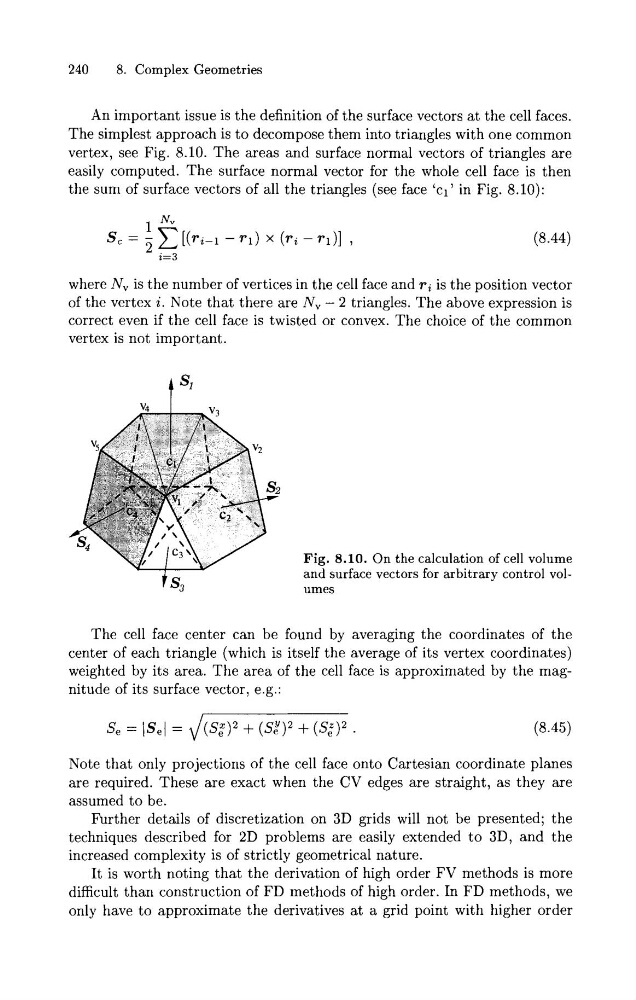
An important issue is the definition of the surface vectors a t the cell faces.
The simplest approach is to decompose them into triangles with one common
vertex, see Fig. 8.10. The areas and surface normal vectors of triangles are
easily computed. The surface normal vector for the whole cell face is then
the sum of surface vectors of all the triangles (see face 'cl' in Fig. 8.10):
where N, is the number of vertices in the cell face and ri is the position vector
of the vertex i. Note that there are N, - 2 triangles. The above expression is
correct even if the cell face is twisted or convex. The choice of the common
vertex is not important.
Fig. 8.10. On the calculation of cell volume
and surface vectors for arbitrary control volumes
The cell face center can be found by averaging the coordinates of the
center of each triangle (which is itself the average of its vertex coordinates)
weighted by its area. The area of the cell face is approximated by the magnitude of its surface vector, e g :
Note that only projections of the cell face onto Cartesian coordinate planes
are required. These are exact when the CV edges are straight, as they are
assumed to be.
Further details of discretization on 3D grids will not be presented; the
techniques described for 2D problems are easily extended t o 3D, and the
increased complexity is of strictly geometrical nature.
It is worth noting that the derivation of high order FV methods is more
difficult than construction of FD methods of high order. In FD methods, we
only have to approximate the derivatives at a grid point with higher order
8. Complex Geometries
An important issue is the definition of the surface vectors a t the cell faces.
The simplest approach is to decompose them into triangles with one common
vertex, see Fig. 8.10. The areas and surface normal vectors of triangles are
easily computed. The surface normal vector for the whole cell face is then
the sum of surface vectors of all the triangles (see face 'cl' in Fig. 8.10):
where N, is the number of vertices in the cell face and ri is the position vector
of the vertex i. Note that there are N, - 2 triangles. The above expression is
correct even if the cell face is twisted or convex. The choice of the common
vertex is not important.
Fig. 8.10. On the calculation of cell volume
and surface vectors for arbitrary control volumes
The cell face center can be found by averaging the coordinates of the
center of each triangle (which is itself the average of its vertex coordinates)
weighted by its area. The area of the cell face is approximated by the magnitude of its surface vector, e g :
Note that only projections of the cell face onto Cartesian coordinate planes
are required. These are exact when the CV edges are straight, as they are
assumed to be.
Further details of discretization on 3D grids will not be presented; the
techniques described for 2D problems are easily extended t o 3D, and the
increased complexity is of strictly geometrical nature.
It is worth noting that the derivation of high order FV methods is more
difficult than construction of FD methods of high order. In FD methods, we
only have to approximate the derivatives at a grid point with higher order